Australian Infrastructure and Transport Statistics—Yearbook 2025
The aim of the Australian Infrastructure Statistics and Transport Yearbook is to provide a single, comprehensive annual source of infrastructure statistics for use by policymakers, industry, transport analysts and the wider Australian community. You can download the PDF or data files here:
- Australian Infrastructure and Transport Statistics—Yearbook 2025 (PDF 9.3 MB)
- Australian Infrastructure and Transport Statistics—Yearbook 2025 data (ZIP: 1.4 MB)
For a summary of each chapter select from the list below:



Economic measures of general aviation in Australia
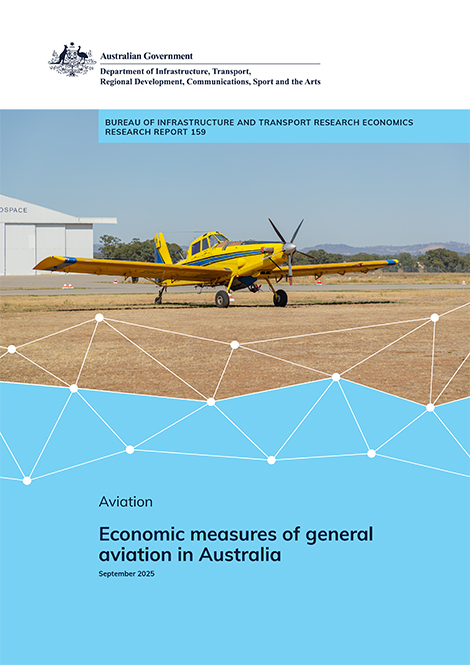
GA plays a range of essential roles in Australia including servicing regional communities, delivering education and health services, regional freight and transport, tourism, recreation, agricultural mustering and spraying, instructional flying, sport and pleasure flying, and emergency services. However, GA is not a stand-alone category in Australia’s System of National Accounts. Instead, it makes up a small subset of a very wide range of economic activities, making it difficult to estimate its actual economic impact. This study considers a range of sources, including innovative methods of matching aircraft registrations to business activity, to estimate the contribution of GA to Australia’s economy.
Australian Infrastructure and Transport Statistics—Yearbook 2024
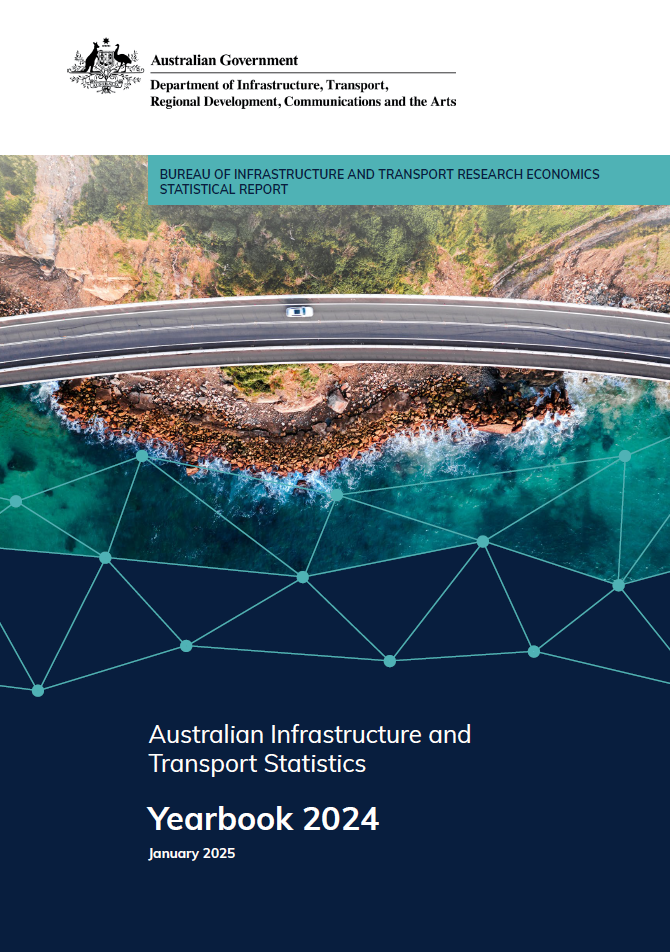
The aim of the Australian Infrastructure Statistics and Transport Yearbook is to provide a single, comprehensive annual source of infrastructure statistics for use by policymakers, industry, transport analysts and the wider Australian community. You can download the PDF or data files:
- Australian Infrastructure and Transport Statistics—Yearbook 2024 (PDF 9.2 MB)
- Australian Infrastructure and Transport Statistics—Yearbook 2024 data (ZIP: 2 MB)
For a summary of each chapter select from the list below:
Australian aviation forecasts—2024 to 2050
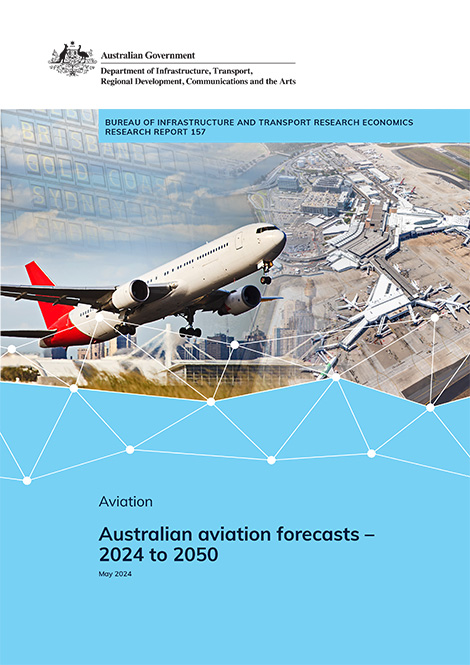
Aviation plays a key role in Australia’s transport system, providing regular scheduled services between Australia's highly dispersed major population centres and vital connectivity for rural and remote communities. As a large island nation, located significant distances from our nearest neighbours, aviation is also the primary means of access for international visitors and for domestic residents travelling overseas.
This report presents long-term forecasts of Australian commercial air passenger and freight activity, and forecasts of air passenger numbers through Australia’s 14 busiest airports / air catchments – i.e. Australia’s eight capital cities and six busiest non-capital city airports – and air freight volumes through Australia’s mainland state capital city airports. The forecasts are based on econometric models of Australian domestic and international air passenger and air freight demand, and the most recent long-term economic outlooks for Australia and developed and major developing countries. The forecasts are intended to help inform long-term Australian aviation policy development and planning.
Australian Infrastructure and Transport Statistics—Yearbook 2023
The aim of the Australian Infrastructure Statistics and Transport Yearbook is to provide a single, comprehensive annual source of infrastructure statistics for use by policymakers, industry leaders, transport analysts and the wider Australian community. Download the PDF or select a chapter below. Data files for each chapter are at the bottom of the page.
Australian Infrastructure and Transport Statistics—Yearbook 2023 - PDF (7.23 MB)
Economic Contribution of Transport in Australia, 2020-21
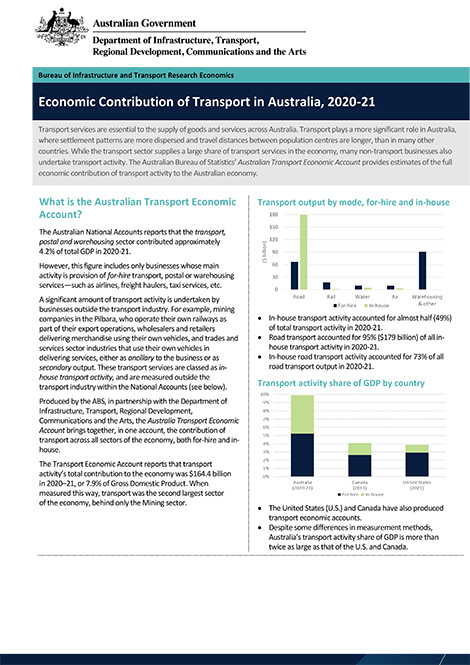
The Australian Bureau of Statistics’ (ABS) Australian Transport Economic Accounts (ATEA) 2020-21 provide estimates of the full economic contribution of transport activity, both for-hire and in-house transport services, to the Australian economy, from 2010-11 to 2020-21.
The ATEA estimates that transport’s total contribution to the economy was $164.4 billion in 2020-21, equivalent to 7.9 per cent of total GDP. Measured in this way, transport was the second largest sector of the economy, behind only the Mining sector.
This release provides a short summary and highlights of the ABS ATEA 2020-21. More detailed ATEA statistics and explanatory notes are available from the ABS website: www.abs.gov.au/statistics/economy/national-accounts/australian-transport-economic-account-experimental-transport-satellite-account
Australian Infrastructure and Transport Statistics—Yearbook 2022
The aim of the Australian Infrastructure Statistics and Transport Yearbook is to provide a single, comprehensive annual source of infrastructure statistics for use by policymakers, industry leaders, transport analysts and the wider Australian community.
The publication is primarily a source of long-term, aggregate time series infrastructure statistics. Most statistics included in the publication are currently collected by BITRE or other Australian, state or territory government agencies.
Australian aggregate freight forecasts – 2022 update
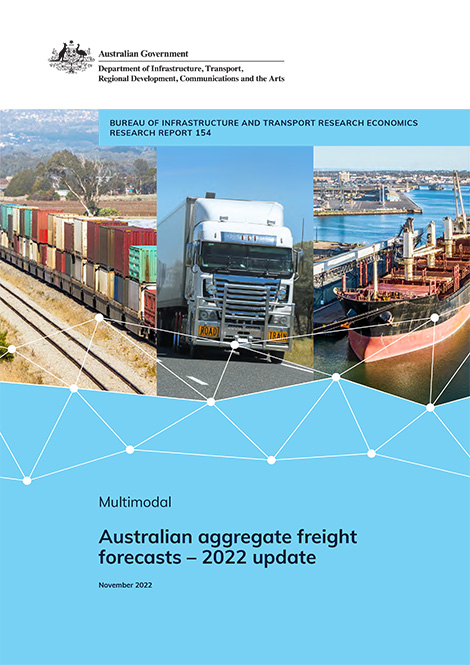
Freight transport plays a significant and wide-ranging role across Australia’s economy. It includes the movement of Australia’s major bulk export commodities to ports for export, the transport of raw materials and semi-processed commodities to businesses for further processing and finished products to household consumers.
This report presents long-term forecasts of total Australian freight volumes for road, rail, coastal shipping and aviation between 2020 and 2050. The forecasts are based on a combination of statistical models relating to historical trends in freight volumes and economic activity and on informed assumptions about likely future long-term economic and demographic trends and international assumptions about likely future world demand for key Australian export commodities. This report updates BITRE 2019 aggregate freight forecasts.
Australian Infrastructure and Transport Statistics—Yearbook 2021
The aim of the Australian Infrastructure Statistics and Transport Yearbook is to provide a single, comprehensive annual source of infrastructure statistics for use by policymakers, industry leaders, transport analysts and the wider Australian community.
The publication is primarily a source of long-term, aggregate time series infrastructure statistics. Most statistics included in the publication are currently collected by BITRE or other Australian, state or territory government agencies.
The Yearbook has 11 chapters:
Domestic aviation activity—cities and regions

Below is a summary analysis of data from Regular Public Transport Domestic Aviation Activity in Australia by route type. The data file is available further down this page.
Summary—2025-26
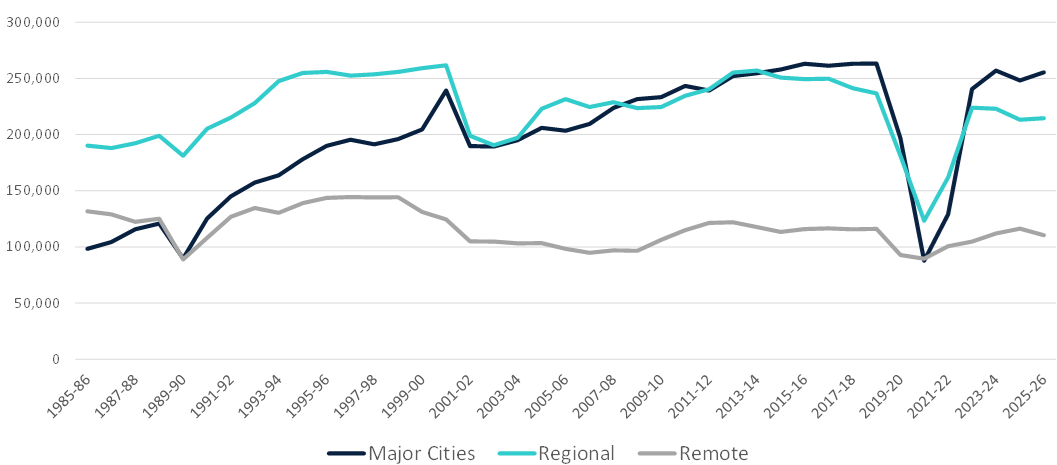
Flights by route type
Flights on Regional and Remote routes combined dropped from 329,593 in 2024-25 to 325,063 in 2025-26 – a decrease of 1.4 per cent. Over the same period, flights between airports located in Major Cities increased from 248,206 to 255,570 - an increase of 3.0 per cent.
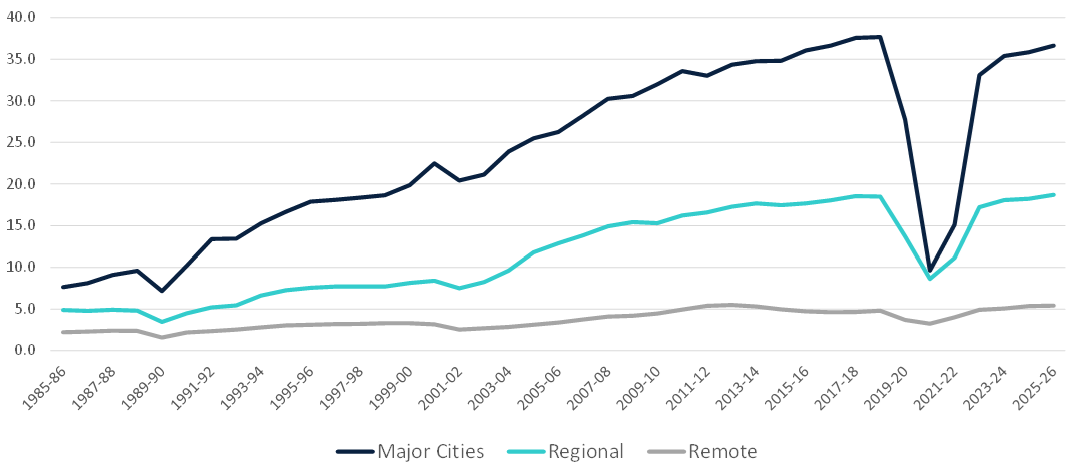
Passengers (millions) by route type
Passengers on Regional and Remote routes combined increased from 23.6 million in 2024-25 to 24.1 million in 2025-26 - an increase of 2.2 per cent. Over the same period, passengers carried between airports located in Major Cities increased from 35.8 million to 36.6 million - an increase of 2.2 per cent.
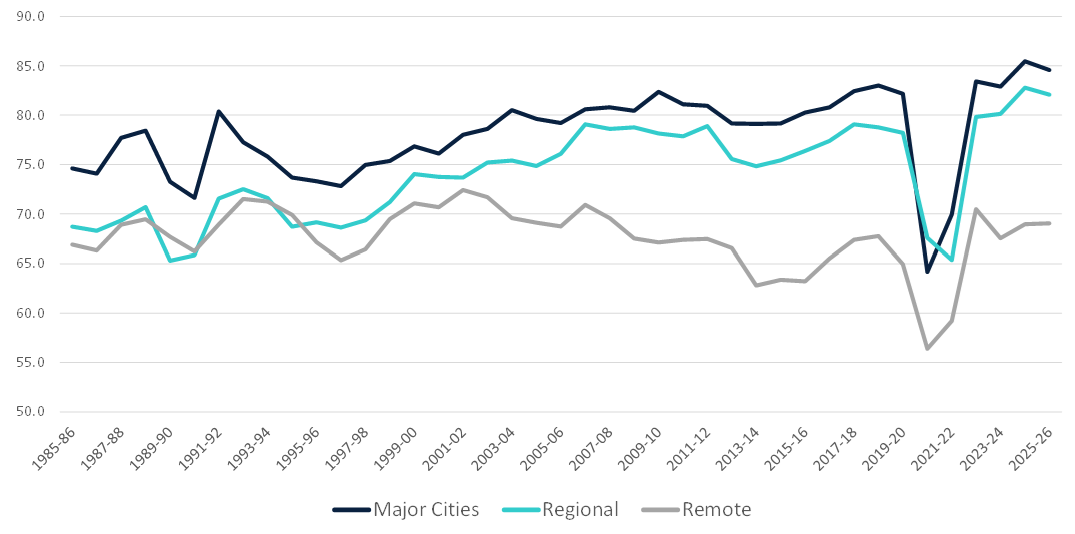
Load factors (RPKs/ASKs as a percentage) by route type
Load factor on Regional and Remote routes combined decrease from 79.1 per cent in 2024-25 to 78.7 per cent in 2025-26. Over the same period, the load factor on flights between Major cities decreased from 85.5 per cent to 84.6 per cent.