
Australian aviation forecasts—2024 to 2050
Aviation plays a key role in Australia’s transport system, providing regular scheduled services between Australia's highly dispersed major population centres and vital connectivity for rural and remote communities. As a large island nation, located significant distances from our nearest neighbours, aviation is also the primary means of access for international visitors and for domestic residents travelling overseas.
This report presents long-term forecasts of Australian commercial air passenger and freight activity and forecasts of air passenger numbers through Australia’s 14 busiest airports / air catchments – i.e. Australia’s 8 capital cities and 6 busiest non-capital city airports – and air freight volumes through Australia’s mainland state capital city airports. The forecasts are based on econometric models of Australian domestic and international air passenger and air freight demand and the most recent long-term economic outlooks for Australia and developed and major developing countries. The forecasts are intended to help inform long-term Australian aviation policy development and planning.
Australian aggregate freight forecasts – 2022 update
Freight transport plays a significant and wide-ranging role across Australia’s economy. It includes the movement of Australia’s major bulk export commodities to ports for export, the transport of raw materials and semi-processed commodities to businesses for further processing and finished products to household consumers.
This report presents long-term forecasts of total Australian freight volumes for road, rail, coastal shipping and aviation between 2020 and 2050. The forecasts are based on a combination of statistical models relating to historical trends in freight volumes and economic activity and on informed assumptions about likely future long-term economic and demographic trends and international assumptions about likely future world demand for key Australian export commodities. This report updates BITRE 2019 aggregate freight forecasts.
Australian interstate, intrastate and capital city road freight forecasts – 2022 update
In Australia, road transport is the predominant mode for moving freight between and within states. It is a vital link in various logistics chains, providing access for freight to ports and terminals and urban freight distribution between warehouses and retail outlets. It is also the dominant mode for moving freight over relatively short distances and where other alternatives are not readily available.
This report presents estimates and forecasts of interstate, intrastate and capital cities freight volumes for each state and territory in Australia. Estimates cover the period 1970 to 2020 and forecasts from 2020 to 2040. The forecasts are based on a combination of statistical models relating historical trends in road freight volumes and economic activity, informed by assumptions about likely future long-term economic and demographic trends.
Forecasting uptake of driver assistance technologies in Australia
This report uses an established modelling framework for forecasting the uptake of technologies that assist drivers and full vehicle automation in Australian light vehicles. Taking uncertainties into consideration, the report provides sensitivity analysis, based on several assumptions, to estimate the possible uptake of sales and fleet penetration till 2070. BITRE will maintain a watch on automated vehicles (AVs) as they are deployed and use the modelling framework to update its estimates when new information to inform forecasts becomes available.
- Forecasting uptake of driver assistance technologies in Australia [PDF: 7029 KB]
Australian aggregate freight forecasts—2019 update
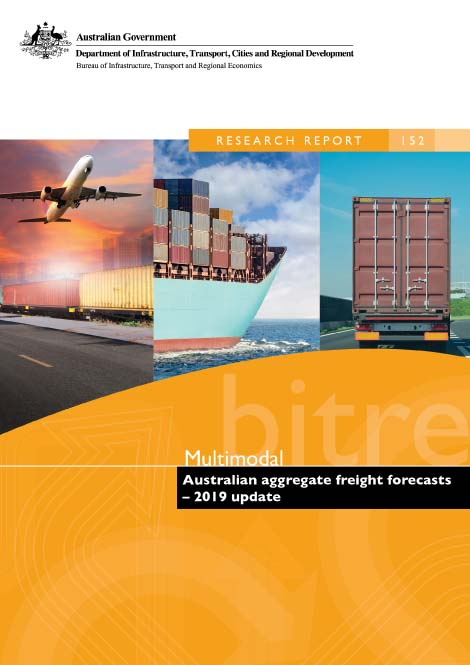
This report presents long-term forecasts of total Australian freight volumes for road, rail, coastal shipping and aviation between 2018 and 2040. The forecasts are based on a combination of statistical models relating historical trends in freight volumes and economic activity, informed assumptions about likely future long-term economic and demographic trends, and international assumptions about likely future world demand for key Australian export commodities. This report represents the first issue in BITRE's revamped forecasting series, which aims to provide regularly updated long-term forecasts of Australian freight activity by major transport mode at national, state, territory and regional scales.
Electric Vehicle Uptake: Modelling a Global Phenomenon
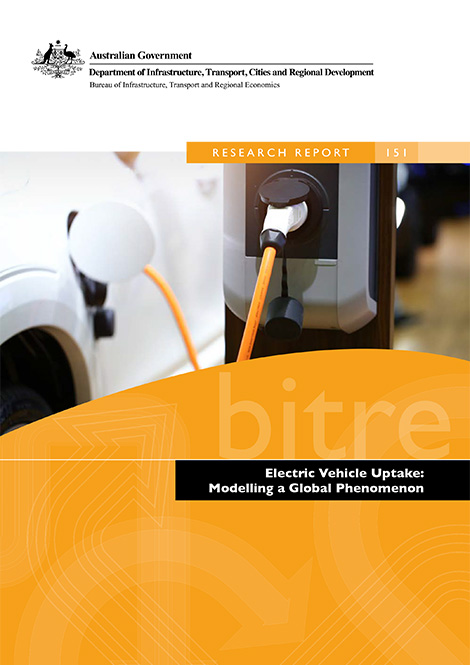
This report describes an approach to estimating likely electric vehicle uptake for each of 22 countries around the world. Models of electric vehicle uptake were derived for Australia, Austria, Belgium, Britain, Canada, China, Denmark, Finland, France, Germany, India, Ireland, Italy, Japan, Korea, the Netherlands, New Zealand, Norway, Spain, Sweden, Switzerland, and the United States (as well as for the 'Rest of Europe').
- Electric Vehicle Uptake: Modelling a Global Phenomenon
- Data
Prices for Petrol and Gasoline—Modelling a Global Phenomenon
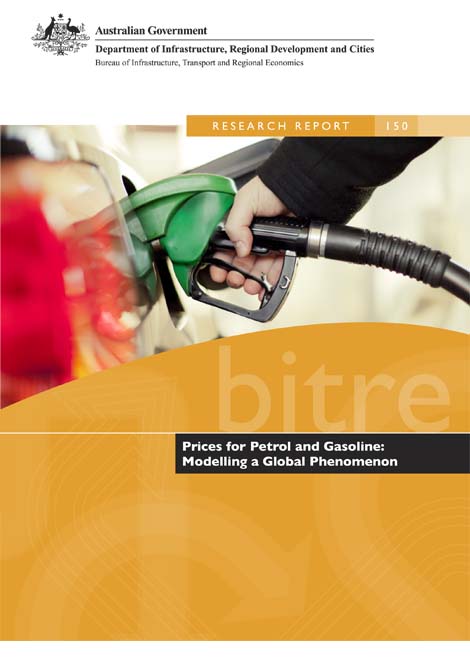
The report models petrol prices in 24 countries around the world - the world oil price determines the energy content of the petrol price, and then adding in taxes produces a prediction of the country's petrol price. The analysis also allows a prediction of how responsive a county's petrol price is to changes in the world oil price.
- Prices for Petrol and Gasoline–Modelling a Global Phenomenon
- World Petrol Prices Model
Aviation activity as a leading indicator of economic activity
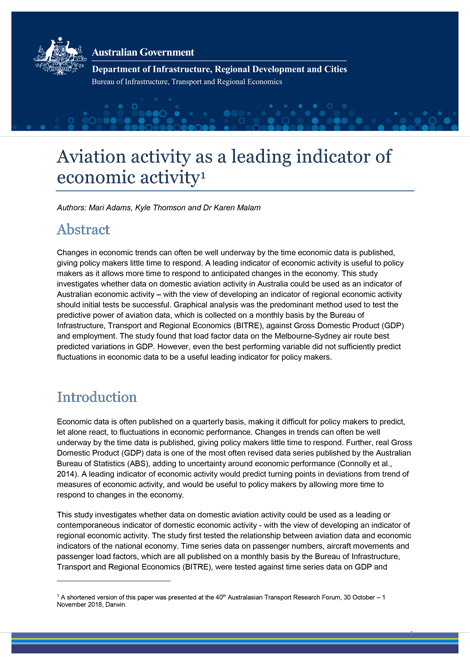
This study investigates whether data on domestic aviation activity in Australia could be used as an indicator of Australian economic activity–with the view of developing an indicator of regional economic activity should initial tests be successful. Graphical analysis was the predominant method used to test the predictive power of aviation data, which is collected on a monthly basis by the Bureau of Infrastructure, Transport and Regional Economics (BITRE), against Gross Domestic Product (GDP) and employment.
- Aviation activity as a leading indicator of economic activity
Introduction to road economics
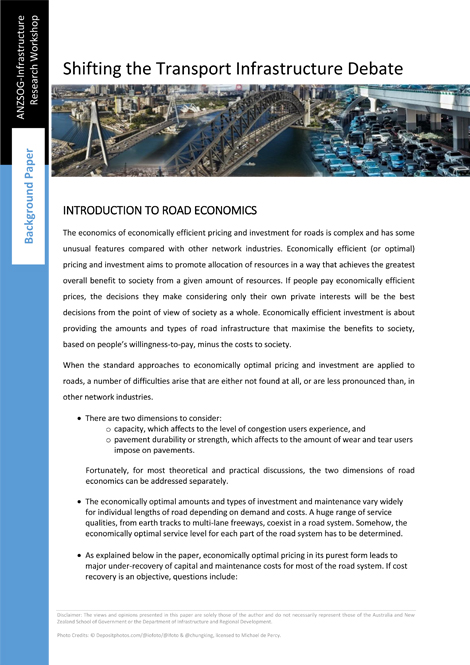
Paper prepared for the ANZSOG Infrastructure Research Workshop, Canberra, 2015. Author: Mark Harvey
- Shifting the Transport Infrastructure Debate
Traffic and congestion cost trends for Australian capital cities
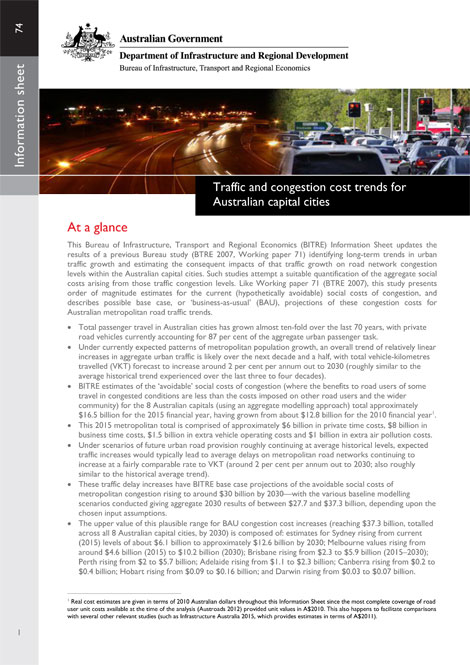
The avoidable cost of congestion for the Australian capital cities is estimated to be around $16.5 billion for the 2015 financial year, having grown from about $12.8 billion for 2010. BITRE 'business-as-usual' projections of these costs of metropolitan congestion rise to around $30 billion by 2030–with the various modelling scenarios conducted giving aggregate 2030 results of between $27.7 and $37.3 billion, depending upon the chosen assumptions.
- Traffic and congestion cost trends for Australian capital cities
- VKT and Summary Cost Data