Australian aircraft activity - summary
Summary of current report
This annual survey covers all civilian registered aircraft used in the Commercial Air Transport (CAT), general aviation, sport and recreation sectors of the Australian aviation industry.
The CAT sector is scheduled commercial air transport and non-scheduled commercial air transport operations. The general aviation sector is all other VH registered aircraft (other than commercial air transport). The sport and recreation sector includes aircraft registered with one of the following Civil Aviation Safety Authority regulated self-administration bodies:
- Recreational Aviation Australia (RA-Aus)
- Gliding Australia
- Sports Aviation Federation of Australia (SAFA)
- the Australian Sport Rotorcraft Association (ASRA).
The major categories of flying are aerial work, own use business flying, instructional flying, personal and pleasure flying and other flying. In addition, the sport aviation segment includes operations by ultralight aircraft, gliders, hang gliders and gyrocopters. The survey results are merged with details from the civil aircraft register which gives access to additional relevant information including aircraft type, engine and fuel type, country and year of manufacture.
The base measure of this report is flying hours. All operators of Australian registered aircraft are asked to report the hours flown and landings across the various flying categories. The VH registered response to this year's reporting request was 70.2%.
Since 2020 aircraft registered with RA-Aus have been included in the annual Australian Aircraft Activity Report. The RA-Aus response to this year’s reporting request was 72.6%. Statistics for the remainder of the sport aviation segment are collected directly from the self-administrating associations.
Key indicators
In 2024 the total hours flown in Australia by Australian owned and operated aircraft increased by 1.4% to 3.63 million hours.
CAT hours flown by VH registered aircraft increased by 1.5% to 1.93 million hours. Hours flown by scheduled commercial air transport increased by 4.7% to 1.44 million hours, while hours flown by non-scheduled commercial air transport decreased by 6.9% to 489,442 hours.
General aviation hours flown by VH registered aircraft increased by 2% to 1.4 million hours. Sport and pleasure flying hours decreased (down 10% to 221,665 hours), instructional flying (up 14.5% to 437,458 hours), own-use business flying (up 1.3% to 131,330 hours) and aerial work (down 1.4% to 542,419 hours).
Sport aviation (ultralights, gliders, hang gliders and gyrocopters) activity generally experiences large swings in activity from year to year. In 2024, sport aviation activity decreased 1.5 % to 328,574 hours.
Hours flown in Australian aircraft activity (000's)—year ending December
| Year | |||
|---|---|---|---|
| 2023 | 2024 | ||
| (thousands) | |||
| Commercial air transport | Scheduled | 1 371.6 | 1 436.2 |
| Non-scheduled | 526 | 489.4 | |
| Total commercial air transport | 1 897.6 | 1 925.6 | |
| General aviation (VH)* | Aerial work | 550.4 | 542.4 |
| Own-use business | 129.6 | 131.3 | |
| Instructional flying | 381.9 | 437.5 | |
| Sport and pleasure flying | 246 | 221.7 | |
| Other flying | 41.9 | 43.5 | |
| Total general aviation (VH) | 1 349.9 | 1 376.4 | |
| Sport aviation (non-VH) | 333.6 | 328.6 | |
| Total hours flown | 3 581.1 | 3 630.6 | |
*VH aircraft are registered with CASA
*non-VH aircraft are registered with self-administrating associations
This release provides statistics relating to the number of vehicles registered for road use in Australia on 31 January 2026. The statistics encompass all vehicles that were registered with an Australian state or territory motor vehicle registry for unrestricted use on public roads, as reported by jurisdictions to the National Exchange of Vehicle and Driver Information System (NEVDIS). This is the fifth annual release of Road vehicles, Australia, and replaces the ABS Motor Vehicle Census, discontinued in 2021. More detailed relevant statistics are available on data.gov.au.
Waterline reports on container-handling performance at 5 major Australian container ports: Brisbane, Sydney, Melbourne, Adelaide and Fremantle. It covers the loading and unloading of container ships; container receival and delivery on the landside, and the costs incurred at the port interface.
This issue covers activity up to June quarter 2025.
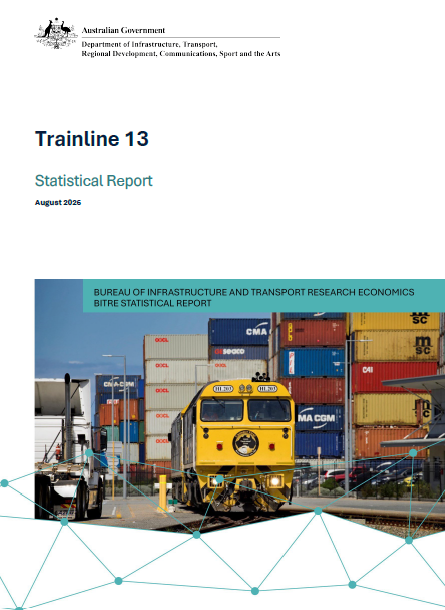
This compendium provides insights, analysis and an understanding of the railway industry. Australia's railways are evolving due to changes outside and within the industry. These changes include logistics, commodity flows, technology, urban patronage, and regional passenger services. The publication presents an overview and data on railway transport tasks performed, characteristics of the railways and train operators' working rolling stock and aspects of railway performance including safety, environment and reliability.
Trainline 13 gives an overview of freight, urban and non-urban passenger rail. The report analyses traffic levels, the provision of infrastructure and rolling stock, and railway performance. It is the thirteenth in the publication series.
Snapshot of cities and regions
This placemat provides a snapshot of cities and regions in regard to population, employment, housing and liveability.
Estimated resident population
Estimated Resident Population is the official measure of Australia’s population produced by the Australian Bureau of Statistics. These preliminary population estimates were released on 29 March 2022.
Population trends BCARR migration geography
This fact sheet provides an overview of population trends in Australia over 5 years, from 2016 to 2021. The analysis is based on Estimated Resident Population (ERP) data released by the Australian Bureau of Statistics (ABS) in July 2022. A custom geography – Bureau of Communications, Arts and Regional Research (BCARR) migration geography – is used to analyse Australia's population trends.
The BCARR migration geography classifies Australia into 6 region categories (without overlap) according to natural endowments, administration boundaries and proximity to amenities. These categories are:
- Capital cities
- Coastal cities
- Coastal country areas
- Inland cities
- Inland country areas; and
- Remote areas.
Bass Strait Passenger Vehicle Equalisation Scheme Monitoring Report No. 20
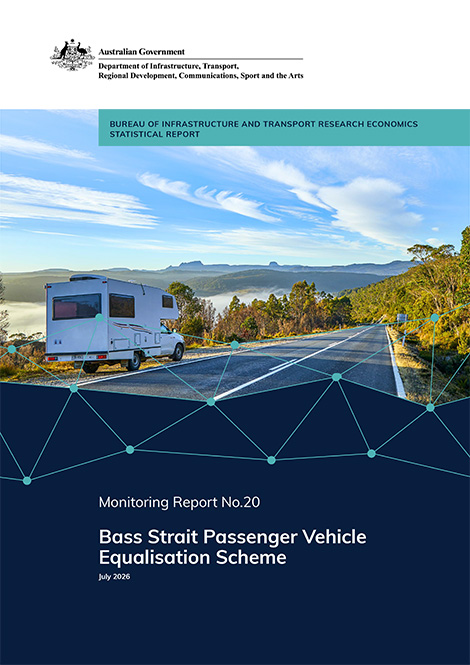
The Australian Government spent $58.3 million under the Scheme in 2023–24 and $53.9 million in 2024–25
Background
Introduction
The Bureau of Infrastructure, Transport and Regional Economics (BITRE) monitors the punctuality and reliability of major domestic airlines operating between Australian airports. The purpose of this is to allow for evaluation of overall industry and individual airline performance, so that consumers of air travel can make informed decisions.
Coverage
The following domestic airlines currently report this information monthly to the BITRE: Jetstar, Qantas, QantasLink, Regional Express, Tigerair Australia, Virgin Australia and Virgin Australia Regional Airlines. Data has been gathered since November 2003, although some airlines commenced reporting at a later date, including Jetstar which first reported in May 2004, MacAir in July 2005, Tigerair Australia in April 2008 and Virgin Australia Regional Airlines in May 2013. MacAir ceased operations in February 2009 and data was not received for December 2008 onwards. Virgin Blue was rebranded as Virgin Australia in May 2011 and Tiger Airways was rebranded as Tigerair Australia in July 2013 and time series data in Microsoft Excel spread sheet format on the BITRE website have been revised to reflect these changes. Services operated by Skywest on behalf of Virgin Australia using ATR/F100 aircraft commenced in November 2011 and were shown separately as Virgin Australia - ATR/F100 Operations. Virgin Australia Regional Airlines commenced operations in May 2013. It was formed after the acquisition of Skywest by Virgin Australia and represented a combination of operations previously reported under Skywest and Virgin Australia - ATR/F100 Operations. In January 2016, Virgin Australia transferred their ATR fleet from Virgin Australia Regional Airlines to Virgin Australia.
On time performance is reported for Australian domestic routes for which the passenger load averaged 8 000 or more passengers per month over the previous six months and where two or more airlines operated in competition on those routes. There were 66 routes that met this definition in May 2016. Over time, routes which meet these criteria change as airline networks and traffic levels vary.
Participating airlines also report their overall monthly network performance figures. Total industry figures encompass all services operated by reporting airlines only. These airlines collectively carried over 95 per cent of total domestic passengers (regular public transport only) in 2015.
Definitions
A flight arrival is counted as "on time" if it arrived at the gate before 15 minutes after the scheduled arrival time shown in the carriers' schedule. Neither diverted nor cancelled flights count as on time. Similarly, a flight departure is counted as "on time" if it departs the gate before 15 minutes after the scheduled departure time shown in the carriers' schedule.
A flight is regarded as a cancellation if it is cancelled or rescheduled less than 7 days prior to its scheduled departure time.
On time performance is measured as the number of flights operating on time as a percentage of the number of flights operated on any particular sector. Cancellations are measured as the number of flights cancelled as a percentage of the number of flights scheduled for that particular sector.
The method of capturing on time performance varies between airlines utilising different recording systems. Jetstar and Qantas jet aircraft use Aircraft Communication Addressing and Reporting System (ACARS) to electronically measure on time performance. Regional Express, Tigerair, Virgin Australia, Virgin Australia Regional Airlines and the Qantas non-jet fleet record on time performance manually using records from pilots, gate agents and/or ground crews.
Reports
Reports are published monthly on the BITRE web site. After collection of initial data, aggregate reports are subject to internal audit by participating airlines prior to publication. The target date for publication is 15 working days after of the end of the reporting period.
International airline activity
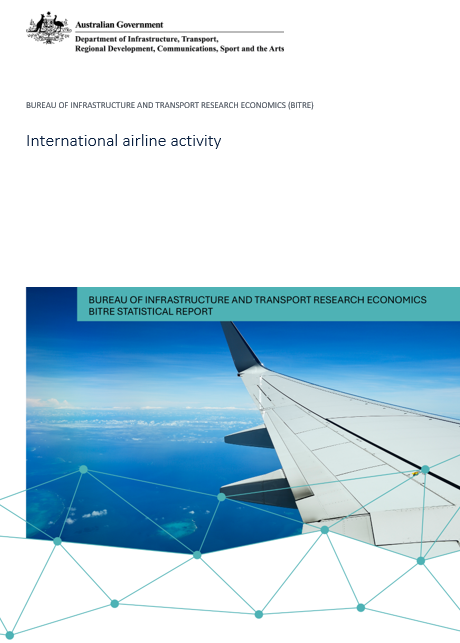
Summary
Sixty-two international airlines operated scheduled services to/from Australia during the month (includes 3 dedicated freight airlines but excludes airlines operating only via codeshare arrangements).
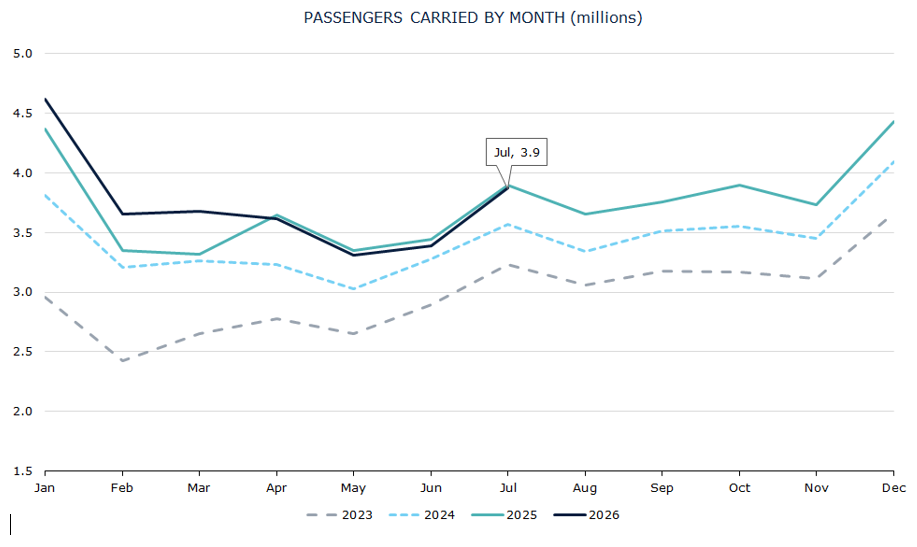
International scheduled passenger traffic in July 2026 was 3.873 million compared with 3.896 million in July 2025, representing a decrease of 0.6%. This is the fourth consecutive monthly year-on-year decline since the first decrease recorded in April 2026. Prior to these recent declines the last monthly year-on-year decrease occurred in October 2021 (COVID).
Passenger traffic for the year ended July 2026 was 45.624 million which is a 5.3% increase over the figure for the year ended July 2025 (43.336 million).
Total seats made available on international scheduled operations to/from Australia during July 2026 were 4.843 million – an increase of 2.0% compared with July 2025. The overall seat utilisation percentage was 82.0% in July 2026. It was 83.7% in July 2025 and 83.3% in July 2024.
In terms of passenger carriage, Qantas Airways had the largest share of the market in July 2026 with 16.4% of the total followed by Jetstar with 14.1%, Singapore Airlines with 8.8%, Air New Zealand with 6.5% and Virgin Australia with 4.6%.
The Qantas Group (Qantas Airways and Jetstar) accounted for 30.5% of total passenger carriage in July 2026. The group’s share was 28.8% in July 2025 and 28.2% in July 2024.
Australian designated airlines (Qantas Airways, Jetstar and Virgin Australia) accounted for 35.1% of total passenger carriage in July 2026. Their share was 33.4% in July 2025 and 31.6% in July 2024.
Low-cost carriers (LCCs) AirAsia Berhad, AirAsia X, Cebu Pacific Air, Indonesia AirAsia, Jetstar, Scoot, T’Way Air and Vietjet Air accounted for 20.9% of total international passenger traffic to/from Australia in July 2026. The LCCs’ share in July 2025 was 20.7% and 20.5% in July 2024.
International scheduled freight traffic in July 2026 increased by 6.8% over July 2025 to 93,318 tonnes. Inbound freight traffic increased by 9.3% and outbound freight traffic increased by 2.1% compared with July 2025.
Freight traffic for the year ended July 2026 was 1.108 million tonnes - a decrease of 0.6% compared with the year ended July 2025 (1.115 million tonnes).
Summary of year-on-year activity
| Year ended July 2025 | Year ended July 2026 | % Change | |
|---|---|---|---|
| Total passenger movements (million) | 43.336 | 45.624 | 5.2 |
Summary of month-on-month activity
| July 2025 | July 2026 | % Change | |
|---|---|---|---|
| Passengers carried (million) | 3.896 | 3.873 | -0.6 |
| Freight (tonnes) | 87 337 | 93 318 | 6.8 |
| Mail (tonnes) | 2 110 | 2 126 | 0.8 |
| Available Seats (million) | 4.746 | 4.843 | 2.0 |
| Flights | 18 664 | 19 208 | 2.9 |
| Aircraft Movements | 19 130 | 19 542 | 2.2 |