
Road and rail supply chain resilience review
BITRE is leading a review into the resilience of Australian road and rail supply chains.
This review will identify the supply chains that are most critical to Australian communities and businesses, the risks they face, and a stocktake of any work underway to mitigate risks. This work will help to inform action by government on how to effectively and efficiently mitigate risks in supply chains for the benefit of all Australians.
The Terms of Reference for the review are presented below.
Phase One of the review was released on 6 February 2023.
Enquiries about the review can be addressed to: RoadandRailResilience@infrastructure.gov.au
All media enquiries should be addressed to: media@infrastructure.gov.au
Road and rail supply chain resilience review – terms of reference
All Australians depend on strong and resilient supply chains. The impacts of COVID-19, natural disasters and a growing freight task have shown the increasing importance of Australian on-land supply chains, and their critical importance to the national economy, and the lives and livelihoods of Australians. Understanding which supply chains are of national importance, the risks they face, and how government and industry can work to mitigate these risks is essential to ensure supply chains remain resilient and fit-for-purpose now and in the future.
In March 2022, the Department of Infrastructure, Transport, Regional Development, Communications and the Arts was asked to conduct a review into Australia’s road and rail supply chain resilience, supported by independent advice as required.
The review will:
- Define and determine key risks to critical supply routes – routes that transport large quantities of freight or are critical to supply of essential goods or services across Australia;
- Identify key risks to critical supply routes in the short, medium and long term — including weather events or natural disasters, limited alternative routes, and limited and difficult to access alternative transport modes;
- Assess the potential vulnerabilities in critical supply routes;
- Complete a stocktake of recent relevant work by government and industry intended to identify and mitigate Australian domestic road and rail supply chain risks;
- Identify data generation, capture and use requirements necessary to assess, inform best‑practice and improve road and rail supply chain resilience;
- Determine the critical routes at highest risk of failure; and
- Develop and present pragmatic options for governments to mitigate or address risks to critical road and rail supply chains, in alignment with the Government-agreed framework to identify and mitigate critical supply chain risks.
The focus of the review is on Australia’s road and rail infrastructure and linked infrastructure. Matters such as international supply chain vulnerability, costs of freight, the transport workforce and critical inputs to the transport sector are outside the scope of the review.
The review will take into consideration supporting work, including but not limited to the:
- Australian Infrastructure Plan;
- National Freight and Supply Chain Strategy, including the National Freight Data Hub;
- National Urban Freight Planning Principles;
- Final Report of the Royal Commission into National Natural Disaster Arrangements;
- Final Report of the Productivity Commission Study into Vulnerable Supply Chains;
- National Rail Action Plan;
- Supply Chain Resilience Initiative; and
- DITRDC’s Key Freight Routes Map.
The review will engage closely with the Freight Industry Reference Panel, and also consult with:
- Key infrastructure owners and operators;
- Freight industry stakeholders – including freight customers;
- State and territory governments;
- National Recovery and Resilience Agency (NRRA);
- Infrastructure Australia;
- CSIRO;
- The Department of the Prime Minister and Cabinet, including the Office of Supply Chain Resilience;
- The Department of Home Affairs (including Emergency Management Australia and the National Coordination Mechanism);
- The Department of Agriculture, Water and the Environment, including the Australian Climate Service; and
- Any other groups DITRDC deems necessary.
Phase 1 – Building the evidence base
This report presents the Bureau of Infrastructure and Transport Research Economics’ (BITRE) findings for the first six components of the Terms of Reference based on an initial assessment of Australia’s road and rail supply chain resilience.
The evidence in this report draws on a literature review, extensive stakeholder consultation and geospatial analysis, including scenario modelling. Scenario modelling provides greater insight into a number of key critical and vulnerable routes, including an assessment of the likelihood and expected impact of various hazards on road and rail supply chains. The Review also presents a number of case studies to provide real-world illustrations of the impact of natural and human induced risks, as well as examples of initiatives to address supply chain issues.
Supplementary materials
- Appendix B – Resilience analysis of key freight roads and railways using CSIRO’s TraNSIT
- Appendix C – Analysis of risks impacting the resilience of supply chains
- Appendix F – Summary of risks and impacts on critical KFRs
- Appendix G – Stocktake of current or recently completed resilience initiatives across government
Australian Infrastructure and Transport Statistics Yearbook 2025: Roads chapter
Chapter 4: Roads
- Australian Infrastructure and Transport Statistics Yearbook 2025 - Download full report PDF
- Road—Yearbook 2025 (266 KB) - Download Excel file
- For information on road-related revenue and expenditure - see chapter 3 of the 2025 Yearbook
This chapter provides information on Australian roads including length, use, the vehicle fleet, and the number of vehicle licences.
- An estimated 264 billion vehicle kilometres were travelled on Australia's roads in 2024–25.
- In 2024, there were 476,000 km of paved roads in Australia.
- 20 million Australians had vehicle licences at 2024–25.
- In 2024–25, Sports Utility Vehicles (SUVs) comprised 59% of new motor vehicle sales (excluding motorcycles) compared with only 33% ten years earlier.
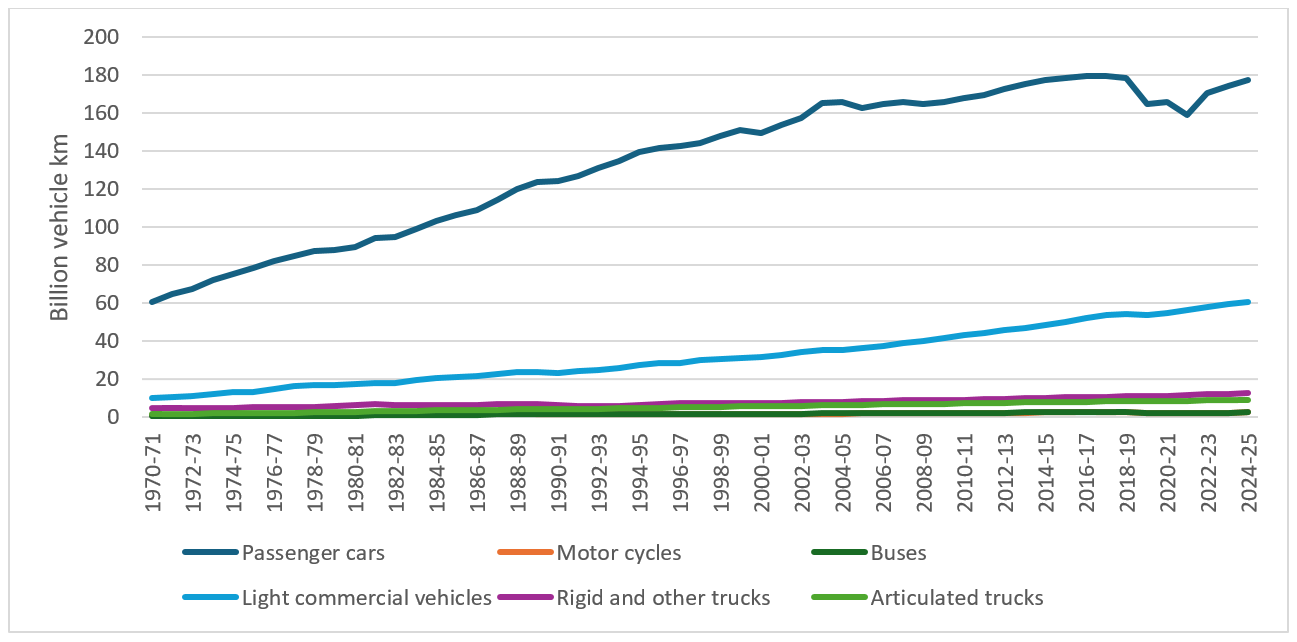
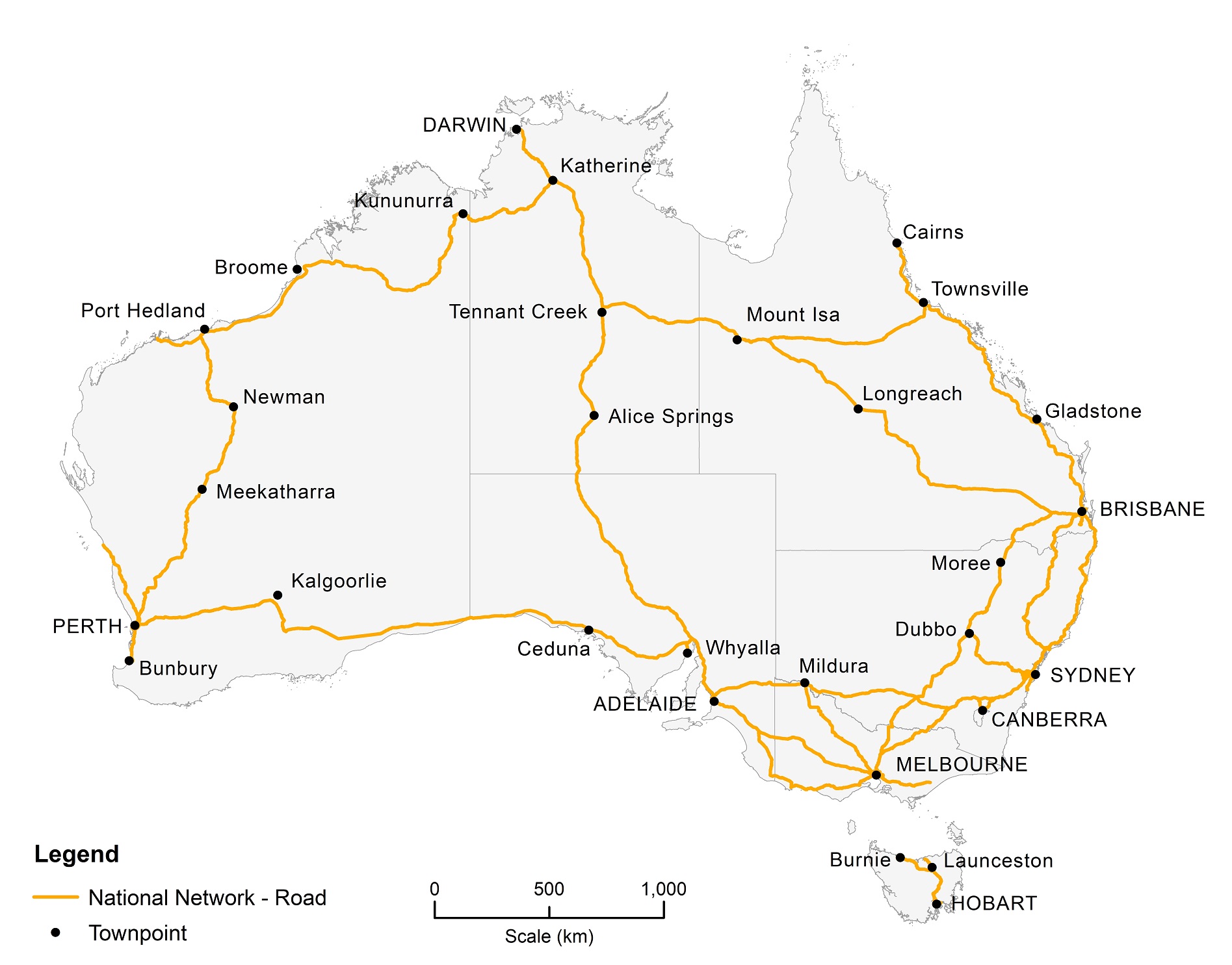
Figure 8 shows total vehicle kilometres by vehicle type. Figure 9 shows Australia’s national road network. Total vehicle kilometres travelled fell significantly during the COVID pandemic, only surpassing their previous 2017–18 peak in 2023–24.
Figure 8 Vehicle kilometres travelled by vehicle type
Source: Table 4.2
Figure 9 Map of national road network
Source: DITRDCSA, 2022
Assessment of road improvements in remote and regional areas
The report addresses the challenge that low traffic volumes in remote and regional areas pose to traditional cost–benefit analysis (CBA) methods to support road improvements in these areas in line with community expectations and government policy objectives. Roads in remote and regional areas are often provided at standards above what would be considered economically efficient levels under traditional CBA methods, but there is currently no clear way to make a recommendation as to an acceptable standard. This report develops ways to improve the efficiency, equity and transparency of decision-making for road funding in remote and regional areas. CBA is retained as the core appraisal tool with the additions of social benefits, wider economic benefits and equity weights. The development of the equity weights draws on recent thinking about equity and distributive justice from literature in the disciplines of philosophy, economics and transport planning.