
Australian aviation forecasts—2024 to 2050
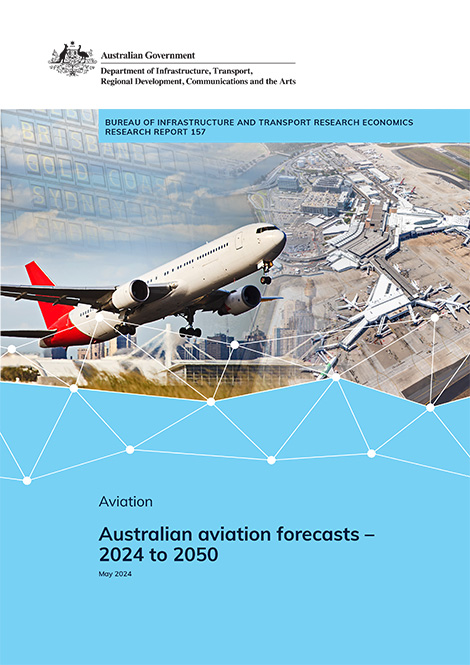
Aviation plays a key role in Australia’s transport system, providing regular scheduled services between Australia's highly dispersed major population centres and vital connectivity for rural and remote communities. As a large island nation, located significant distances from our nearest neighbours, aviation is also the primary means of access for international visitors and for domestic residents travelling overseas.
This report presents long-term forecasts of Australian commercial air passenger and freight activity and forecasts of air passenger numbers through Australia’s 14 busiest airports / air catchments – i.e. Australia’s 8 capital cities and 6 busiest non-capital city airports – and air freight volumes through Australia’s mainland state capital city airports. The forecasts are based on econometric models of Australian domestic and international air passenger and air freight demand and the most recent long-term economic outlooks for Australia and developed and major developing countries. The forecasts are intended to help inform long-term Australian aviation policy development and planning.
Air Passenger Movements Through Capital and Non-Capital City Airports to 2030–31
This report presents forecasts of air passenger movements through Australia's eight capital city airports and five largest non-capital city airports (Newcastle, Cairns, Gold Coast, Townsville and Launceston). The forecasts have been developed using econometric models of domestic and international air passenger travel demand, and incorporating the most recent economic outlook for Australia and its major trading partners. Population, income, airfares, exchange rates and the prices of domestic and overseas travel and accommodation are the principal factors influencing growth in air passenger movements through Australian airports.
- Air Passenger Movements Through Capital and Non-Capital City Airports to 2030–31
Passenger Movements between Australian Cities, 1970–71 to 2030–31
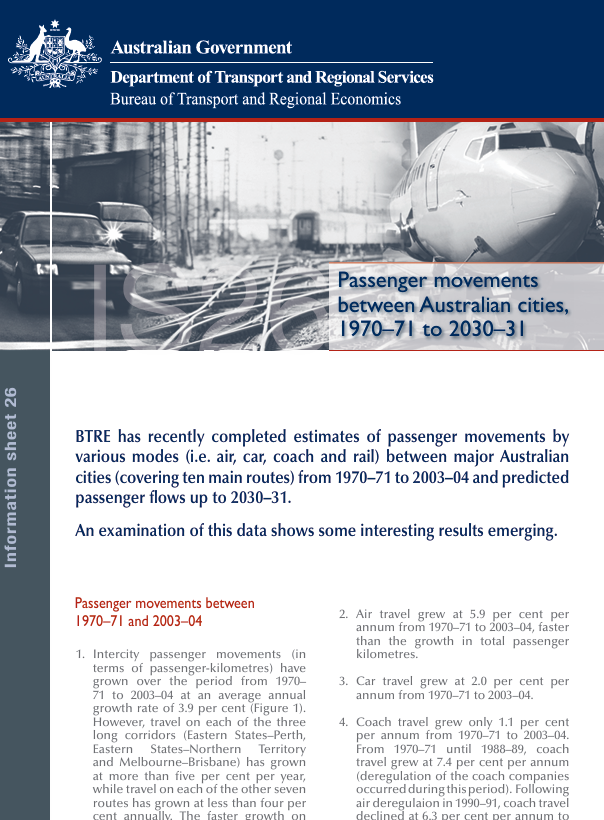
BTRE has recently completed estimates of passenger movements by various modes (i.e. air, car, coach and rail) between major Australian cities (covering ten main routes) from 1970–71 to 2003–04 and predicted passenger flows up to 2030–31.
Air passenger movements through capital city airports to 2025–26
This report presents the forecasts of passenger and aircraft traffic at capital city airports over the next 20 years. The forecasts have been developed on the basis of the estimated econometric models of passenger demand and the most recent economic outlook for Australia and its major trading partners. Australia's eight capital city airports (Adelaide, Brisbane, Canberra, Darwin, Hobart, Melbourne, Perth and Sydney) are included in the development of the forecasts. The report has been updated to 2029–30 in Aircraft movements through capital city airports to 2029–30 in Research report 117.
- Air passenger movements through capital city airports to 2025–26
Aircraft movements through capital city airports to 2029–30
This report presents forecasts of air passenger and aircraft movements through Australia's eight capital city airports (Adelaide, Brisbane, Canberra, Darwin, Hobart, Melbourne, Perth and Sydney) to 2030.
- Aircraft movements through capital city airports to 2029–30