
Airline on-time performance statistics—monthly summary
- Airline on-time performance—monthly reports and time series data
- Airline on-time performance—annual reports (financial and calendar years)
Summary—September 2026
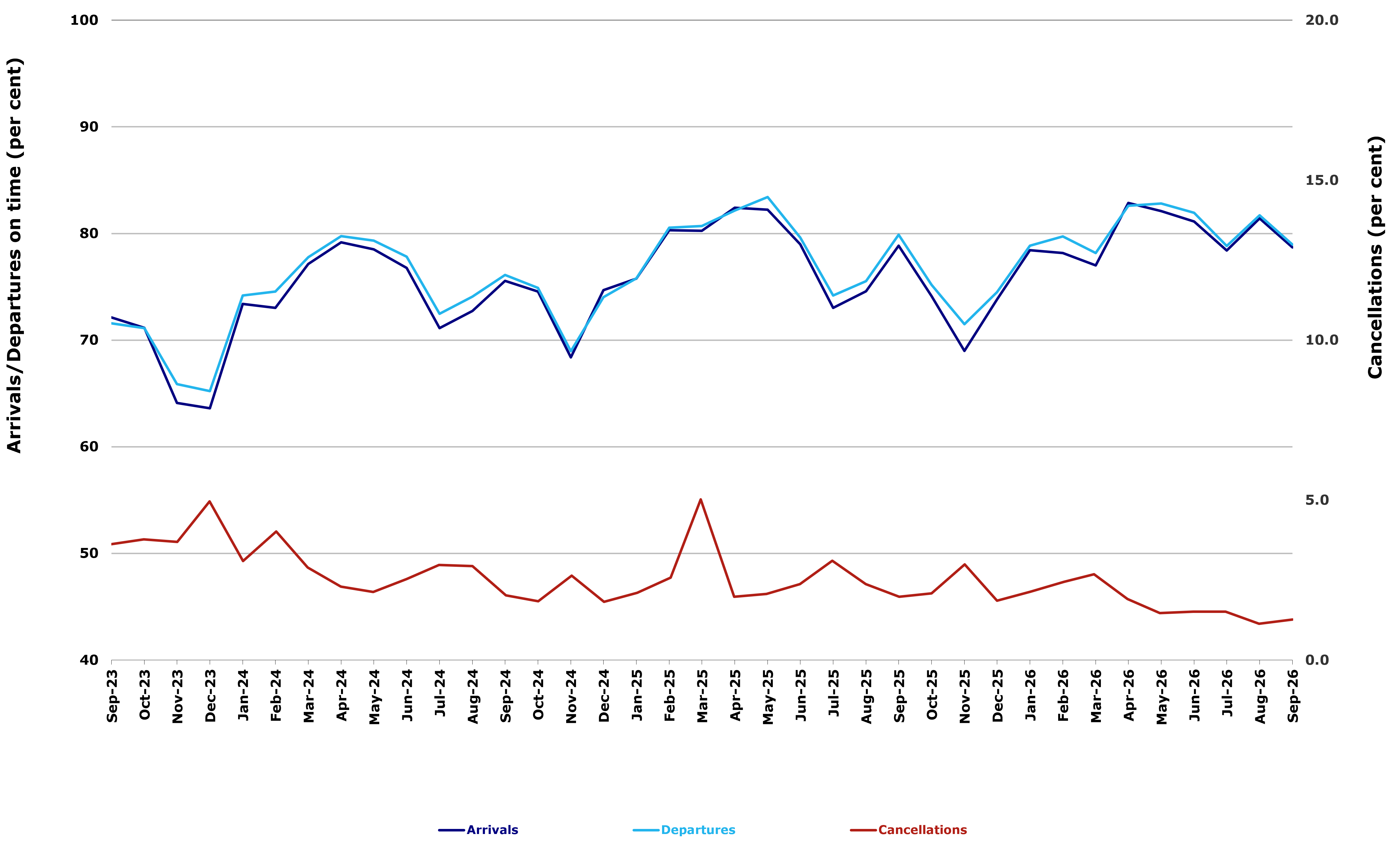
For September 2026, on-time performance over all routes operated by participating airlines (Hinterland, Jetstar, Qantas, QantasLink, Rex Airlines, Skytrans Australia, Virgin Australia and Virgin Australia Regional Airlines) averaged 78.7% for on-time arrivals and 79.0% for on-time departures. The cancellation rate for the month was 1.3%. The equivalent figures for September 2025 were 78.9% for on-time arrivals, 79.9% for on-time departures and 2.0% for cancellations.
This month’s on-time arrivals figure was lower than the long-term average (average over the period of OTP reporting starting in November 2003) performance for all routes (80.5%) and the on-time departures figure was also lower than the long-term average (81.6%). The rate of cancellations was lower than the long-term average of 2.2%.
On-time arrivals
The Qantas network (Qantas and QantasLink combined operations) recorded 82.5% for on-time arrivals while the Virgin Australia network (Virgin Australia and Virgin Australia Regional Airlines combined operations) recorded 74.2%. Hinterland achieved the highest on-time arrivals at 95.2%, followed by QantasLink at 83.5%, Qantas at 80.7%, Rex Airlines at 77.7%, Virgin Australia Regional Airlines at 76.9%, Virgin Australia at 74.2%, Jetstar at 73.8% and Skytrans at 69.6%.
On-time departures
The Qantas network recorded 83.2% for on-time departures while the Virgin Australia network recorded 74.3%. Hinterland achieved the highest level of on-time departures for September 2026 at 97.2%, followed by Qantas at 84.5%, QantasLink at 82.4%, Rex Airlines at 81.0%, Virgin Australia Regional Airlines at 80.2%, Virgin Australia at 74.2%, Jetstar at 71.4% and Skytrans Australia at 70.2%
Cancellations
Skytrans Australia recorded the highest percentage of cancellations at 3.3% during the month. The second highest cancellation rate was from QantasLink at 1.7%, Virgin Australia at 1.6%, Rex Airlines at 1.1%, Jetstar at 0.8%, Qantas at 0.7%, and Hinterland and Virgin Australia Regional Airlines both at 0.0%.
Routes
Airlines’ on-time performance varies across the routes they serve. Individual route data by specific airline for 59 routes (118 sectors when counting both directions of flights) are shown on pages 10-21 of the monthly report.
Of the 59 routes which met the criteria for on-time performance reporting in September 2026, the Brisbane-Mount Isa sector had the highest percentage of on-time arrivals (97.1%) and the highest percentage of on-time departures (95.7%). The Hamilton Island-Sydney sector had the lowest percentage of on-time arrivals (51.7%) and the lowest percentage of on-time departures (50.0%).
Cancellations were highest on the Canberra-Sydney and Port Lincoln-Adelaide sectors at 4.0%, followed by the Sydney-Canberra sector 3.7%, the Adelaide-Port Lincoln sector at 3.6%, the Ayers Rock-Melbourne, Kalgoorlie-Perth and Port Macquarie-Sydney sectors at 3.2%, the Orange-Sydney sector at 3.1%, the Adelaide-Sydney sector at 2.9% and the Melbourne-Sydney sector at 2.7%.
For the month of September 2026 30 out of the 118 route sectors (from the 59 routes) had zero cancellations: Adelaide-Alice Springs, Adelaide-Gold Coast, Adelaide-Perth, Alice Springs-Adelaide, Brisbane-Darwin, Brisbane-Emerald, Brisbane-Gladstone, Brisbane-Hamilton Island, Brisbane-Hobart, Brisbane-Launceston, Brisbane-Mount Isa, Brisbane-Newcastle, Brisbane-Proserpine, Canberra-Gold Coast, Emerald-Brisbane, Gold Coast-Adelaide, Gold Coast-Canberra, Hamilton Island-Sydney, Hobart-Brisbane, Launceston-Brisbane, Mount Isa-Brisbane, Newcastle-Brisbane, Perth-Adelaide, Perth-Darwin, Perth-Newman, Proserpine-Brisbane, Sydney-Ballina, Sydney-Hamilton Island, Sydney-Launceston and Melbourne-Ayers Rock.
Airports
Mount Isa Airport recorded the highest percentage of on-time arrivals (97.1%) while Emerald Airport had the highest percentage of on-time departures (94.2%). Launceston Airport recorded the lowest percentage of on-time arrivals (69.4%) while Hamilton Island Airport had the lowest percentage of on-time departures (55.5%). These figures only refer to reported routes and do not cover all flights at these airports.
Table 1: Total industry on-time performance for September 2026
| Reporting Airlines | Sectors Scheduled | Arrivals on-time % | Departures on-time % | Cancellations % |
|---|---|---|---|---|
| Hinterland | 1,632 | 95.2 | 97.2 | 0.0 |
| Jetstar | 8,188 | 73.8 | 71.4 | 0.8 |
| Qantas - all QF designated services | 19,489 | 82.5 | 83.2 | 1.4 |
| Rex Airlines | 4,378 | 77.7 | 81.0 | 1.1 |
| Skytrans Australia | 337 | 69.6 | 70.2 | 3.3 |
| Virgin Australia - all VA designated services | 11,882 | 74.2 | 74.3 | 1.6 |
| All Airlines | 45,906 | 78.7 | 79.0 | 1.3 |
| Individual operating entities | ||||
| Qantas | 6,993 | 80.7 | 84.5 | 0.7 |
| QantasLink | 12,496 | 83.5 | 82.4 | 1.7 |
| Virgin Australia | 11,700 | 74.2 | 74.2 | 1.6 |
| Virgin Australia Regional Airlines | 182 | 76.9 | 80.2 | 0.0 |
Figure 1: Total industry on-time performance by month from September 2023
Airline on-time performance—2025 calendar year
- Airline on-time performance—annual reports
- Airline on-time performance—monthly reports and time series data
Summary – 2025 Calendar Year
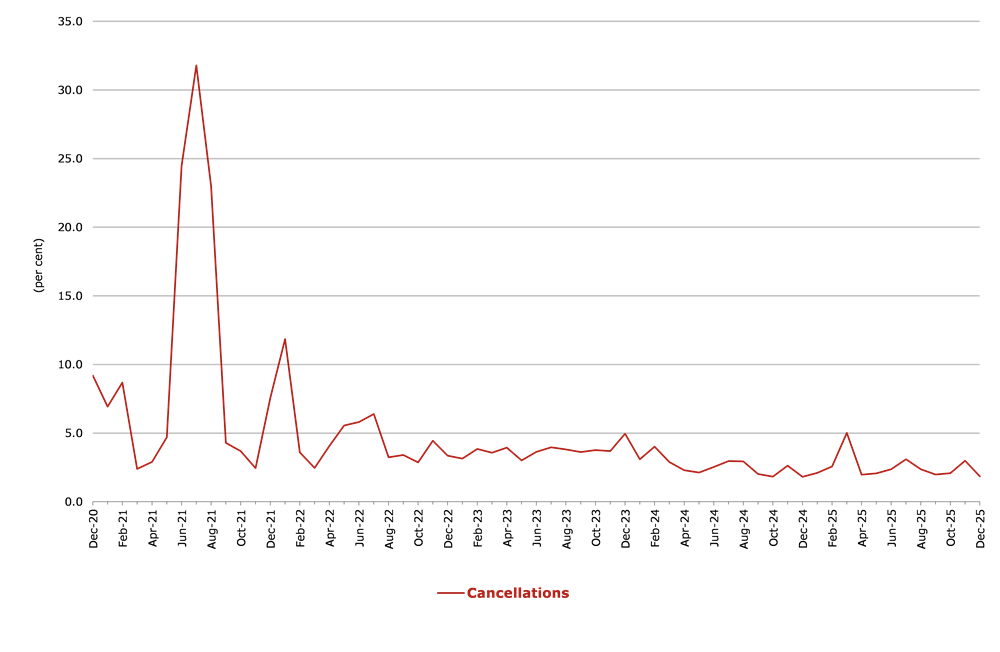
For the year ended December 2025, on time performance (OTP) over all routes operated by participating airlines (Hinterland, Jetstar, Qantas, QantasLink, Rex Airlines, Skytrans Australia (formerly Smartlynx Australia), Virgin Australia and Virgin Australia Regional Airlines) averaged 76.9 per cent for on time arrivals and 77.7 per cent for on time departures. The cancellation rate for the year was 2.5 per cent. The equivalent figures for 2024 were 74.6 per cent for on time arrivals, 75.4 per cent for on time departures and 2.6 per cent for cancellations. Airlines’ on time performance varies across the routes they serve. Individual route data by specific airline for 60 routes which operated for at least part of the 2025 calendar year are shown on pages 9-21.
The 2025 on time arrivals figure was lower than the long-term average (average over the period of OTP reporting starting in November 2003) performance for all routes (80.5 per cent) and the on time departures figure was also lower than the long-term average (81.6 per cent). The rate of cancellations was higher than the long-term average of 2.2 per cent.
On time arrivals
The Qantas network (Qantas and QantasLink combined operations) recorded 77.9 per cent for on time arrivals while the Virgin Australia network (Virgin Australia and Virgin Australia Regional Airlines combined operations) recorded 76.0 per cent. Hinterland achieved the highest on time arrivals at 88.4 per cent, followed by Skytrans Australia at 85.1 per cent, QantasLink at 78.3 per cent, Qantas at 77.2 per cent, Virgin Australia at 76.0 per cent, Jetstar at 75.2 per cent, Rex Airlines at 73.0 per cent and Virgin Australia Regional Airlines at 71.5 per cent.
On time departures
The Qantas network recorded 78.8 per cent for on time departures while the Virgin Australia network recorded 77.0 per cent. Hinterland achieved the highest level of on time departures for 2025 at 92.5 per cent, followed by Skytrans Australia at 86.3 per cent, Qantas at 79.7 per cent, QantasLink at 78.3 per cent, Virgin Australia at 77.2 per cent, Rex Airlines at 76.0 per cent, Jetstar at 73.6 per cent and Virgin Australia Regional Airlines at 67.6 per cent.
Cancellations
Skytrans Australia recorded the highest percentage of cancellations at 8.4 per cent during the year. The second highest cancellation rate was from QantasLink at 3.6 per cent, followed by Qantas at 2.7 per cent, Rex Airlines at 2.5 per cent, Jetstar at 2.2 per cent, Virgin Australia at 1.7 per cent, Virgin Australia Regional Airlines at 1.1 per cent and Hinterland at 0.8 per cent.
Routes
Of the 60 routes which met the criteria for OTP reporting, the Townsville-Cairns route (Jan 2025 only) had the highest percentage of on time arrivals (90.9 per cent) and the highest percentage of on time departures (90.9 per cent). For those routes reporting for the entirety of 2025, Emerald-Brisbane had the highest percentage of on time arrivals (89.8 per cent) and the highest percentage of on time departures (88.4 per cent). The Hamilton Island-Sydney route had the lowest percentage of on time arrivals (60.8 per cent) and the lowest percentage of on time departures (61.6 per cent).
Cancellations were highest on the Canberra-Sydney route at 6.2 per cent, followed by the Sydney-Canberra route at 5.6 per cent, the Port Lincoln-Adelaide and Sydney-Melbourne routes at 4.4 per cent, the Port Macquarie-Sydney and Melbourne-Sydney routes at 4.3 per cent, the Adelaide-Port Lincoln and Gladstone-Brisbane routes at 4.1 per cent, the Sydney-Port Macquarie route at 4.0 per cent and the Devonport-Melbourne route at 3.9 per cent.
Cancellations were lowest on the Melbourne-Ayers Rock at 0.0 per cent, followed by the Sydney-Hamilton Island route at 0.1 per cent, Ayers Rock-Melbourne and Sydney-Cairns routes at 0.3 per cent, and the Perth-Newman and Melbourne-Sunshine Coast routes at 0.4 per cent.
Airports
Of the airports with OTP reporting for 2025, Emerald Airport recorded the highest percentage of on time arrivals (86.2 per cent) and the highest percentage of on time departures (88.4 per cent). Port Macquarie Airport recorded the lowest percentage of on time arrivals (70.0 per cent) and Broome Airport recorded the lowest percentage of on time departures (64.8 per cent). These figures only refer to reported routes and do not cover all flights at these airports.
Table 1: Total industry on-time performance for 2025
| Reporting Airlines | Sectors Scheduled | Arrivals On Time % | Departures On Time % | Cancellations % |
|---|---|---|---|---|
| Hinterland | 18,415 | 88.4 | 92.5 | 0.8 |
| Jetstar | 96,686 | 75.2 | 73.6 | 2.2 |
| Qantas - all QF designated services | 231,962 | 77.9 | 78.8 | 3.2 |
| Rex Airlines | 52,716 | 73.0 | 76.0 | 2.5 |
| Skytrans Australia (formerly SmartLynx Australia) | 6,191 | 85.1 | 86.3 | 8.4 |
| Virgin Australia - all VA designated services | 145,379 | 76.0 | 77.0 | 1.7 |
| All Airlines | 551,349 | 76.9 | 77.7 | 2.5 |
| Individual operating entities | ||||
| Qantas | 88,886 | 77.2 | 79.7 | 2.7 |
| QantasLink | 143,076 | 78.3 | 78.3 | 3.6 |
| Virgin Australia | 143,031 | 76.0 | 77.2 | 1.7 |
| Virgin Australia Regional Airlines | 2,348 | 71.5 | 67.6 | 1.1 |
Figure 1. Total Industry Arrivals and Departures On Time by month from December 2020
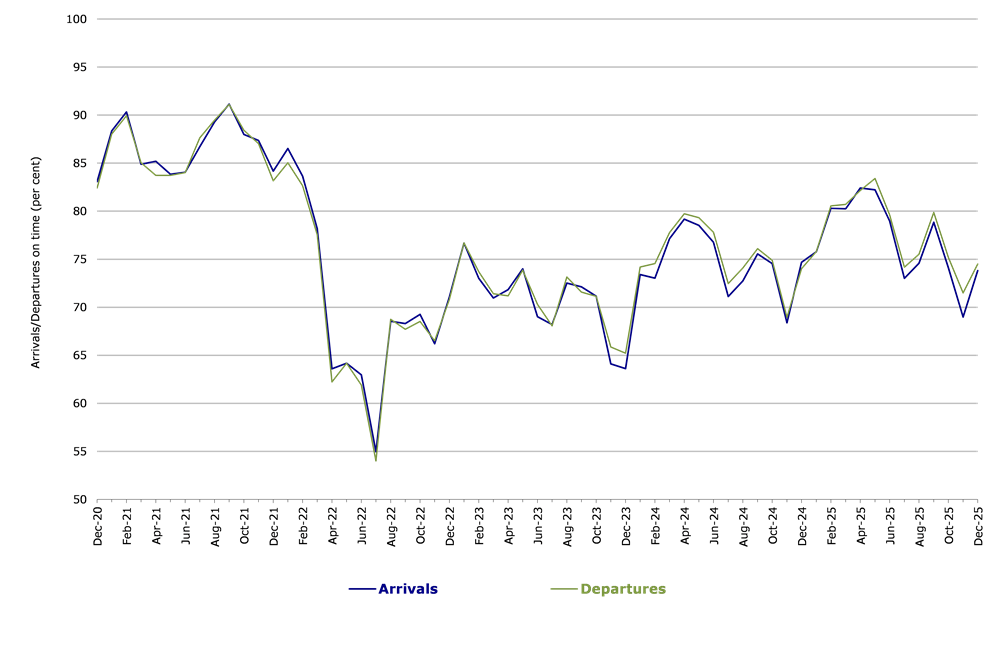
Figure 2. Total Industry Cancellations by month from December 2020
Aviation activity as a leading indicator of economic activity
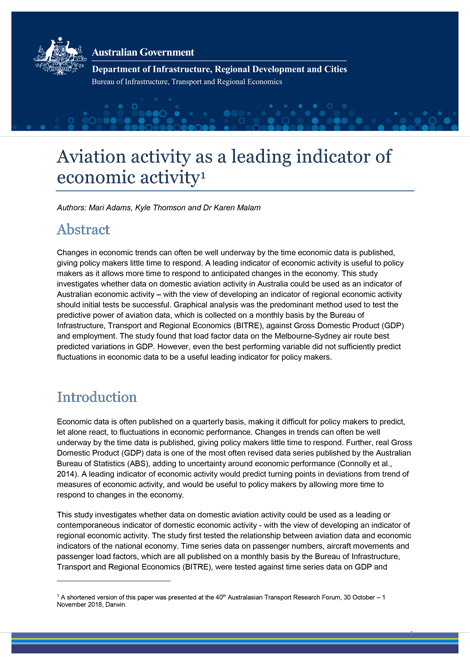
This study investigates whether data on domestic aviation activity in Australia could be used as an indicator of Australian economic activity–with the view of developing an indicator of regional economic activity should initial tests be successful. Graphical analysis was the predominant method used to test the predictive power of aviation data, which is collected on a monthly basis by the Bureau of Infrastructure, Transport and Regional Economics (BITRE), against Gross Domestic Product (GDP) and employment.
- Aviation activity as a leading indicator of economic activity
General aviation study
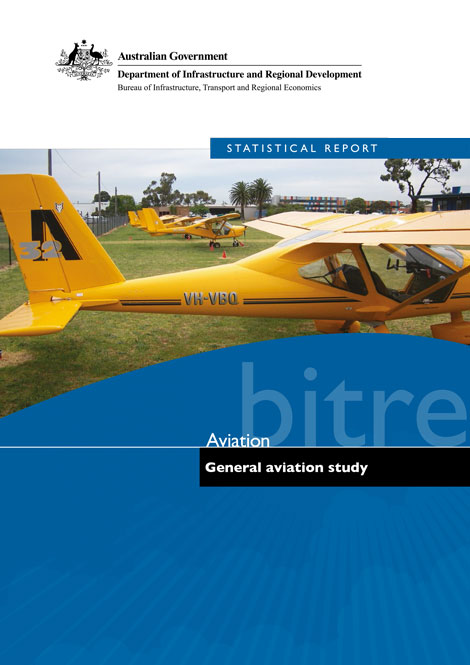
General aviation (GA) is a diverse sector that is undergoing change. While overall GA activity appears to be declining slowly, it is not accurate to say that all parts of GA are declining.
Those parts of GA that are discretionary in nature such as pleasure flying appear to decline in more conservative economic times, while those parts of GA that are key to expanding industries such as aerial mustering have been growing strongly. Detailed economic analysis of these relationships is not currently possible due to the lack of financial statistics for GA however this report outlines some of the challenges facing GA and identifies some opportunities for the industry and government to respond to these challenges.
Employment Generation and Airports
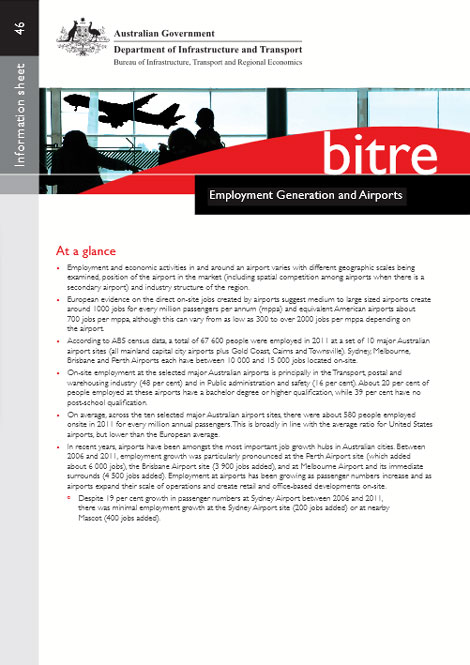
This information sheet provides evidence about the relationship between airport infrastructure and economic activity. It draws together evidence from the international literature and evidence for major Australian airports. It presents estimates of the number of jobs located at major Australian airports in 2011, the industry structure and skill mix of that employment, and recent growth in employment based on the ABS Census of Population and Housing.
- Employment Generation and Airports
Brisbane Airport: Interim Report on International Terminal
This Report represents part of a full-scale study by BTE, at the direction of the Minister for Transport, of the development requirements for Brisbane Airport. The full report will be issued at a later date and will present a detailed examination of the civil aviation requirements of the region and the appropriate expansion/replacement program.
- Brisbane Airport: Interim Report on International Terminal
Deregulation of Domestic Aviation—The First Year
The Commonwealth's regulation of interstate aviation, in place for over thirty years, came to an end at midnight on 30 October 1990. This study reviews the developments in the last few months of regulation and in the first year of deregulation.
- Deregulation of Domestic Aviation–The First Year
Air Transport Service Trends in Regional Australia—2011 update
This report updates and supersedes the time series statistics presented in Report 115 and Information sheet 35 on Air transport services in regional Australia: trends and access. It updates the data (to 2012) and the geographic basis of the analysis.
- Air Transport Service Trends in Regional Australia–2011 update
Avline provides a summary of previously released Aviation related data drawing on a range of sources including BITRE, ABS, Airservices Australian and the US Energy Information Administration. In addition, Avline provides a comparison of published airport charges at the five major capital city airports and at a selection of regional airports. Avline 2010–11 covers the financial year 2010–11 and is the third of the series to be published annually instead of biannually.
Brisbane Airport: Economic Evaluation of Alternative Development Strategies
This Report presents the results of an economic comparison of alternative strategies for the development of Brisbane Airport.
- Brisbane Airport: Economic Evaluation of Alternative Development Strategies