
General aviation study
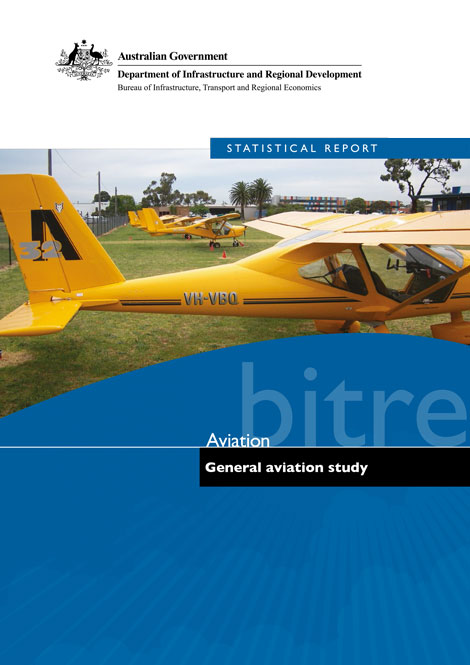
General aviation (GA) is a diverse sector that is undergoing change. While overall GA activity appears to be declining slowly, it is not accurate to say that all parts of GA are declining.
Those parts of GA that are discretionary in nature such as pleasure flying appear to decline in more conservative economic times, while those parts of GA that are key to expanding industries such as aerial mustering have been growing strongly. Detailed economic analysis of these relationships is not currently possible due to the lack of financial statistics for GA however this report outlines some of the challenges facing GA and identifies some opportunities for the industry and government to respond to these challenges.
Infrastructure benchmarking report
Australian, State and Territory Governments are committed to improving the infrastructure that is critical to efficient, productive and equitable operations of our economy. Achieving this objective requires efficient procurement processes and careful examination of costs to ensure value for money in infrastructure investments. Governments have cooperated to conclude the first national pilot benchmarking of infrastructure procurement processes and construction costs (as recommended by the 2014 Productivity Commission Inquiry into Public Infrastructure and agreed by the Council on 28 August 2014). This report covers the findings of the initial benchmarking and outlines plans for continued and improved future monitoring of infrastructure procurement performance and construction costs.
The analysis was undertaken by the Bureau of Infrastructure, Transport and Regional Economics (BITRE) for the Infrastructure Working Group of the Transport and Infrastructure Council. The report is also available on the Transport and Infrastructure Council website.
- Infrastructure Benchmarking Report
Commuting to Work by Private Vehicle in Melbourne: Trends and Policy Implications
Paper given to the 33rd Australasian Transport Research Forum, 29 September–1 October 2010, Canberra. Authors: Hema de Silva, Anatoli Lightfoot.
- Commuting to Work by Private Vehicle in Melbourne: Trends and Policy Implications
International Aviation: Trends and Issues
This report analyses the historical trends and current issues facing the international aviation industry and comments on possible future developments in international aviation.
- International Aviation: Trends and Issues
Greenhouse Gas Emissions from Australian Transport: A Macro Modelling Approach
This paper presents the results of a Bureau of Transport and Regional Economics (BTRE) study involving a general equilibrium modelling (or 'top-down') approach to deriving projections of greenhouse emissions from the Australian transport sector.
- Greenhouse Gas Emissions from Australian Transport: A Macro Modelling Approach
Regional Public Transport In Australia: Long-Distance Services, Trends And Projections
Regional public transport plays an important role in meeting the needs of Australians living in regional and remote areas for access to essential services and for mobility. This paper provides information on long-distance regional public transport services in Australia, and includes a snapshot of all such services across Australia in 2000–01 and the level of demand and characteristics of regional passenger travel in 1999–2000. The report also provides projections of likely future long-term trends in regional passenger travel. A companion paper, Regional public transport in Australia: Economic regulation and assistance measures (Working Paper 54), provides information on the regulatory arrangements and assistance measures relating to regional public transport.
- Regional Public Transport In Australia: Long-Distance Services, Trends And Projections
Investment Trends in the Lower Murray-Darling Basin
This paper looks at differing investment and growth patterns of irrigation dependent regions along the course of the Murray River. It derives estimates of investment in irrigated agriculture and in the associated manufacturing industries in the regions and then identifies the key underlying causes of regional differences.
- Working Paper 58: Investment Trends in the Lower Murray-Darling Basin
BTRE 2007 Transport Colloquium—Australian Transport and the Challenge of Growth

Keynote Speaker: Prof. Dr. Rothengatter is an internationally recognised authority on the application of transport theory to policymaking. He is head of the Institute of Economic Policy Research and the Unit of Transport and Communication at the University of Karlsruhe, Germany.
To be included on the 2008 Colloquium mailing list, please email btre.colloquium@dotars.gov.au
- BTRE 2007 Transport Colloquium–Program
National Workshop on Urban Transport Modelling
In order to maximise the value of urban transport modelling as a tool for improving urban congestion interventions, a National Workshop on Urban Transport Modelling was held in Canberra on 5 March 2008. It was co-convened by the Urban Congestion Management Working Group and the Bureau of Infrastructure, Transport and Regional Economics.The workshop brought together nearly 60 participants, including urban transport modellers, decision-makers, research bodies and transport and planning agencies.
The initiative to organise a national workshop on urban transport modelling derives from COAG's consideration of the Urban Congestion Review in April 2007. COAG tasked the Australian Transport Council of Ministers (ATC) with establishing arrangements to improve urban congestion data, modelling and performance information for decision-making and to report back to COAG by June 2008.ATC subsequently asked the Standing Committee on Transport (SCOT), through the SCOT Urban Congestion Management Working Group, to progress this agenda. The proposal for a national urban transport modelling workshop was one ofa small number of actions endorsed by SCOT to assist in developing improving information for urban congestion decision-making.
Presentations
The morning consisted of a series of papers presented by experts in six key urban congestion management intervention areas. Keynote papers were also given by the Department of Infrastructure, Transport, Regional Development and Local Government Secretary, Michael Taylor AO, and Professor David Hensher. The afternoon consisted of a series of small group workshops to propose a number of possible future action areas.
Presentations in the morning sessions were as follows:
- Professor David Hensher, Keynote Address, Institute of Transport and Logistics Studies, Faculty of Economics and Business, The University of Sydney
- Rod Tudge, Traffic Management and Microsimulation, Traffic and Transport Modelling, Roads and Traffic Authority, New South Wales
- Lindsay Oxlad, Road Pricing, Road Transport Policy and Investment, Department for Transport, Energy and Infrastructure, South Australia
- Professor Graham Currie, Public Transport, Public Transport, Civil Engineering, Monash University
- Associate Professor Geoff Rose, Passenger Travel Demand Management, Institute of Transport Studies, Civil Engineering, Monash University
- Fotios Spiridonos, Freight and Business Sector Transport and Victoria's Freight Movement Model (VicFMM), Transport Modelling and Analysis Policy, Intergovernmental Relations Division, Department of Infrastructure, Victoria
- Frank Milthorpe, Integrated Transport and Land Use, Transport Model Development, Transport Data Centre, Ministry of Transport, New South Wales
Please see below for links to presentation slides and photos of the day.
Outcomes
The workshop recognised that modelling is capable of informing urban congestion management interventions but that currently policy and modelling are not well coordinated. Improvements need to be made for policy makers and modellers to work collaboratively in framing appropriate urban congestion management questions. The socio-economic impact of urban congestion interventions, for example, is an area which needs to be better modelled and understood.
The following five key areas summarise the proposed areas which received most support for further action:
- Time of travel and behaviour shifts (i.e. how people make travel decisions) are not adequately modelled: New models need to be developed for peak spreading/time of day choice. Current models often exaggerate modal shift, compared to changing time of travel.
- Socio-economic impacts of various interventions are not modelled to an adequate level: For example the distributional impacts of road pricing on different socio-economic groups; willingness to pay; ability to pay and access to alternatives, need to be captured.
- Freight/Light Commercial Vehicles: A cost-effective way of getting data for freight and business sector transport modelling needs to be found. The establishment of a Freight Movement Working Group to develop and implement a better data framework for freight and business sector transport was recommended.
- Reliability modelling: Better modelling is needed to assess the role reliability plays in mode choice and how reliability affects patronage, compared to other aspects of travel choice.
- Collaboration to improve methodologies: There has been a lack of communication and collaboration between agencies, academics and decision makers and this makes maximising the uses of modelling for national urban congestion strategy difficult. Informal networks need to be strengthened and 'best Australian practice' needs to be documented. A clearing house for modelling resources needs to be established.
- David Hensher

- Rod Tudge
- Graham Currie
- Geoff Rose
- Fotios Spiridonos
- Frank Milthorpe
- Photos from the workshop