
Economic measures of general aviation in Australia
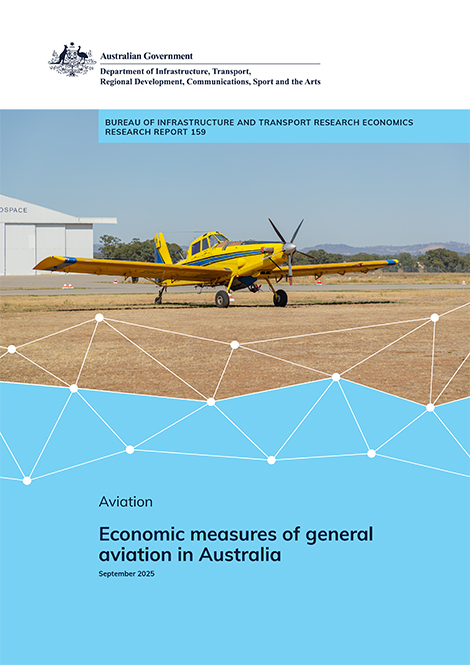
General aviation (GA) plays a range of essential roles in Australia including servicing regional communities, delivering education and health services, regional freight and transport, tourism, recreation, agricultural mustering and spraying, instructional flying, sport and pleasure flying, and emergency services. However, GA is not a stand-alone category in Australia’s System of National Accounts. Instead, it makes up a small subset of a very wide range of economic activities, making it difficult to estimate its actual economic impact. This study considers a range of sources, including innovative methods of matching aircraft registrations to business activity, to estimate the contribution of GA to Australia’s economy.
Ex-post Economic Evaluation of National Road Investment Projects

BITRE undertook two rounds of ex-post evaluations of national road investment projects: one in 2005–2007 and the other in 2014–2016. Available evidence suggests that there is much room for improvement in the quality of Australian road CBAs if they are to be used as an effective tool for ranking options and prioritising projects. The net present value (NPV) was over-estimated by significant margins in some of the selected case study projects. Over-estimation in NPV was largely caused by over-estimation of road user benefits (up to 500 per cent), with the errors mostly coming from travel time cost saving estimates. Inaccurate traffic forecasts and methodology errors were mostly responsible for the over-estimated road user benefits. There was no evidence of systematic cost overruns for the projects selected for ex-post review. Lessons learned include recommendations for improvements in CBA documentation and review, traffic forecasts, and estimation of road user benefits and residual values.
- Ex-post Economic Evaluation of National Road Investment Projects–Volume 1 Synthesis Report
- Ex-post Economic Evaluation of National Road Investment Projects–Volume 2 Case Studies
Infrastructure benchmarking report
Australian, State and Territory Governments are committed to improving the infrastructure that is critical to efficient, productive and equitable operations of our economy. Achieving this objective requires efficient procurement processes and careful examination of costs to ensure value for money in infrastructure investments. Governments have cooperated to conclude the first national pilot benchmarking of infrastructure procurement processes and construction costs (as recommended by the 2014 Productivity Commission Inquiry into Public Infrastructure and agreed by the Council on 28 August 2014). This report covers the findings of the initial benchmarking and outlines plans for continued and improved future monitoring of infrastructure procurement performance and construction costs.
The analysis was undertaken by the Bureau of Infrastructure, Transport and Regional Economics (BITRE) for the Infrastructure Working Group of the Transport and Infrastructure Council. The report is also available on the Transport and Infrastructure Council website.
- Infrastructure Benchmarking Report
Developing productivity elasticities for estimating WEBs in Australia—Scoping Study
Estimates of Wider Economic Benefits (WEBs) are increasingly featuring in cost-benefit analyses (CBAs) of major urban transport infrastructure projects. Governments are particularly interested in WEBs because they relate to productivity. The parameters used to estimate WEBs in Australia to date have been estimated using methodologies that are inconsistent and not in line with international best-practice. Thus the reliability and comparability of WEBs estimates in Australian CBAs is questionable. The report proposes a way to develop a robust set of parameters for practitioners to use when estimating WEBs.
The report was commissioned by BITRE on behalf of Steering Committee oversighting the Review of the National Guidelines for Transport System Management. If a robust set of parameters can be developed, it will be published in the Guidelines. BITRE engaged consultants KPMG to undertake the task.
- Developing productivity elasticities for estimating WEBs in Australia–Scoping Study
International trade and cities: what house prices say
The relationship between changes in the value and direction of trade and house prices are examined for Ireland, Britain, Canada, the United States and New Zealand. It finds a strong relationship between trade patterns and locational value. Australia is examined at a continental scale. As Australias trade is steadily more focused on Asia, the values of those cities located in the north and west have risen faster than the rest.
- International trade and cities: what house prices say
International trade and Australian cities: what house prices say
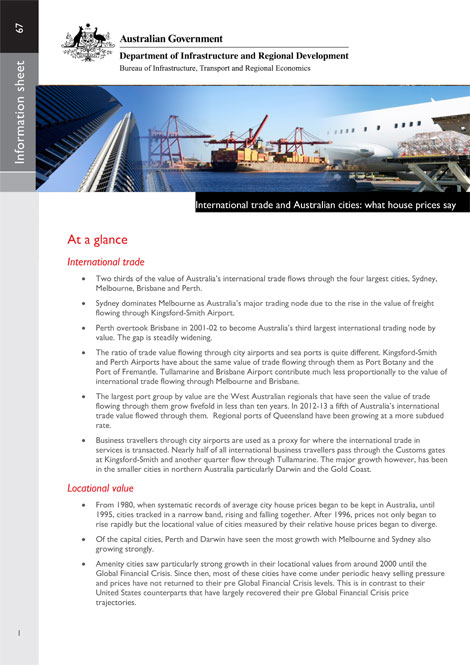
Information Sheet 67 opens with a brief discussion on recent insights into Australian international trade, particularly ways to better measure its real value. It then looks at the changes in the value of international trade flowing through individual sea and airports. Changes in locational value from 1992–2014 are then presented for each city. The relationship between trade patterns and locational values are then tested mathematically.
- International trade and Australian cities: what house prices say
BITRE Road Construction and Maintenance Price Index—2012 update
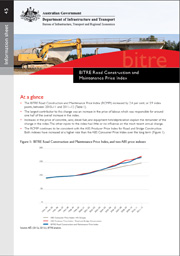
This publication provides the 2012 update of BITRE's Road Construction and Maintenance Price Index.
- BITRE Road Construction and Maintenance Price Index–2012 update
Paper given to the 33rd Australasian Transport Research Forum, 29 September–1 October 2010, Canberra.
Author: David Gargett.
- Petrol Prices in Australia
Deregulation of Domestic Aviation—The First Year
The Commonwealth's regulation of interstate aviation, in place for over thirty years, came to an end at midnight on 30 October 1990. This study reviews the developments in the last few months of regulation and in the first year of deregulation.
- Deregulation of Domestic Aviation–The First Year
Commercial Road Supply with Incentive Regulation
Paper published in the International journal of sustainable transportation, 2015, 9(4):241-53. Author: Mark Harvey
- Commercial Road Supply with Incentive Regulation