
Impact of COVID-19 on petrol prices in Australia
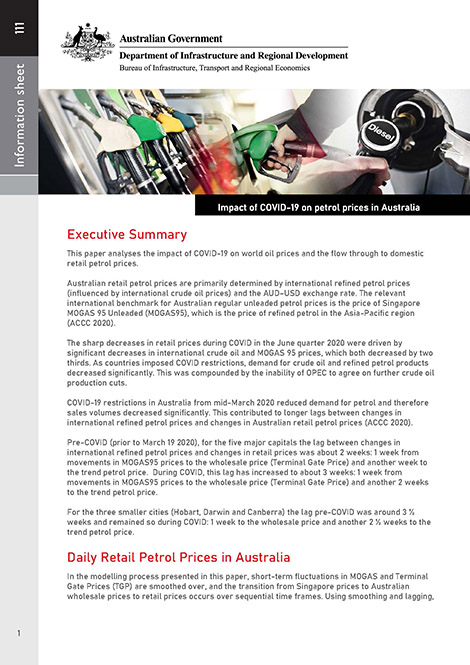
Australian retail petrol prices are primarily determined by international world oil prices and overseas refined petroleum prices, and variations in exchange rates. As a result of COVID-19 restrictions imposed around the wold, demand for crude oil and refined petroleum products decreased significantly from mid-March 2020 onwards, and led to sharp decreases in crude oil and refined product prices.
The analysis presented in this paper outlines the principal components of Australian retail petrol prices, the impact of COVID-19 on weekly petrol prices and also the typically observed time lag between international refined petroleum product prices and domestic retail petrol prices.
Petrol Prices and Diesel Prices in Australia
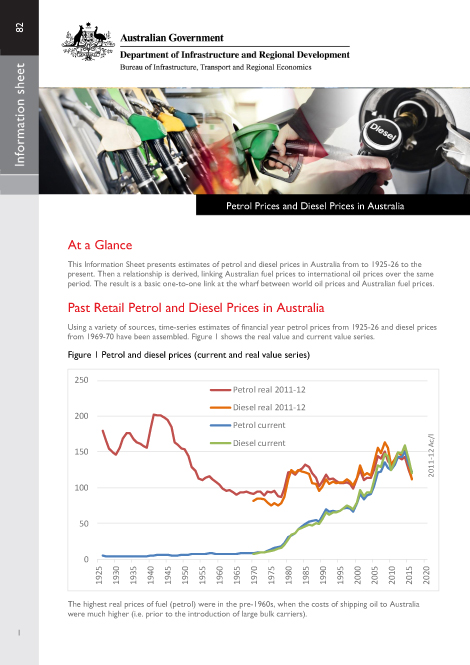
This information sheet presents estimates of petrol and diesel prices in Australia from 1925-26 to the present. Then a relationship is derived, linking Australian fuel prices to international oil prices over the same period. The result is a basic one-to-one link at the wharf between world oil prices and Australian fuel prices.
- Petrol Prices and Diesel Prices in Australia
Paper given to the 33rd Australasian Transport Research Forum, 29 September–1 October 2010, Canberra.
Author: David Gargett.
- Petrol Prices in Australia
Road Vehicle-Kilometres Travelled Estimated from State/Territory Fuel Sales
Paper given to the 34th Australasian Transport Research Forum, 28–30 September 2011, Adelaide. Authors: Afzal Hossain, David Gargett.
- Road Vehicle-Kilometres Travelled Estimated from State/Territory Fuel Sales
Fuel Consumption by New Passenger Vehicles in Australia
BTRE has examined trends in the fuel consumption of new passenger vehicles. The overall trend in fuel consumption was down during the 1980s. However during the 1990s, a more gradual reduction in the fuel consumption of cars, coupled with increasing sales of 4-wheel-drive vehicles, saw fuel consumption for new passenger vehicles as a whole stabilise.
- Fuel Consumption by New Passenger Vehicles in Australia
Fuel Consumption by New Passenger Vehicles in Australia 1979–2008

BITRE has examined trends in the fuel consumption of new passenger vehicles sold in Australia. Up to 2001, technological advances in engine technology, which improved fuel efficiency, were offset by increases in power, weight and the popularity of 4WD vehicles. Since 2001 the overall trend in fuel consumption has continued to decrease with average new light vehicle fuel consumption down 8.4 per cent to 8.14 litres per 100 kilometres (L/100 km).
- Fuel Consumption by New Passenger Vehicles in Australia 1979-2008
Road vehicle-kilometres travelled: estimation from state and territory fuel sales
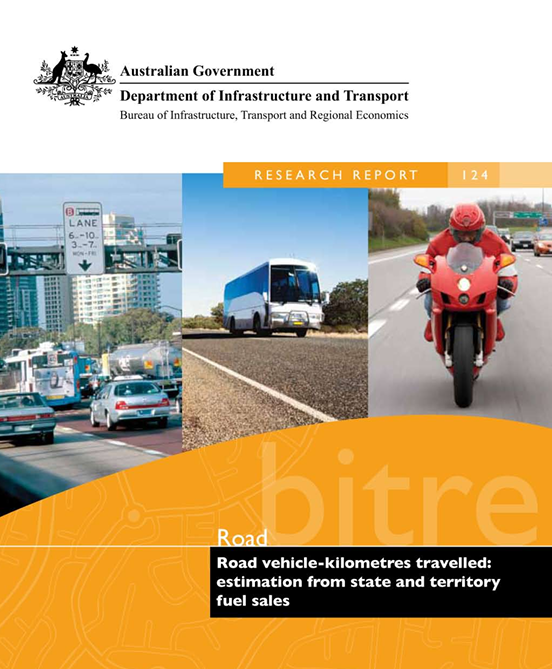
This report develops a methodology for estimating traffic levels for each of the eight states and territories in Australia from March 1965 to June 2010. This method is based on state and territory fuel sales data. Quarterly traffic on capital city roads was also estimated. The motor vehicle types used were passenger vehicles (i.e. cars), motorcycles, light commercial vehicles, rigid trucks, articulated trucks and buses, while three different types of fuel were considered, i.e. petrol, diesel and liquefied petroleum gas.