
Australian aggregate freight forecasts – 2022 update
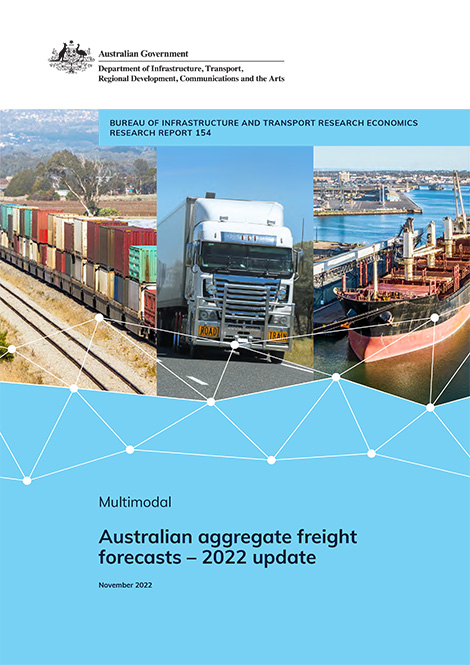
Freight transport plays a significant and wide-ranging role across Australia’s economy. It includes the movement of Australia’s major bulk export commodities to ports for export, the transport of raw materials and semi-processed commodities to businesses for further processing and finished products to household consumers.
This report presents long-term forecasts of total Australian freight volumes for road, rail, coastal shipping and aviation between 2020 and 2050. The forecasts are based on a combination of statistical models relating to historical trends in freight volumes and economic activity and on informed assumptions about likely future long-term economic and demographic trends and international assumptions about likely future world demand for key Australian export commodities. This report updates BITRE 2019 aggregate freight forecasts.
Australian interstate, intrastate and capital city road freight forecasts – 2022 update
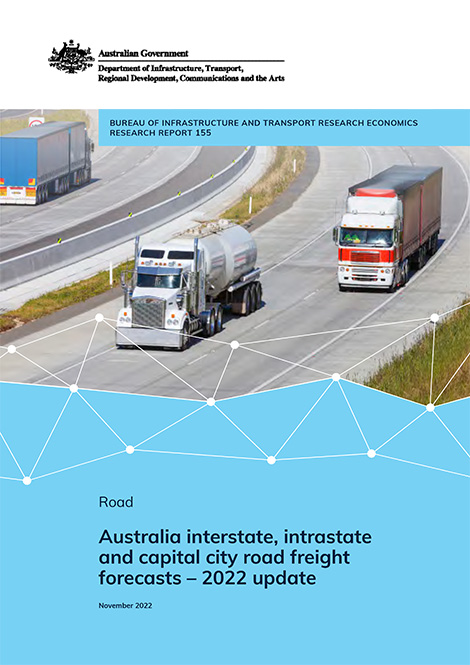
In Australia, road transport is the predominant mode for moving freight between and within states. It is a vital link in various logistics chains, providing access for freight to ports and terminals and urban freight distribution between warehouses and retail outlets. It is also the dominant mode for moving freight over relatively short distances and where other alternatives are not readily available.
This report presents estimates and forecasts of interstate, intrastate and capital cities freight volumes for each state and territory in Australia. Estimates cover the period 1970 to 2020 and forecasts from 2020 to 2040. The forecasts are based on a combination of statistical models relating historical trends in road freight volumes and economic activity, informed by assumptions about likely future long-term economic and demographic trends.
Australian aggregate freight forecasts—2019 update
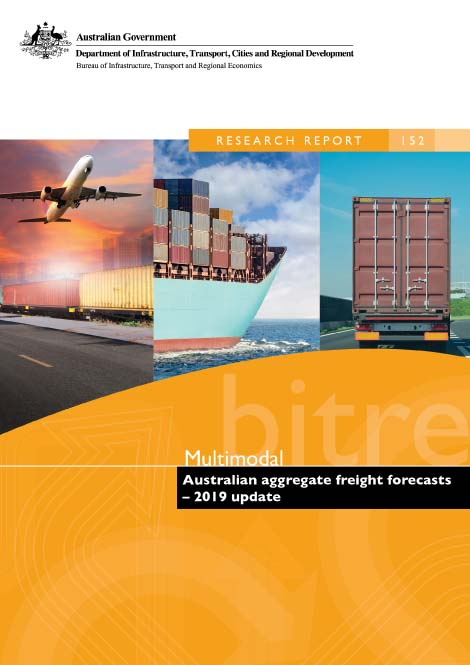
This report presents long-term forecasts of total Australian freight volumes for road, rail, coastal shipping and aviation between 2018 and 2040. The forecasts are based on a combination of statistical models relating historical trends in freight volumes and economic activity, informed assumptions about likely future long-term economic and demographic trends, and international assumptions about likely future world demand for key Australian export commodities. This report represents the first issue in BITRE's revamped forecasting series, which aims to provide regularly updated long-term forecasts of Australian freight activity by major transport mode at national, state, territory and regional scales.
Containerised and non-containerised trade through Australian ports to 2032–33
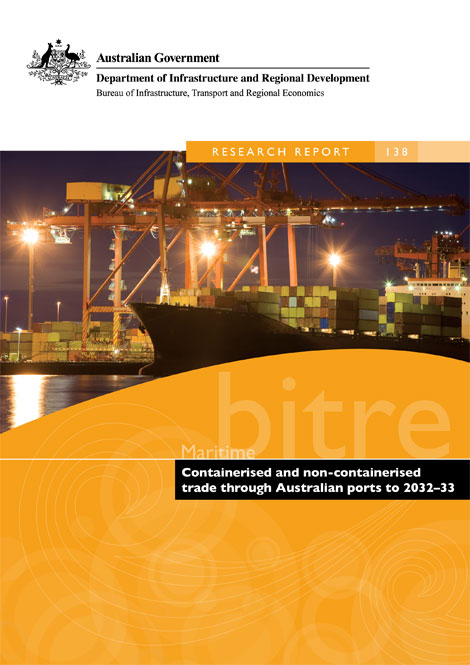
This report presents 20-year forecasts of exports and imports of containerised and non-containerised freight and sea passenger movements through Australia's 5 largest capital city ports and, in aggregation, all other ports. The forecasts, which update those previously published by BITRE in 2002, 2006 and 2010, are driven by population, real income, exchange rates, import prices and export prices. The most recent economic outlook and population growth forecasts for Australia and its major trading partners have been used to derive the forecasts. The forecasts imply that Australia's sea trade will double over the next 20 years, largely due to the continuing positive economic outlook for Australia and its major trading partners. The long-term outlook for the cruise shipping industry is also positive, largely due to the projected economic growth in source countries of cruise passengers, particularly the USA.
Road freight estimates and forecasts in Australia: interstate, capital cities and rest of state
In Australia, road transport is the predominant mode for moving freight within the country, especially interstate and within capital cities. It represents a vital link in various logistics chains, providing access for freight to ports and terminals and urban freight distribution between warehouses and retail outlets. It is also the dominant mode for moving freight over relatively short distances and where alternatives are not readily available.
Truck productivity: sources, trends and future prospects
Analysis of the impact of past heavy vehicle reforms on truck productivity and projected future productivity trends.