
Infrastructure construction dashboard
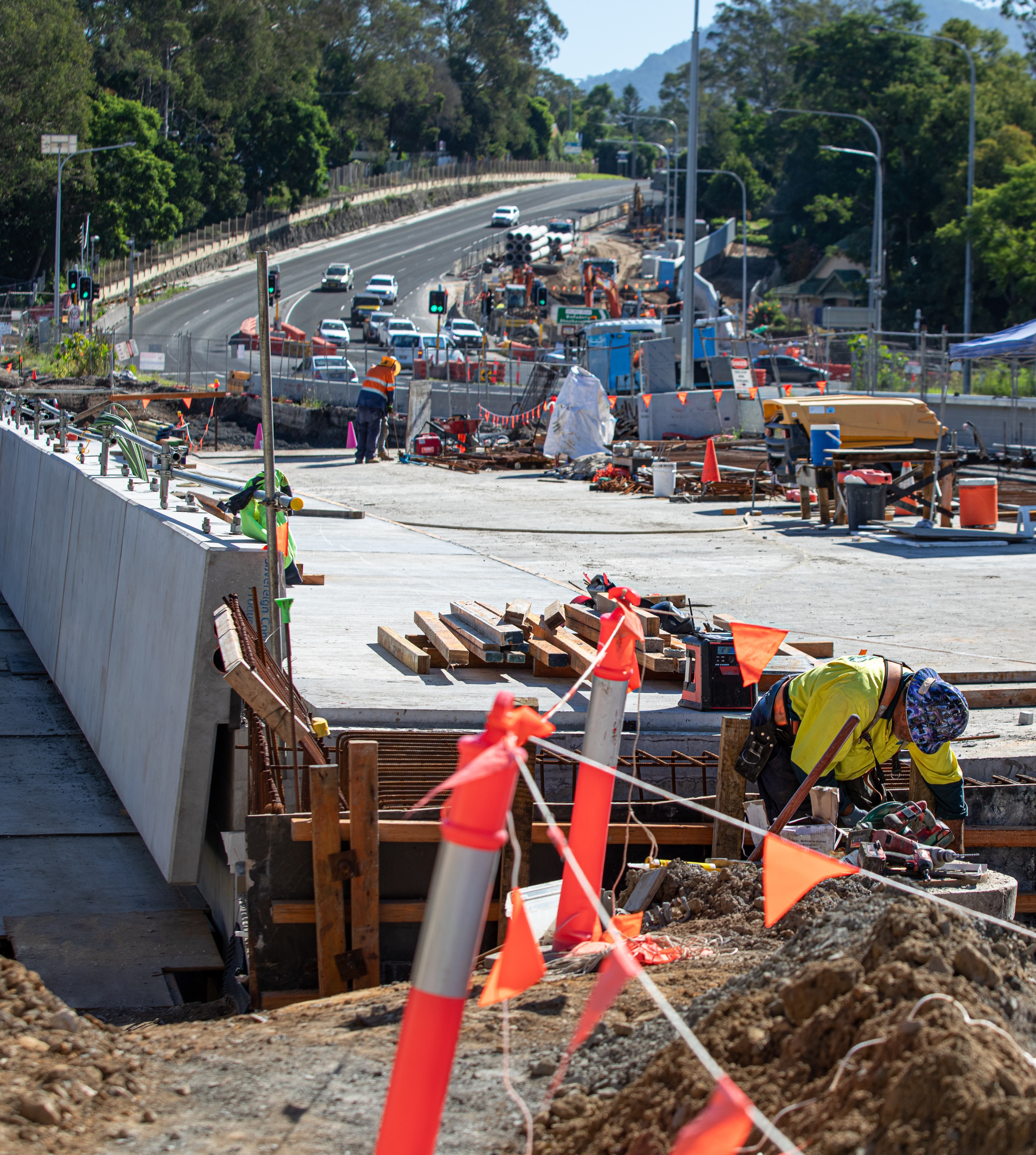
The transport infrastructure construction dashboard shows costs for projects that are underway or completed according to whether they are owned privately or publicly.
Economic Contribution of Transport in Australia, 2020-21
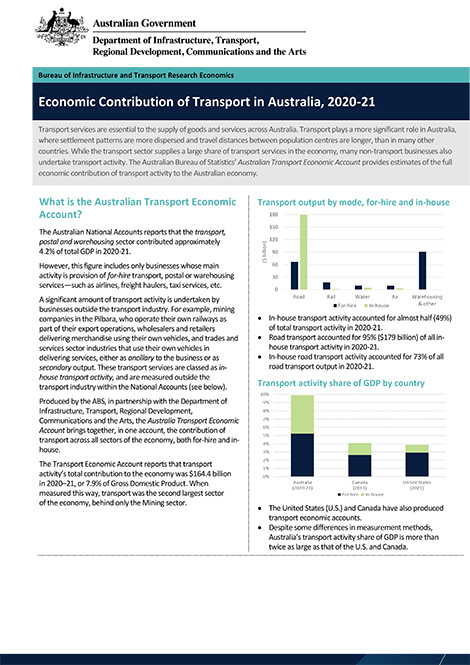
The Australian Bureau of Statistics’ (ABS) Australian Transport Economic Accounts (ATEA) 2020-21 provide estimates of the full economic contribution of transport activity, both for-hire and in-house transport services, to the Australian economy, from 2010-11 to 2020-21.
The ATEA estimates that transport’s total contribution to the economy was $164.4 billion in 2020-21, equivalent to 7.9 per cent of total GDP. Measured in this way, transport was the second largest sector of the economy, behind only the Mining sector.
This release provides a short summary and highlights of the ABS ATEA 2020-21. More detailed ATEA statistics and explanatory notes are available from the ABS website: www.abs.gov.au/statistics/economy/national-accounts/australian-transport-economic-account-experimental-transport-satellite-account
Infrastructure and Transport PPPs and Privatisation in Australia
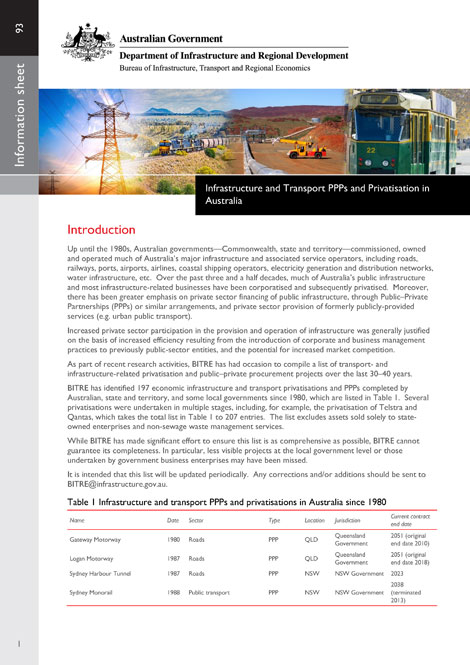
This information sheet provides a list of infrastructure and transport-related Public Private Partnerships and privatisations in Australia since 1980. To the Bureau of Infrastructure Transport and Regional Economics' (BITRE) knowledge, this is the most comprehensive list on the subject to date.
One hundred and ninety seven economic infrastructure assets have been privatised or procured through PPPs since 1980. Several privatisations were undertaken in multiple stages, including, for example, the privatisations of Telstra and Qantas. Including all these stages takes the total list to 207 entries. The list excludes assets sold solely to state-owned enterprises, and non-sewage waste management services.
- Infrastructure and Transport PPPs and Privatisation in Australia
Land Transport Infrastructure Pricing: An Introduction
The BTRE projects that the total freight task will continue to grow strongly. Such growth will increase the infrastructure maintenance needs and possibly hasten the need for capacity expansion. Setting prices for infrastructure use that reflect costs provides important signals as to the appropriate level of transport activity, choice of transport mode, and the level of infrastructure spending. At the Australian Logistics Council (ALC) meeting on 7 November 2002, the Council asked BTRE to provide a comparative analysis of current land transport pricing regimes and their objectives and to present the findings at the next Council meeting, held on 27 February 2003. This working paper comprises the paper prepared for the ALC and already released by the ALC as a discussion paper.
- Land Transport Infrastructure Pricing: An Introduction
Rail Infrastructure Pricing: Principles and Practice

Since the early 1990s, railway operations in Australia and in many overseas countries have been radically reformed. One reform has been widespread outsourcing of railway activities such as infrastructure maintenance, to encourage efficient provision through competitive tendering for services. In some cases, entire rail operations have been contracted out or privatised. The major reform, however, has been to introduce regulations to require access to rail infrastructure by outside ("third-party") train operators. This mandated access also supports rail interoperability objectives facilitating train service coordination by streamlining the logistics chain across infrastructure networks.
Prior to these regulations, there were no access charges because the track use was an internal transaction within the railway company the company maintaining the infrastructure had exclusive use of the tracks for its own trains. In essence, the railway's revenue was generated only from tariffs for transporting goods and passengers. However, with mandatory access, rail infrastructure owners offer an additional service non-track owners' access to the infrastructure.
What are fair, equitable and efficient charges for that access? We know that the level and structure of these charges matter, for they account for, perhaps, one-third of the train operator's total operating costs. This report focuses on the rail infrastructure pricing structures that have developed with mandated access around the world, and the lessons that can be drawn from the subsequent experiences.
Our analysis involves consideration of the benefits and costs of mandatory access; the principles of efficient access charges; Australia's systems of access and pricing; international pricing and access systems and the lessons from the experiences with them. While principles of access charges apply equally to freight and passenger trains, mandated access is generally directed only at freight operations. For that reason, in this report we consider only freight operations.
- Rail Infrastructure Pricing: Principles and Practice
Submission to the Productivity Commission Road and Rail Freight Infrastructure Pricing Inquiry
The submission commences with a brief general discussion of the economics of road and rail infrastructure and some implications for pricing; examines the relationship between estimates of road infrastructure costs attributable to Australian heavy vehicle operators and charges paid, both at the aggregate level and for particular road corridors; discusses issues in improving the efficiency of both road and rail freight infrastructure pricing, and finally considers the question of charging for freight externalities.
- Submission to the Productivity Commission Road and Rail Freight Infrastructure Pricing Inquiry