
Airport traffic data

The files below contain monthly and annual details of passenger and aircraft movement data on scheduled regular Public Transport services at selected Australian airports.
Road Deaths Australia—Monthly Bulletins
Latest summaries of road crash deaths and fatal road crashes are presented here. Updates are monthly and published on BITRE's website on or around the 14th of each month.
Data are sourced from the road traffic or police authorities in each jurisdiction. Data are preliminary and subject to revision.
Latest Month
- Link to Monthly Bulletin: Monthly road deaths | National Road Safety Data Hub
- Road Deaths Australia—Dashboard
Archives
Australian infrastructure statistics—Yearbook 2012
The Australian Infrastructure Statistics Yearbook provides a single comprehensive source of Australian infrastructure time series statistics for measures of transport, energy, communications and water infrastructure and the use of this infrastructure in Australia. Statistics are presented in a coherent framework that enables comparisons across the four forms of infrastructure and the activities associated with each form of infrastructure.
- Australian Infrastructure Statistics–Yearbook 2012
- Australian Infrastructure Statistics Yearbook 2012
Part I–Infrastructure and the Economy
- Australian Infrastructure Statistics Yearbook 2012
Part T–Transport
- Australian Infrastructure Statistics Yearbook 2012
Part E–Energy
- Australian Infrastructure Statistics Yearbook 2012
Part C–Communication
- Australian Infrastructure Statistics Yearbook 2012
Part W–Water
TrainLine 1 is a collaborative report between the Australasian Railway Association (ARA) and BITRE. It is a further development of the previous rail freight performance publications series. This report provides an overview of rail freight performance, railway infrastructure standards and freight haulage between 2007–08 and 2009–10. Further development of the range of information is envisaged.
The report is split into 3 sections that provide freight market, freight train and track indicators.
Bass Strait Passenger Vehicle Equalisation Scheme Monitoring Report No. 13
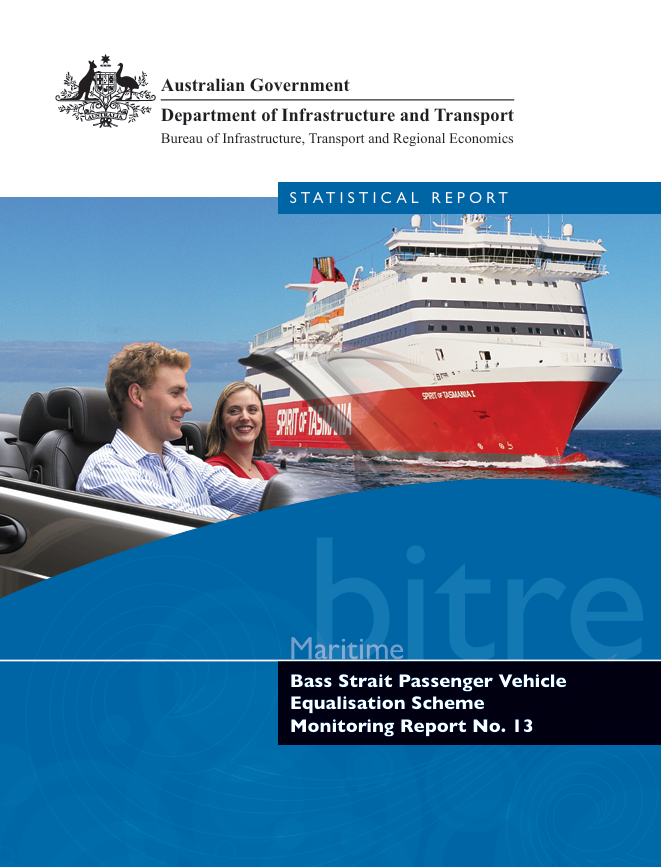
This report presents the results of our thirteenth review of the Bass Strait Passenger Vehicle Equalisation Scheme, covering the operation and impact of the Scheme for the period 1 July 2009 to 30 June 2011.
Container and Ship Movements Through Australian Ports: 2007–08 to 2029–30, Preliminary Estimates
Paper given to the 31st Australasian Transport Research Forum, 2 October–3 October 2008, Gold Coast. Authors: Godfrey Lubulwa, Rob Bolin, Ben Slatter, Tony Carmody
- Container and Ship Movements Through Australian Ports: 2007–08 to 2029–30, Preliminary Estimates
Avline provides a summary of previously released Aviation related data drawing on a range of sources including BITRE, ABS, Airservices Australian and the US Energy Information Administration. In addition, Avline provides a comparison of published airport charges at the five major capital city airports and at a selection of regional airports. Avline 2010–11 covers the financial year 2010–11 and is the third of the series to be published annually instead of biannually.
Tasmanian Freight Equalisation Scheme: Recommended Northbound Assistance Rates at 1 January 1978
When the Commonwealth Government introduced the Tasmanian Freight Equalisation Scheme on 1 July 1976 it directed the Bureau of Transport Economics to recalculate the rates of assistance by December 1977.
This report presents the recommended new rates of assistance calculated on the basis of the freight rates prevailing at the end of December 1977. The method of recalculation was based on that used by the Nimmo Commission although with some modifications.
The new assistance rates were calculated as the difference between the costs of moving a consignment from Tasmania to mainland destinations and the costs of moving a similar consignment on comparable mainland routes.
Sydney Region Aviation Forecasts
The Paper presents methods used for forecasting future passenger and aircraft movements at Sydney Airport. Forecast movements at 5-year intervals to the year 2000 are also presented using these methods, on the basis of assumptions about the future course of many underlying determinants such as population, income, fares, aircraft types, load factors and so on. The forecasts were prepared in support of the Major Airports Needs of Sydney (MANS) Study, and embody assumptions adopted by a Forecasting Consultative Group consisting of members drawn from various Commonwealth and State Government bodies.
- Sydney Region Aviation Forecasts