
Australian road freight estimates: 2016 update
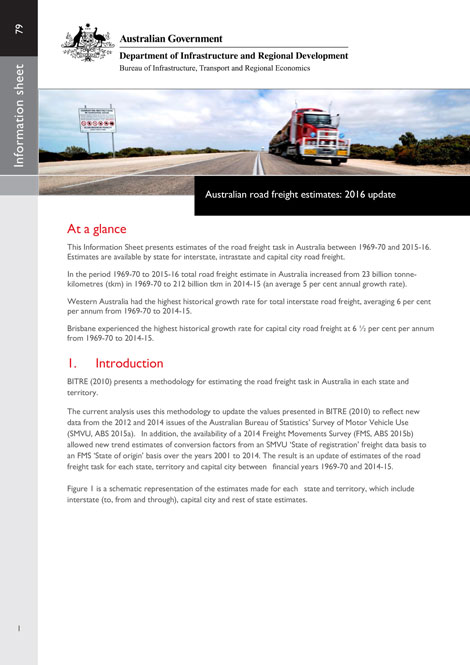
The Information Sheet provides revised estimates of road freight by State, capital city and rest-of-state. The long-term trend in growth has been substantial, interrupted only by the 1990 recession and the Global Financial Crisis.
- Australian road freight estimates: 2016 update
Bass Strait Passenger Vehicle Equalisation Scheme Monitoring Report No. 15
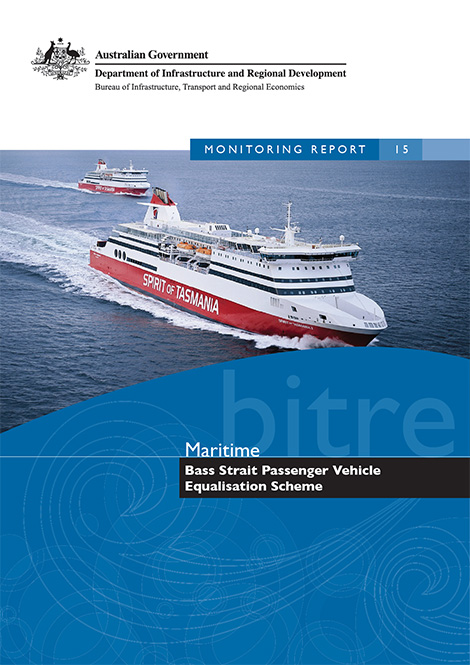
The Ministerial Directions governing the Bass Strait Passenger Vehicle Equalisation Scheme require us to produce a monitoring report every 2 years. Over the monitoring period (2013–14 to 2014–15):
- The Australian Government spent $40.9 million in 2014–15 on the Scheme, up 9.1% from 2013–14, and $37.5 million in 2013–14 (up 14.3% on 2012–13).
- The number of sea passengers with a motor vehicle may have been 23.6% higher than without the Scheme.
- Just under 18 000 new visitors to Tasmania travelled by sea due to the Scheme in 2014–15 (up from 14 500 new visitors in 2013–14).
- New visitors to Tasmania spent an estimated $50.2 million in Tasmania in 2014–15 (up from an estimated $39.0 million in 2013–14).
Freightline 3—Australia sugar freight transport
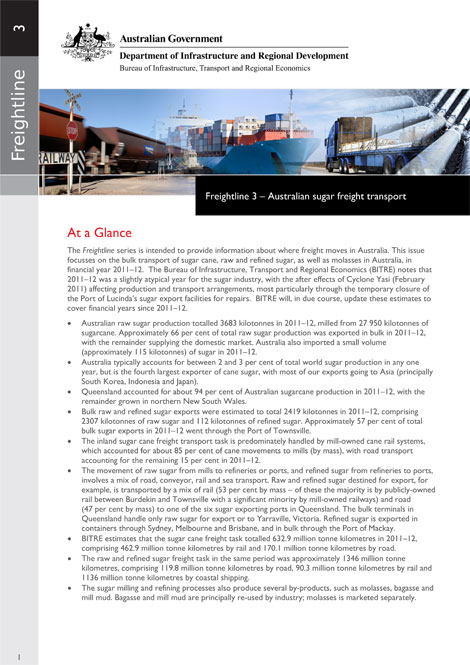
The Freightline series is intended to provide information on interregional freight movements across Australia, filling a major gap in Australian transport-related data and information, to help better inform and support policy development and infrastructure planning. The Freightline series begins with a broad overview of the freight task, followed by separate commodity-specific issues that provide more detailed information about the size and location of major freight movements, supply chain composition and key infrastructure components. Freightline 3 (this issue) focusses on Australian sugar-related transport supply chains and freight movements in 2011–12.
- Freightline 3–Australia sugar freight transport
Australian infrastructure statistics—Yearbook 2015 and key Australian infrastructure statistics booklet 2015
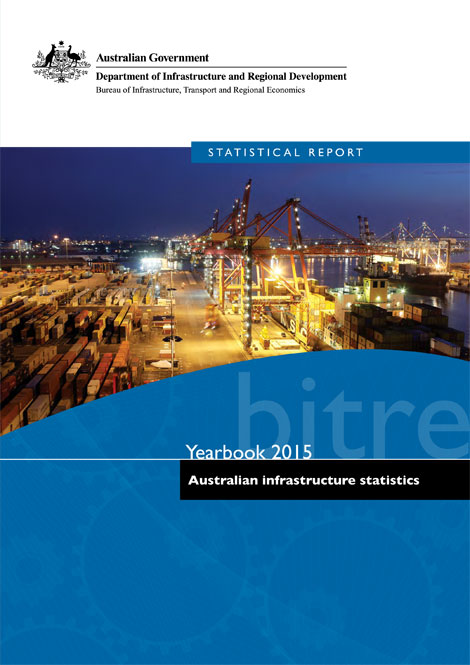
The Yearbook provides a comprehensive evidence base to examine long-term and emerging trends as well as inform policy development and regulatory reform in the transport, energy, water and communications sectors. It is the only comprehensive source of time series statistics for Australia's major areas of economic infrastructure. The Yearbook is accompanied by the key Australian infrastructure statistics booklet which is a summary of statistics from the Yearbook.
- Yearbook 2015–Australian Infrastructure Statistics
- Key Australian Infrastructure Statistics 2015
- Australian Infrastructure Statistics
Yearbook 2015
Part I–Infrastructure and the Economy

- Australian Infrastructure Statistics
Yearbook 2015
Part T–Transport
- Australian Infrastructure Statistics
Yearbook 2015
Part E–Energy
- Australian Infrastructure Statistics
Yearbook 2015
Part C–Communication
- Australian Infrastructure Statistics
Yearbook 2015
Part W–Water
Waterline 57—December 2015
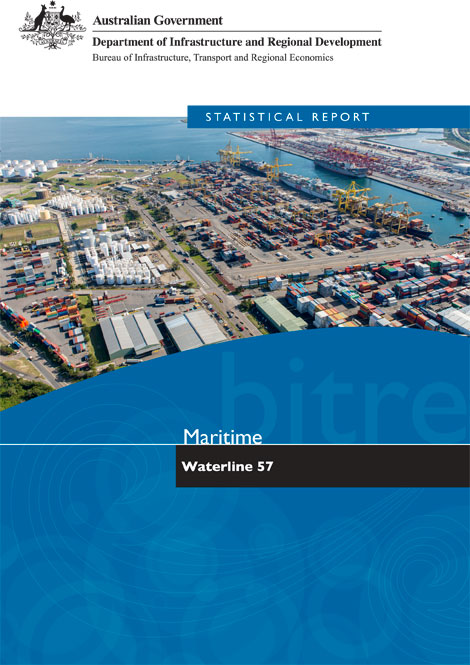
Waterline reports on trends in throughput, container handling productivity and the cost of importing and exporting containers through Australia's 5 major container ports. It covers container exchange with specialised container ships and transport of containers on the landside of the ports.
This issue covers port terminal activity up to the June quarter 2015. It introduces 3 new indicators–2 examine truck movements outside formal booking systems for containers and TEUs; the third quantifies backloaded operations, whereby trucks carry containers on both inbound and outbound legs of their trip.
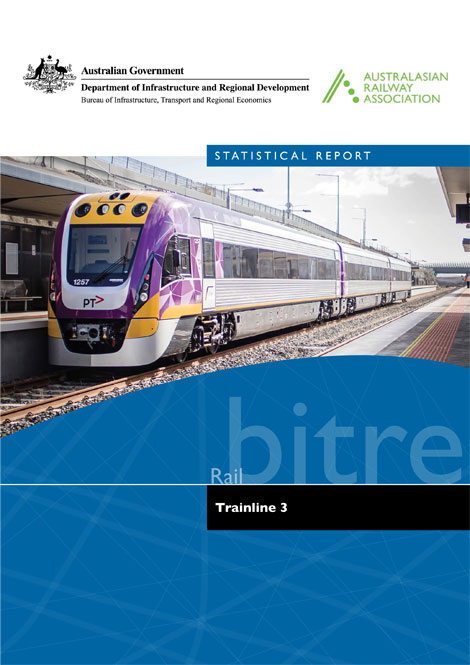
Trainline 3 is a collaborative compendium between the Australasian Railway Association (ARA) and BITRE, providing insights, analysis, and an understanding of the Australian freight and passenger railway industry.
Australia's railways are evolving due to factors within and outside the industry, including changes in bulk and non-bulk logistics, commodity flows, technology, urban rail patronage and regional passenger services. The publication presents an overview and data illustrating these changes in terms of rail tasks performed, characteristics of the railway networks, train operators' rolling stock and aspects of railway performance including safety, environment and reliability.
BITRE road construction and maintenance price index—2015 update
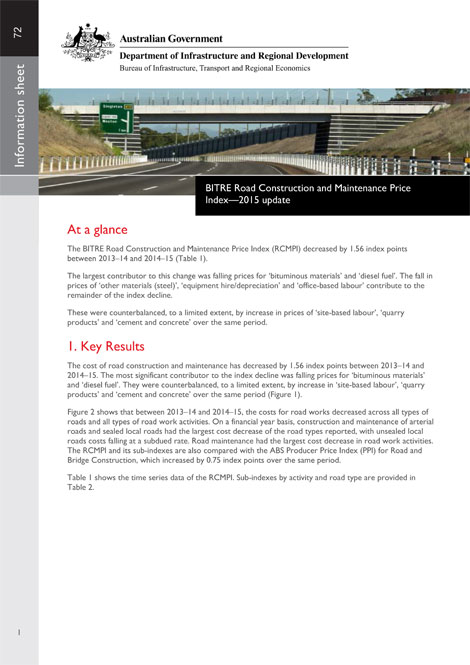
This Information Sheet presents the quarterly road construction and maintenance price index for the year 2014–15. Additionally, it presents sub-indexes by activity type for road construction and road maintenance, and by road type for arterial, sealed local and unsealed local roads.
- BITRE road construction and maintenance price index–2015 update
Australian sea freight 2013–14
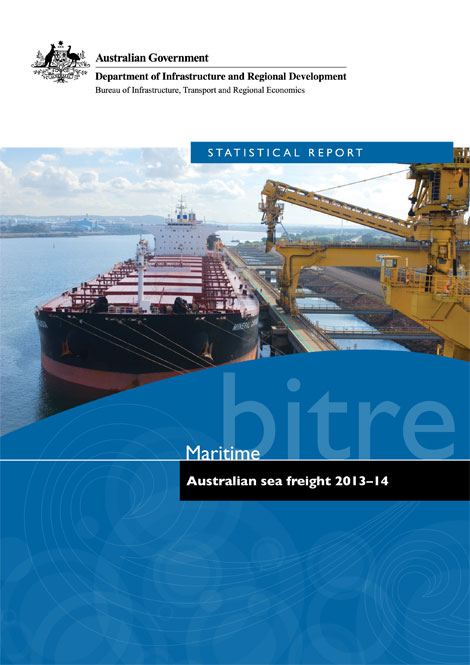
This is the latest in a series of BITRE reports that provide information on Australian sea freight movements, vessel activity, the use of coastal trading licences and the size and composition of the Australian trading fleet. This report contains statistics on maritime freight and shipping activities in Australia from 2004–05 to 2013–14.
Waterline 56—May 2015
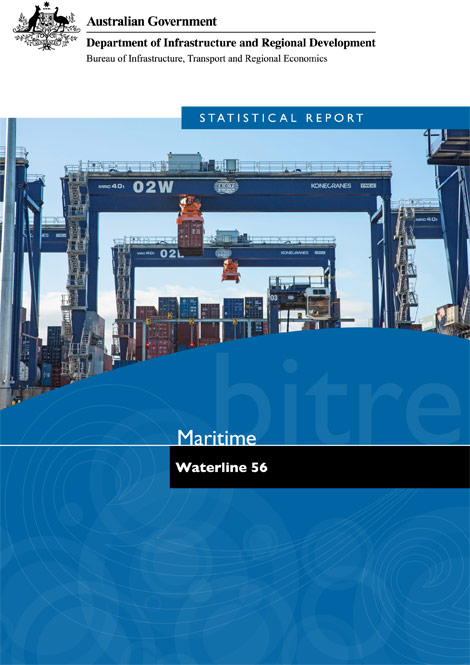
Waterline provides the latest data on throughput, container handling productivity (both wharf-side and landside), and the cost of importing and exporting containers. It covers the unloading of container ships and the transport of containers from terminals. Highlights from this edition include:
- Throughput at Australian ports increased 3% over the period July-December 2014 relative to the previous year, with a total throughput of 3.7 million TEUs. This compares to non-farm GDP growth over the same period of 2.7%: port throughput continues to increase faster than non-farm GDP. Fremantle experienced the strongest increase of 11.3%; the other ports showed more modest growth, except Adelaide, which recorded a 2.6% decline.
- Wharf-side productivity showed a modest improvement in average labour productivity (up 0.9%); however reduced crane rates (down 3.3%) showed lower capital productivity and translated to longer median ship turnaround rates at Brisbane, Sydney and Melbourne. Fremantle exhibited the strongest performance (with elapsed labour rate, crane rate and ship rate improvements of 39.4, 32.8 and 10.9% respectively), with the sharpest declines in Brisbane (elapsed labour rate and ship rate down by 12.3 and 14.5% respectively).
- Land-side efficiency continued its decline in all ports except Adelaide: average truck and container turnaround times increased by 5.7 and 4.7%, respectively.
- The Port Interface Cost Index (PICI) increased by $10-$14/TEU over the reporting period, with the larger increases for smaller vessel sizes. Port Interface Cost for medium- and large-size vessels is now approaching parity. While historically, port handling costs have been declining as the general price level across the economy (the GDP deflator) has been increasing, this trend has reversed since 2010, and port interface costs are now rising.
Archived Road Deaths In Crashes Involving Heavy Vehicles—Quarterly Bulletins
Older issues of Road Deaths In Crashes Involving Heavy Vehicles – Quarterly Bulletins are available below.
Formerly entitled ‘Fatal heavy vehicle crashes Australia—Quarterly Bulletins’.
- Apr-Jun 2024
- Jan-Mar 2024
- Oct-Dec 2023
- Jul-Sep 2023
- Apr-Jun 2023
- Jan-Mar 2023
- Oct-Dec 2022
- Jul-Sep 2022
- Apr-Jun 2022
- Jan-Mar 2022
- Oct-Dec 2021
- Jul-Sep 2021
- Apr-Jun 2021
- Jan-Mar 2021
- Oct-Dec 2020
- Jul-Sep 2020
- Apr-Jun 2020
- Jan-Mar 2020
- Oct-Dec 2019
- Jul-Sep 2019
- Apr-Jun 2019
- Jan-Mar 2019
- Oct-Dec 2018
- Jul-Sep 2018
- Apr-Jun 2018
- Jan-Mar 2018
- Oct-Dec 2017
- Jul-Sep 2017
- Apr-Jun 2017
- Jan-Mar 2017
- Oct-Dec 2016
- Jul-Sep 2016
- Apr-Jun 2016
- Jan-Mar 2016
- Oct-Dec 2015
- Jul-Sep 2015
- Apr-Jun 2015
- Jan-Mar 2015
- Oct–Dec 2014
- Jul–Sep 2014
- Apr–Jun 2014
- Jan–Mar 2014
- Oct–Dec 2013
- Jul–Sep 2013
- Apr–Jun 2013
- Jan–Mar 2013
- Oct–Dec 2012
- Jul–Sep 2012
- Apr–Jun 2012
- Jan–Mar 2012
- Oct–Dec 2011
- Jul–Sep 2011
- Apr–Jun 2011
- Jan–Mar 2011
- Oct–Dec 2010
- Jul–Sep 2010
- Apr–Jun 2010
- Jan–Mar 2010
- Oct–Dec 2009
- Jul–Sep 2009
- Apr–Jun 2009