
Changes in Australia's industry structure: cities and regions, 2006–2011
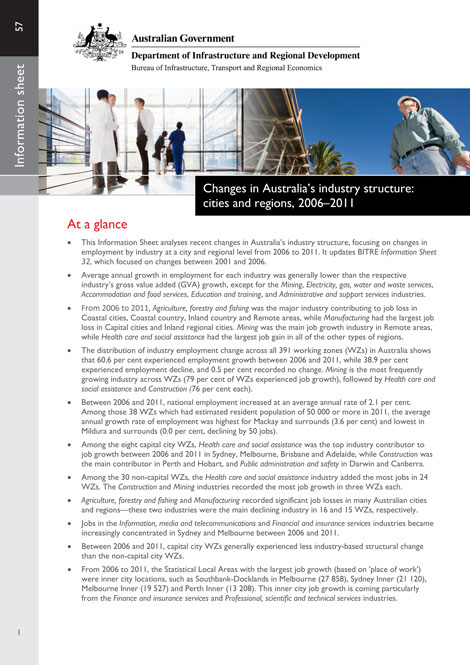
This Information Sheet identifies recent trends (2006 to 2011) in employment by various industries for regional areas, capital cities and non-capital cities. It updates BITRE's previous Information Sheet 32, which focused on employment changes between 2001 and 2006. The information presented in this publication will assist regional communities (including local government and RDAs) to understand how their regions are changing, and help regions map out where their opportunities and challenges might lie.
- Changes in Australia's industry structure: cities and regions, 2006–2011
International trade and cities: what house prices say
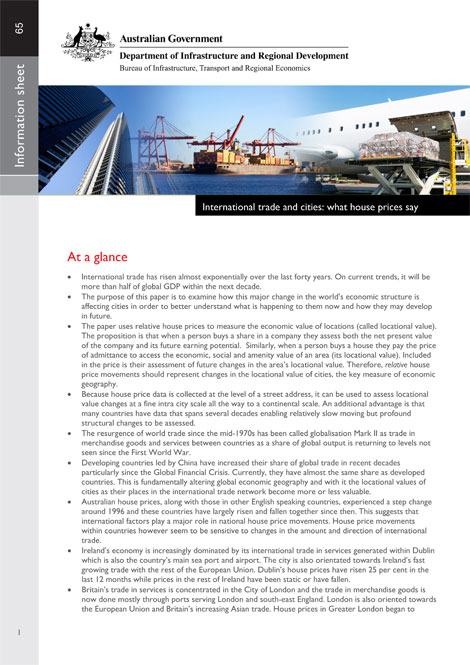
The relationship between changes in the value and direction of trade and house prices are examined for Ireland, Britain, Canada, the United States and New Zealand. It finds a strong relationship between trade patterns and locational value. Australia is examined at a continental scale. As Australias trade is steadily more focused on Asia, the values of those cities located in the north and west have risen faster than the rest.
- International trade and cities: what house prices say
International trade and Australian cities: what house prices say
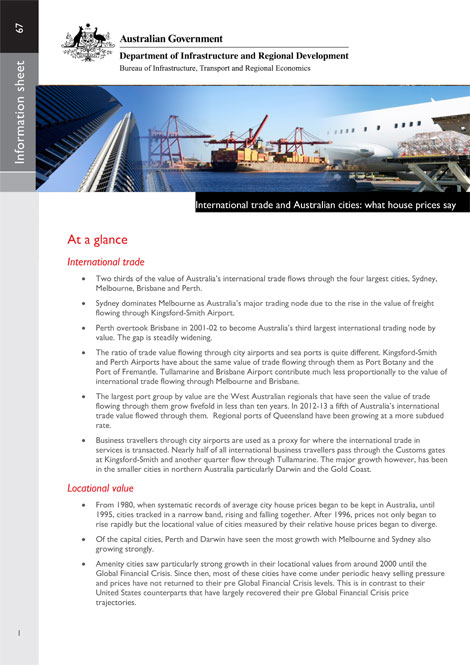
Information Sheet 67 opens with a brief discussion on recent insights into Australian international trade, particularly ways to better measure its real value. It then looks at the changes in the value of international trade flowing through individual sea and airports. Changes in locational value from 1992–2014 are then presented for each city. The relationship between trade patterns and locational values are then tested mathematically.
- International trade and Australian cities: what house prices say
Australian infrastructure statistics—Yearbook 2014 and key Australian infrastructure statistics booklet
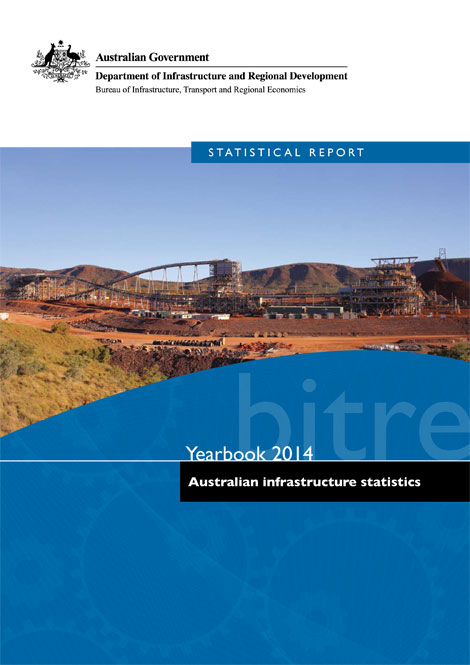
The Yearbook provides a comprehensive evidence base to examine long-term and emerging trends as well as inform policy development and regulatory reform in the transport, energy, water and communications sectors. It is the only comprehensive source of time series statistics for Australia's major areas of economic infrastructure. The Yearbook is accompanied by the Key Australian Infrastructure Statistics booklet which is a summary of statistics from the Yearbook.
- Yearbook 2014–Australian Infrastructure Statistics
- Key Australian Infrastructure Statistics
- Australian Infrastructure Statistics
Yearbook 2014
Part I–Infrastructure and the Economy
- Australian Infrastructure Statistics
Yearbook 2014
Part T–Transport
- Australian Infrastructure Statistics
Yearbook 2014
Part E–Energy
- Australian Infrastructure Statistics
Yearbook 2014
Part C–Communication
- Australian Infrastructure Statistics
Yearbook 2014
Part W–Water
Major transport employment hubs
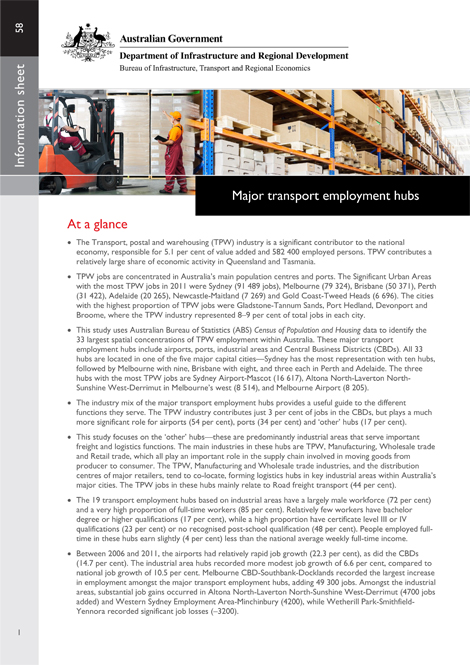
This Information Sheet identifies the 33 largest spatial concentrations of transport industry employment within Australia. These major transport employment hubs are all located within the five most populous capital cities and include airports, ports, CBDs and a range of industrial areas. This study presents evidence on the number of jobs located in each of these transport employment hubs, the industry mix of those jobs, and the characteristics of workers in each location. In particular, it focuses on investigating the nature of employment in the industrial area hubs, many of which serve important freight and logistics functions.
- Major transport employment hubs
National profile of Transport, postal and warehousing workers
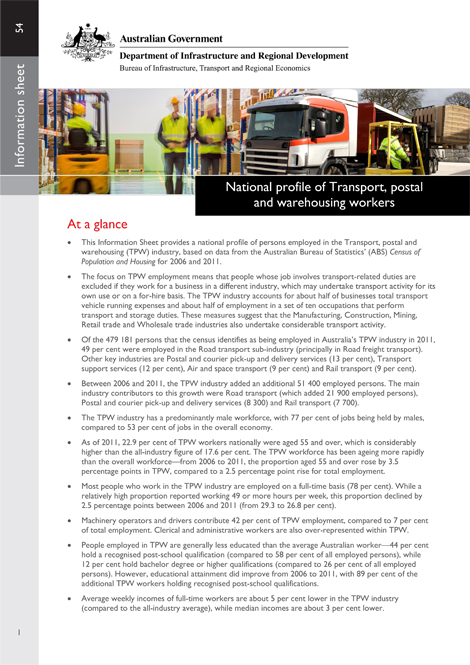
This study aims to improve understanding of the current characteristics of the Transport, postal and warehousing (TPW) workforce and how the workforce is evolving over time. It provides details of the sub-industries in which TPW workers are employed, their hours worked, gender, age, occupation, educational qualifications, income and commuting behaviour. It also describes some of the key changes that occurred between 2006 and 2011, such as the ageing and upskilling of the TPW workforce.
- National profile of Transport, postal and warehousing workers
Ports: job generation in the context of regional development
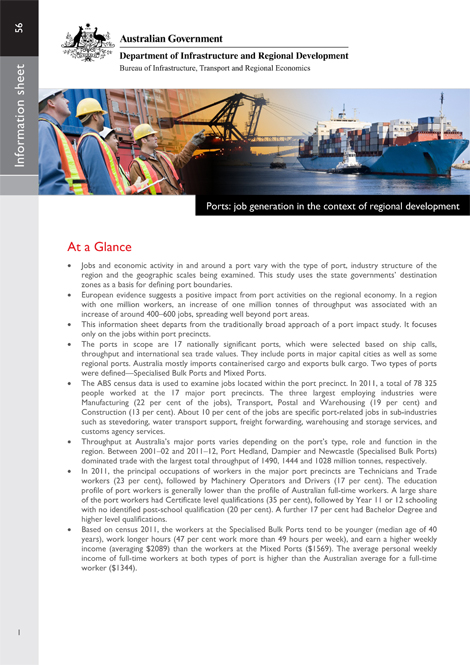
This paper presents recent evidence on jobs at Australian ports, based on ABS Census of Population and Housing data. It examines 17 major ports that are of national economic significance, based on the level of activity as measured by ship visits, throughput and the value of trade. It presents the number of jobs located at port precinct, the industry structure, median age, educational qualifications and skill mix of that employment.
- Ports: job generation in the context of regional development
The evolution of Australian towns

This is a historical, economic analysis of change in Australian settlement patterns over a century. Towns have been subject to significant economic, social and technological changes since 1911. This report examines how Australia's town settlement patterns reacted to that change and examines the underlying factors and processes involved. It examines the interacting effects of geography, history, goods and services markets, industry, amenity and investment. The analysis reveals the important roles of competition, existing infrastructure, improved technology, longer life expectancy and increased wealth. It concludes that a stronger focus on amenity and services are likely potential success factors for modern towns.
- The evolution of Australian towns–full report
- Preliminaries
- Executive Summary
- Chapter 1
- Chapter 2
- Chapter 3
- Chapter 4
- Chapter 5
- Chapter 6
- Chapter 7
- Chapter 8
- Chapter 9
- Chapter 10
- Chapter 11
- Chapter 12
- Appendix A
- Appendix B
- Appendix C
- Appendix D
- Appendix E
- Abbreviations and references
Population growth, jobs growth and commuting flows—a comparison of Australia's four largest cities
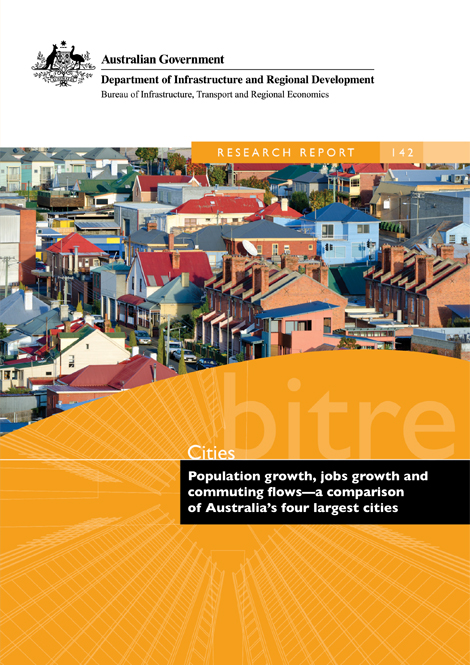
This is the first comparative study of spatial changes in population, jobs and commuting patterns within Australia's largest cities. It focuses on recent patterns of change in Sydney, Melbourne, Brisbane and Perth, while also presenting an overview of change in other capital cities and regional cities between 2001 and 2011. The report identifies some common trends and differences across the cities, and investigates the extent to which these recent spatial changes match up to the stated strategic planning goals for the four largest cities.
- Population growth, jobs growth and commuting flows–a comparison of Australia's four largest cities
Australian infrastructure statistics—Yearbook 2013 and Key Australian infrastructure statistics booklet
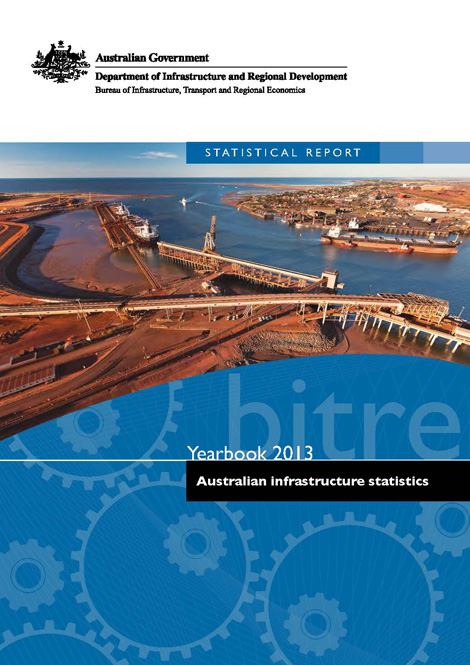
The Yearbook is an important piece of work for the Department and provides a comprehensive evidence base to examine long-term and emerging trends as well as inform policy development and regulatory reform in the transport, energy, water and communications sectors. It is the only comprehensive source of time series statistics for Australia's major areas of economic infrastructure. The Yearbook is accompanied by the first Key Australian Infrastructure Statistics booklet which is a summary of statistics from the Yearbook.
- Yearbook 2013–Australian Infrastructure Statistics
- Key Australian Infrastructure Statistics
- Australian Infrastructure Statistics
Yearbook 2013
Part 1–Infrastructure and the Economy
- Australian Infrastructure Statistics
Yearbook 2013
Part T–Transport
- Australian Infrastructure Statistics
Yearbook 2013
Part E–Energy
- Australian Infrastructure Statistics
Yearbook 2013
Part C–Communication
- Australian Infrastructure Statistics
Yearbook 2013
Part W–Water