
Ports: job generation in the context of regional development
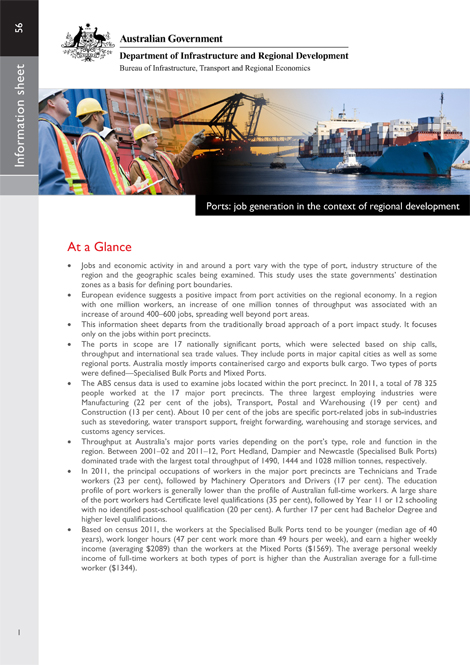
This paper presents recent evidence on jobs at Australian ports, based on ABS Census of Population and Housing data. It examines 17 major ports that are of national economic significance, based on the level of activity as measured by ship visits, throughput and the value of trade. It presents the number of jobs located at port precinct, the industry structure, median age, educational qualifications and skill mix of that employment.
- Ports: job generation in the context of regional development
Waterline 53—January 2014
Waterline reports on trends in throughput, container handling productivity on the waterfront and landside of ports in Australia and the cost of importing and exporting containers. It covers the unloading of container ships and the transport of containers from container terminals. In Waterline 53, the format of the report has been revised and several new productivity measures have been introduced following consultation with industry. This issue covers port terminal activity up to the June quarter 2013.
Container and Ship Movements Through Australian Ports: 2007–08 to 2029–30, Preliminary Estimates
Paper given to the 31st Australasian Transport Research Forum, 2 October–3 October 2008, Gold Coast. Authors: Godfrey Lubulwa, Rob Bolin, Ben Slatter, Tony Carmody
- Container and Ship Movements Through Australian Ports: 2007–08 to 2029–30, Preliminary Estimates
Australian sea port activity to 2029–30
Paper given to the 32nd Australasian Transport Research Forum, 29 September–1 October 2009, Auckland.Authors: Godfrey Lubulwa, Rob Bolin and Anatoli Lightfoot.
- Australian Sea Port Activity to 2029–30
An Investigation of Best Practice Landside Efficiency at Australian Container Ports
Paper given to the 34th Australasian Transport Research Forum, 28–30 September 2011, Adelaide. Authors: Godfrey Lubulwa, Adam Malarz, Shun Peng Wang.
- An Investigation of Best Practice Landside Efficiency at Australian Container Ports
Port Pirie: Economic Evaluation of Harbour Improvements
This report examines in detail the proposal to deepen and widen the entrance channel and harbour of Port Pirie. Not only is this the major port for Broken Hill lead and zinc concentrates and refined metals, but it also handles a considerable volume of wheat and barley exports.
Of the various benefits identified from the work, only two have been found to be substantial in economic terms.
These are the possibility of utilising to full capacity the somewhat larger bulk carriers for bulk concentrate exports and similarly, the possibility of fully loading wheat export ships so that they would not require topping up at deep water ports.
- Port Pirie: Economic Evaluation of Harbour Improvements
Provision of General Cargo Facilities at the Port of Darwin
This study investigates evaluates the various options that could be taken in improving port facilities in Darwin, with particular reference to the impact of Cyclone Tracy.
- Provision of General Cargo Facilities at the Port of Darwin
Demand for Sea Passenger Transport between Tasmania and the Australian Mainland
This Report was prepared in response to a Ministerial reference to the Bureau relating to an investigation of the demand for sea passenger transport between Tasmania and the mainland.
- Demand for Sea Passenger Transport between Tasmania and the Australian Mainland
Regression Analysis of Ship Characteristics
This Paper presents the results of statistical analyses of ship characteristics which have been undertaken to provide input to models of ship costs and operations in particular trades. Standard least squares regressions were performed on the data to relate particular ship characteristics to deadweight. Deadweight was selected as the common denominator for the regressions because of its universal acceptance as a measure of ship size and because of its wide use in the reporting of statistical information.
- Regression Analysis of Ship Characteristics
Cargo Centralisation in the Overseas Liner Trade
With the introduction of cellular container ships in the overseas liner trades, cargo which had traditionally been handled at many ports around Australia was centralised on a few major ports. This change had had a substantial impact on port activity, utilisation of existing facilities, waterside employment and land transport activity.
This report presents the results of a study to determine whether existing cargo centralisation arrangements minimise total transport resource costs and to explore the potential for change.
- Cargo Centralisation in the Overseas Liner Trade