
Petrol Prices and Diesel Prices in Australia
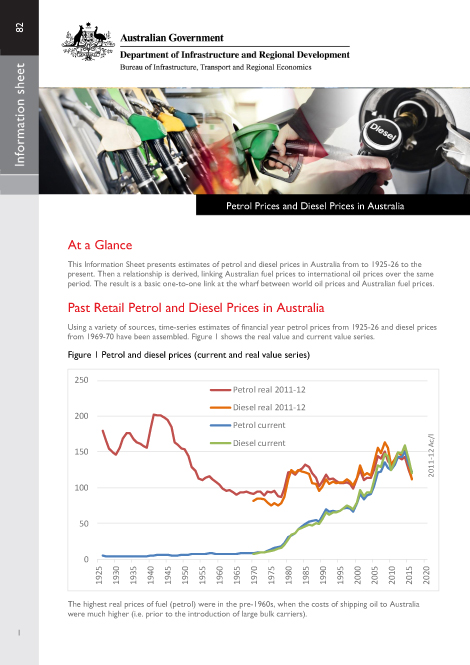
This information sheet presents estimates of petrol and diesel prices in Australia from 1925-26 to the present. Then a relationship is derived, linking Australian fuel prices to international oil prices over the same period. The result is a basic one-to-one link at the wharf between world oil prices and Australian fuel prices.
- Petrol Prices and Diesel Prices in Australia
Australian Infrastructure Statistics—Yearbook 2016
The Australian infrastructure statistics yearbook provides a comprehensive evidence base to examine long-term and emerging trends as well as inform policy development and regulatory reform in the transport, energy, water and communications sectors. It is the only comprehensive source of time series statistics for Australia's major areas of economic infrastructure. The yearbook is accompanied by the Key Australian Infrastructure Statistics Booklet which is a summary of statistics from the yearbook.
- Yearbook 2016–Australian Infrastructure Statistics
- Key Australian Infrastructure Statistics 2016
- Australian Infrastructure Statistics
Yearbook 2016
Part I–Infrastructure and the Economy
- Australian Infrastructure Statistics
Yearbook 2016
Part T–Transport
- Australian Infrastructure Statistics
Yearbook 2016
Part E–Energy
- Australian Infrastructure Statistics
Yearbook 2016
Part C–Communication
- Australian Infrastructure Statistics
Yearbook 2016
Part W–Water
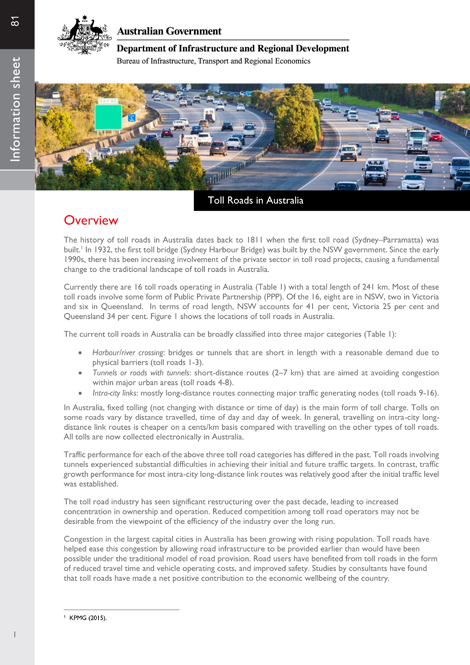
This paper provides an overview of toll roads in Australia based on available information. It covers a range of subjects including information on traffic performance, industry structure and benefits of toll roads and future challenges.
- Toll Roads in Australia
A dozen facts about transport in Australia
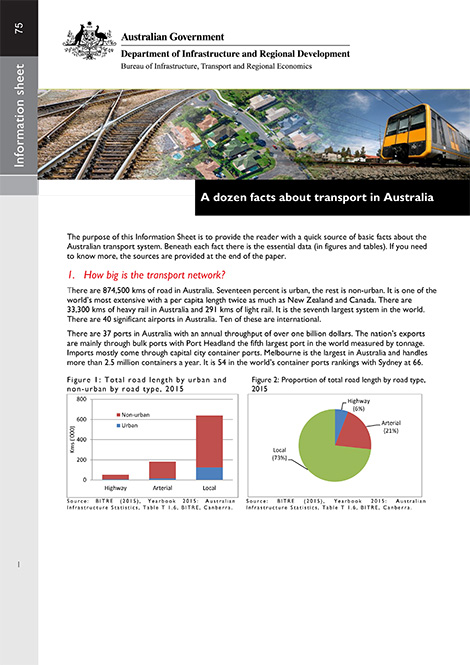
This information sheet covers a wide range of subjects, including commuting, freight, rail, energy and safety. The following 12 facts are included:
- How big is the transport network?
- How far do we travel?
- Is this increasing?
- How do we travel?
- Are we changing how we travel?
- Why do we travel like this?
- What about freight?
- Is freight transport increasing?
- Are we commuting longer?
- How do we pay for transport?
- Is transport becoming more energy efficient and causing less emissions? and
- Is transport safety improving?
- A dozen facts about transport in Australia
Five facts about commuting in Australia
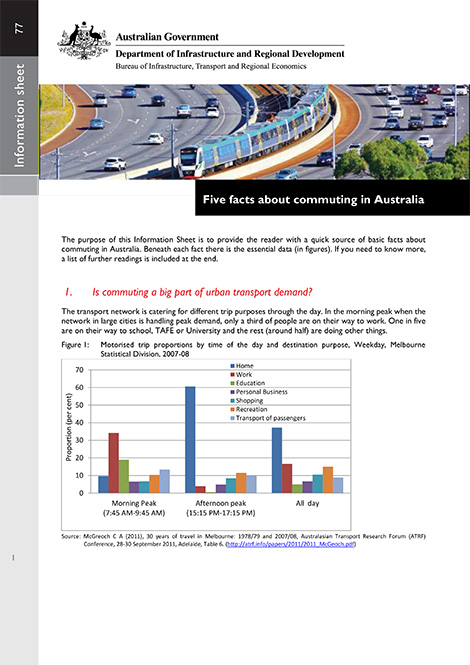
This Information Sheet covers a wide range of subjects, including volume and length of commuting, traffic congestion and commuting patterns. The following five questions are discussed:
- Is commuting a big part of urban transport demand?
- Is it true that a lot of people are spending hours stuck in traffic?
- What has an Italian physicist got to do with commuting?
- Why do some people commute longer? and
- Are our commuting patterns changing?
- Five facts about commuting in Australia
The research provides a solid evidence-base to understand who is undertaking lengthy commutes (those longer than 45 minutes one way), their prevalence and trends. It also explores whether some individuals undertake lengthy commutes for long periods or whether it tends to be temporary.
- Lengthy commutes in Australia
- Data figures from report 144
Australian infrastructure statistics—Yearbook 2015 and key Australian infrastructure statistics booklet 2015
The Yearbook provides a comprehensive evidence base to examine long-term and emerging trends as well as inform policy development and regulatory reform in the transport, energy, water and communications sectors. It is the only comprehensive source of time series statistics for Australia's major areas of economic infrastructure. The Yearbook is accompanied by the key Australian infrastructure statistics booklet which is a summary of statistics from the Yearbook.
- Yearbook 2015–Australian Infrastructure Statistics
- Key Australian Infrastructure Statistics 2015
- Australian Infrastructure Statistics
Yearbook 2015
Part I–Infrastructure and the Economy
- Australian Infrastructure Statistics
Yearbook 2015
Part T–Transport
- Australian Infrastructure Statistics
Yearbook 2015
Part E–Energy
- Australian Infrastructure Statistics
Yearbook 2015
Part C–Communication
- Australian Infrastructure Statistics
Yearbook 2015
Part W–Water
Traffic and congestion cost trends for Australian capital cities
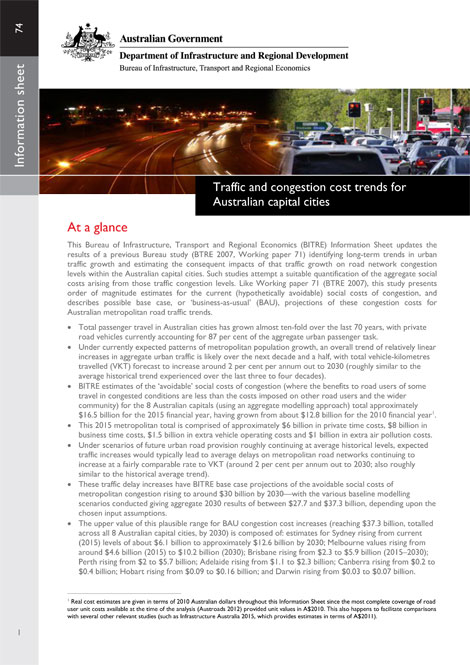
The avoidable cost of congestion for the Australian capital cities is estimated to be around $16.5 billion for the 2015 financial year, having grown from about $12.8 billion for 2010. BITRE 'business-as-usual' projections of these costs of metropolitan congestion rise to around $30 billion by 2030–with the various modelling scenarios conducted giving aggregate 2030 results of between $27.7 and $37.3 billion, depending upon the chosen assumptions.
- Traffic and congestion cost trends for Australian capital cities
- VKT and Summary Cost Data
Australia's commuting distance: cities and regions
The 2011 average commuting distances reflect recent evidence on commuting from home to a place of work at a range of spatial classifications or localities. The main interest is in understanding the patterns and average commuting distances under current land use and availability of transport infrastructure.
- Australia's commuting distance: cities and regions
Transport infrastructure and land value uplift
Users of the transport network are not its only beneficiaries. Land owners can also gain as increased value flows along the network are capitalised into land. Value uplift financing attempts to capture a portion of this by levying the landholders in the catchment areas of new infrastructure. The main problem with this system is that is very difficult to localise benefits in a network. This has led some to propose a broad based land tax instead.
- Transport infrastructure and land value uplift