
The evolution of Australian towns
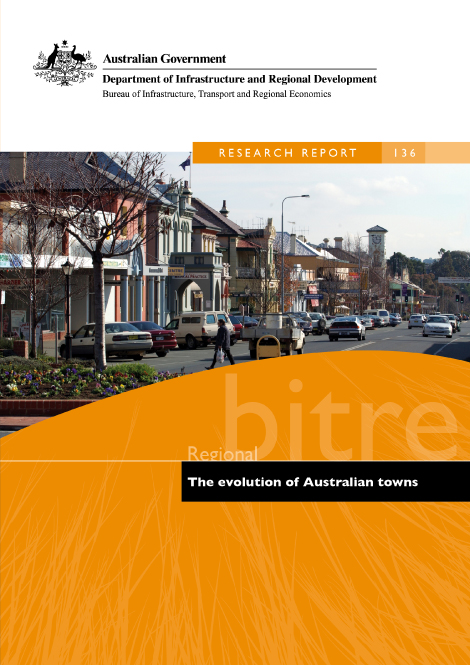
This is a historical, economic analysis of change in Australian settlement patterns over a century. Towns have been subject to significant economic, social and technological changes since 1911. This report examines how Australia's town settlement patterns reacted to that change and examines the underlying factors and processes involved. It examines the interacting effects of geography, history, goods and services markets, industry, amenity and investment. The analysis reveals the important roles of competition, existing infrastructure, improved technology, longer life expectancy and increased wealth. It concludes that a stronger focus on amenity and services are likely potential success factors for modern towns.
- The evolution of Australian towns–full report
- Preliminaries
- Executive Summary
- Chapter 1
- Chapter 2
- Chapter 3
- Chapter 4
- Chapter 5
- Chapter 6
- Chapter 7
- Chapter 8
- Chapter 9
- Chapter 10
- Chapter 11
- Chapter 12
- Appendix A
- Appendix B
- Appendix C
- Appendix D
- Appendix E
- Abbreviations and references
Population growth, jobs growth and commuting flows—a comparison of Australia's four largest cities
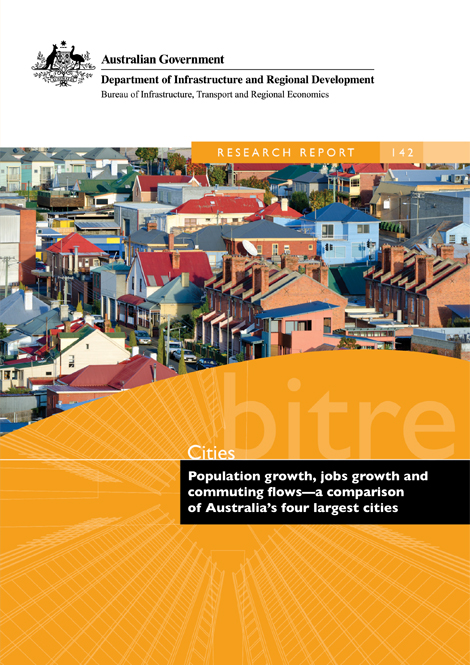
This is the first comparative study of spatial changes in population, jobs and commuting patterns within Australia's largest cities. It focuses on recent patterns of change in Sydney, Melbourne, Brisbane and Perth, while also presenting an overview of change in other capital cities and regional cities between 2001 and 2011. The report identifies some common trends and differences across the cities, and investigates the extent to which these recent spatial changes match up to the stated strategic planning goals for the four largest cities.
- Population growth, jobs growth and commuting flows–a comparison of Australia's four largest cities
Australian infrastructure statistics—Yearbook 2013 and Key Australian infrastructure statistics booklet
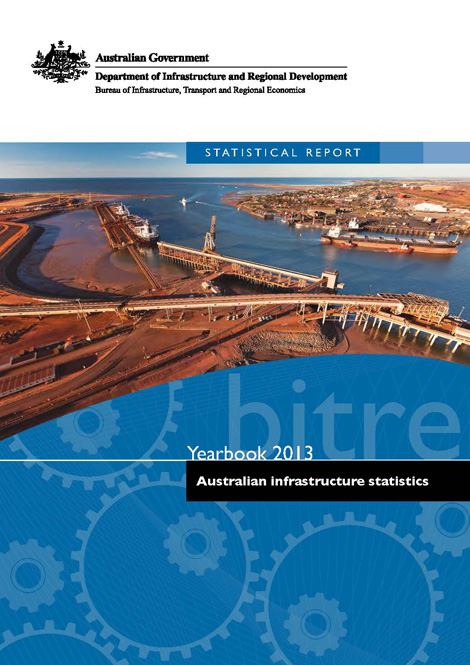
The Yearbook is an important piece of work for the Department and provides a comprehensive evidence base to examine long-term and emerging trends as well as inform policy development and regulatory reform in the transport, energy, water and communications sectors. It is the only comprehensive source of time series statistics for Australia's major areas of economic infrastructure. The Yearbook is accompanied by the first Key Australian Infrastructure Statistics booklet which is a summary of statistics from the Yearbook.
- Yearbook 2013–Australian Infrastructure Statistics
- Key Australian Infrastructure Statistics
- Australian Infrastructure Statistics
Yearbook 2013
Part 1–Infrastructure and the Economy
- Australian Infrastructure Statistics
Yearbook 2013
Part T–Transport
- Australian Infrastructure Statistics
Yearbook 2013
Part E–Energy
- Australian Infrastructure Statistics
Yearbook 2013
Part C–Communication
- Australian Infrastructure Statistics
Yearbook 2013
Part W–Water
Population growth, jobs growth and commuting flows in South East Queensland
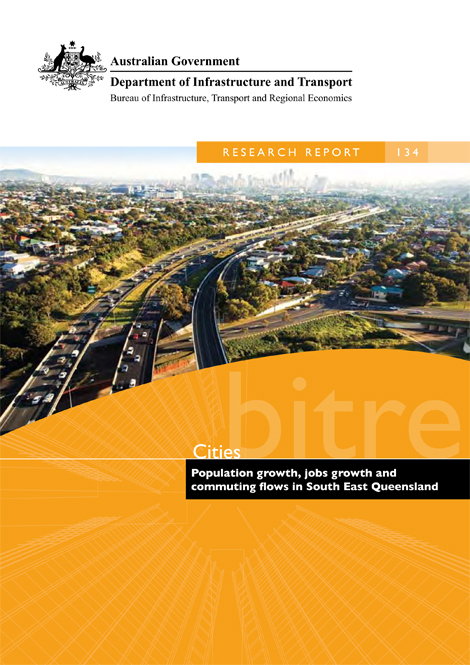
The South East Queensland report discusses changes in the geography of population and employment and the impacts on commuting, with a view to providing a solid evidence base about the trends that have been shaping the region in recent years. The analysis focuses on changes between 2001 and 2011 (wherever data is available). Further, it explores changes at a range of geographical scales to convey an understanding of the overarching patterns as well as some of the finer details. It also investigates the trends in relation to the relevant strategic planning goals.
- Population growth, jobs growth and commuting flows in South East Queensland
Public transport use in Australia's capital cities, Modelling and forecasting
This report allows understanding on forecasting of city passenger travel by motor vehicles and urban public transport. It will aid planning and policy development regarding urban public transport and motor vehicle traffic in cities.
- Public transport use in Australia's capital cities, Modelling and forecasting
Employment Generation and Airports
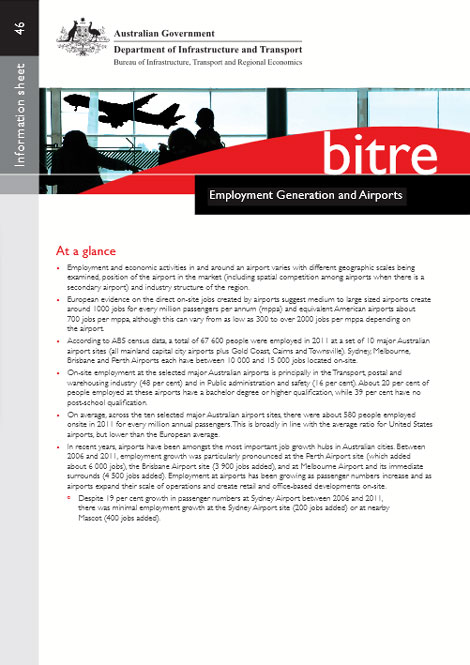
This information sheet provides evidence about the relationship between airport infrastructure and economic activity. It draws together evidence from the international literature and evidence for major Australian airports. It presents estimates of the number of jobs located at major Australian airports in 2011, the industry structure and skill mix of that employment, and recent growth in employment based on the ABS Census of Population and Housing.
- Employment Generation and Airports
Population growth, jobs growth and commuting flows in Sydney
The Sydney report discusses changes in the geography of population and employment and the impacts on commuting. It also investigates the trends in relation to the relevant strategic planning goals. The analysis focuses on changes between 2001 and 2010 (wherever data is available). It explores changes at a range of geographical scales to convey an understanding of the overarching patterns as well as some of the finer details.
- Population growth, jobs growth and commuting flows in Sydney
Australian infrastructure statistics—Yearbook 2012
The Australian Infrastructure Statistics Yearbook provides a single comprehensive source of Australian infrastructure time series statistics for measures of transport, energy, communications and water infrastructure and the use of this infrastructure in Australia. Statistics are presented in a coherent framework that enables comparisons across the four forms of infrastructure and the activities associated with each form of infrastructure.
- Australian Infrastructure Statistics–Yearbook 2012
- Australian Infrastructure Statistics Yearbook 2012
Part I–Infrastructure and the Economy
- Australian Infrastructure Statistics Yearbook 2012
Part T–Transport
- Australian Infrastructure Statistics Yearbook 2012
Part E–Energy
- Australian Infrastructure Statistics Yearbook 2012
Part C–Communication
- Australian Infrastructure Statistics Yearbook 2012
Part W–Water
Understanding Australia's urban railways
Understanding Australia's Urban Railways provides an overview of the urban passenger and freight railways in Sydney, Melbourne, Brisbane, Perth and Adelaide. For passenger rail, the report explores service provision; patronage trends; recent and planned network expansion; and the key challenges facing each system. In addition, the report examines the main characteristics of each city's rail freight network including: the extent of the freight/passenger rail interface; recent and planned network expansion; and the principal freight task on each system.
- Understanding Australia's urban railways
Commuting to Work by Private Vehicle in Melbourne: Trends and Policy Implications
Paper given to the 33rd Australasian Transport Research Forum, 29 September–1 October 2010, Canberra. Authors: Hema de Silva, Anatoli Lightfoot.
- Commuting to Work by Private Vehicle in Melbourne: Trends and Policy Implications