
Road construction cost and infrastructure procurement benchmarking: 2017 update
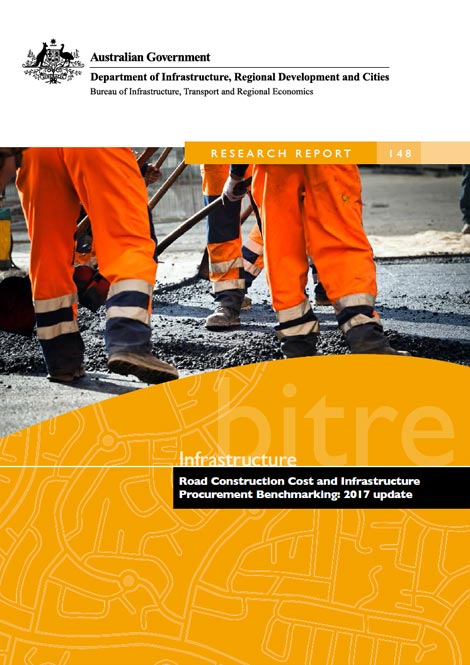
This report benchmarks the costs of road construction and the timeliness of infrastructure procurement processes for projects undertaken by states and territories since 2015. BITRE undertook the analysis under the guidance of the Infrastructure Working Group of the Transport and Infrastructure Council. Road construction costs include total project costs and key cost components such as construction and project management. The procurement timeliness benchmarks cover all stages of procurement from the initial notice of the project to financial completion. This report is an update of the Transport and Infrastructure Council's 2015 Infrastructure Benchmarking Report and contributes to the goal of improving value for money in infrastructure investment.
- Road construction cost and infrastructure procurement benchmarking: 2017 update
Ex-post Economic Evaluation of National Road Investment Projects

BITRE undertook two rounds of ex-post evaluations of national road investment projects: one in 2005–2007 and the other in 2014–2016. Available evidence suggests that there is much room for improvement in the quality of Australian road CBAs if they are to be used as an effective tool for ranking options and prioritising projects. The net present value (NPV) was over-estimated by significant margins in some of the selected case study projects. Over-estimation in NPV was largely caused by over-estimation of road user benefits (up to 500 per cent), with the errors mostly coming from travel time cost saving estimates. Inaccurate traffic forecasts and methodology errors were mostly responsible for the over-estimated road user benefits. There was no evidence of systematic cost overruns for the projects selected for ex-post review. Lessons learned include recommendations for improvements in CBA documentation and review, traffic forecasts, and estimation of road user benefits and residual values.
- Ex-post Economic Evaluation of National Road Investment Projects–Volume 1 Synthesis Report
- Ex-post Economic Evaluation of National Road Investment Projects–Volume 2 Case Studies
Greenhouse gas abatement potential of the Australian transport sector—Summary report
In recognition of both the progress of climate science and the need to manage the risks faced by future generations, the majority of the world's governments are implementing programs for the long term reduction of greenhouse gas emissions. Accordingly, the Australian government has committed to an 80 per cent reduction on the 2000 levels of emissions for the Australian economy by 2050.
As the second largest greenhouse gas emission contributing sector in the economy at 16% of national emissions, transport will need to make a significant contribution to the abatement target. The question then arises as to the potential greenhouse gas abatement options available to the sector.
The Australian transport industry, researchers and government have in many cases deep knowledge about the issues of environmental sustainability, and individual transport sector greenhouse gas abatement options. However, that knowledge is fragmented due to the diversity and complexity of transport.
There are existing studies of transport abatement options but they are limited to a narrow subset of the available options. As a consequence no single document is available to provide an overview of the options and potential for abatement in the transport sector. With this background the ARRB Group, BITRE and CSIRO formed the Australian Low Carbon Transport Forum (ALCTF) in July 2011 to bring together knowledge on the options for greenhouse gas abatement in transport and explore how deeply emissions could be cut in the sector.
- Greenhouse gas abatement potential of the Australian transport sector–Summary report
Greenhouse gas abatement potential of the Australian transport sector—Technical report
The Australian Low Carbon Transport Forum (ALCTF) was initiated by a project secretariat comprising ARRB Group, BITRE and CSIRO. It was organised to bring together knowledge on the options for greenhouse gas abatement in transport and explore how deeply emissions could be cut in the sector.
A report describing the main findings of the study has been published under the title Greenhouse gas abatement potential of the Australian transport sector: Summary report.
This current Technical Report is a companion document to the Summary Report, and aims to detail the methodology and results of the ALCTF process. That is, it describes how the estimated levels of abatement were calculated for each of the abatement options considered in the ALCFT workshops, and how the various abatement potentials were aggregated into an estimate for the maximal potential reduction.
- Greenhouse gas abatement potential of the Australian transport sector–Technical report
General Aviation Study
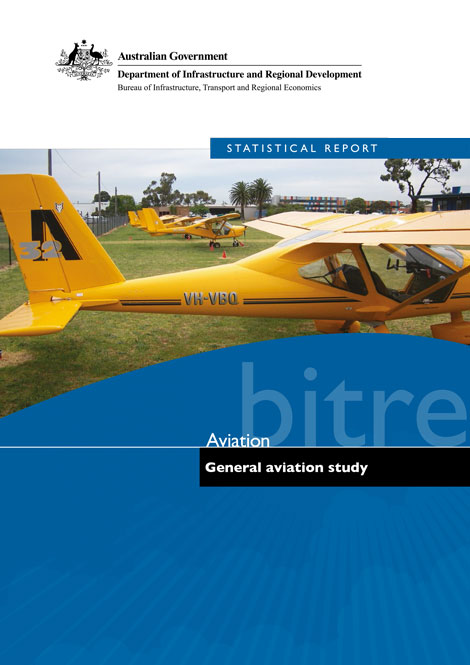
General aviation is a diverse sector that is undergoing change. While overall GA activity appears to be declining slowly, it is not accurate to say that all parts of GA are declining.
Those parts of GA that are discretionary in nature, such as pleasure flying, appear to decline in more conservative economic times, while those parts of GA that are a key part of an expanding industry, such as aerial mustering, have been growing strongly. Detailed economic analysis of these relationships is not currently possible due to the current lack of financial statistics for GA, however this report outlines some of the key challenges facing GA and identifies some key opportunities for the industry and Government to respond to these challenges.
- General Aviation Study
Measuring infrastructure asset performance and customer satisfaction: A review of existing frameworks
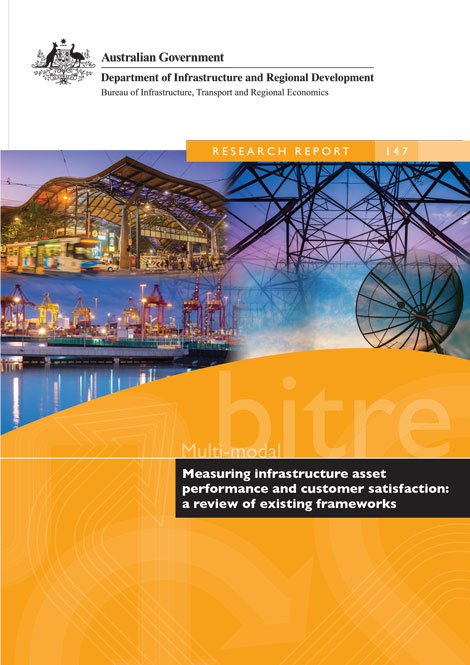
Well-managed, modern and functioning infrastructure underpins much of the economic prosperity of Australia. It is thus crucial that Australia's infrastructure keeps up with the needs of the community.
While some infrastructure asset types, namely public roads and airports, have made significant progress in performance measurement, for others there is a dearth of information or public engagement. The patchwork approach that has resulted means that Australia may be missing out on the potential benefits of consistent and widespread performance measurement: improved accountability, incentivised performance, and better performance evaluation. This report introduces and explores many of the issues surrounding infrastructure performance measurement that should be considered in the context of providing greater consistency across infrastructure asset types.
- Measuring infrastructure asset performance and customer satisfaction: A review of existing frameworks
Costs and benefits of emerging road transport technologies
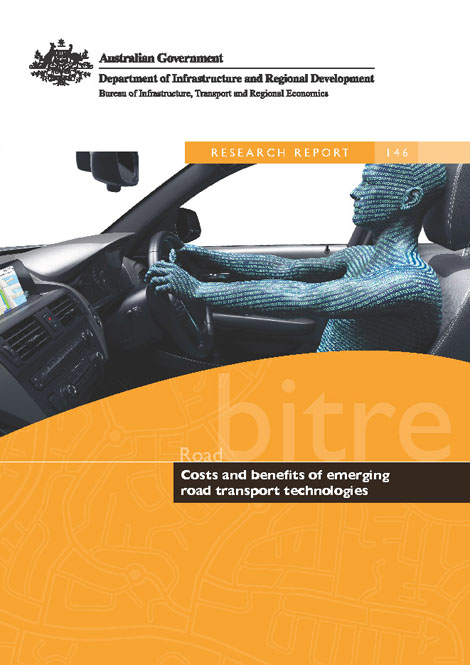
Road transport technologies are evolving rapidly. Recent years have seen the expansion of intelligent transport systems (ITS), such as ramp metering and signal coordination, and low-level vehicle automation. In coming years, communication platforms will connect vehicles, thereby enabling Cooperative-ITS (C-ITS) technologies, such as collision avoidance systems. Car manufacturers and technology companies are actively developing fully automated vehicles. This report summarises estimates of the costs and benefits of ITS, C-ITS and automated vehicles from the existing Australian and international literature. It also provides policy makers with guidance on what further research would improve understanding of the implications of these technologies under Australian conditions.
- Costs and benefits of emerging road transport technologies
Introduction to road economics
Paper prepared for the ANZSOG Infrastructure Research Workshop, Canberra, 2015. Author: Mark Harvey
- Shifting the Transport Infrastructure Debate
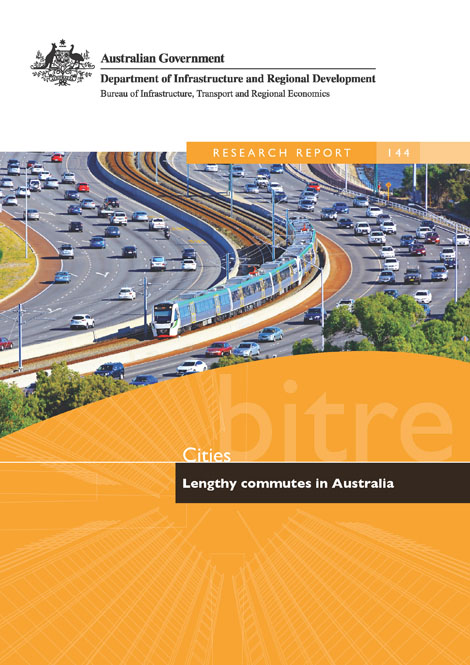
The research provides a solid evidence-base to understand who is undertaking lengthy commutes (those longer than 45 minutes one way), their prevalence and trends. It also explores whether some individuals undertake lengthy commutes for long periods or whether it tends to be temporary.
- Lengthy commutes in Australia
- Data figures from report 144
Why short-haul intermodal rail services succeed
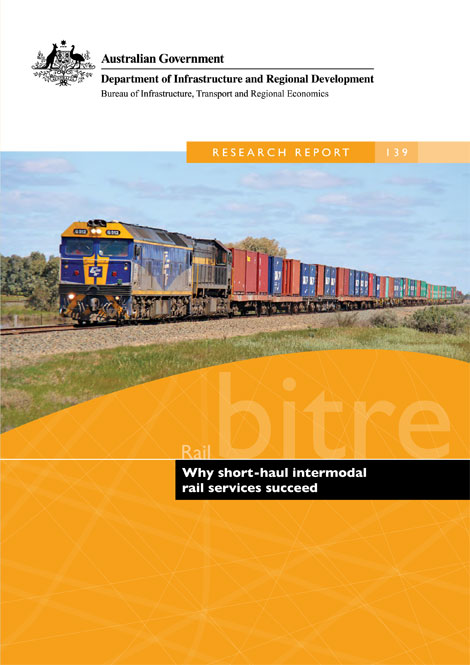
The shipping container has revolutionised freight transport over the last half-century but its success is bringing challenges, not least in landside container movements. Port-induced road traffic congestion impacts on port arteries and communities and undermines port efficiency. Policymakers and planners seek to shift activities from roads to rail. This is a challenge, however, because most of the containers move over short distances, where trains are relatively uncompetitive. Despite that, there are instances where port–hinterland rail services exist. This report analyses the underlying necessary conditions that need to prevail for those rail services to be sustainable.
- Why short-haul intermodal rail services succeed