
Infrastructure benchmarking report
Australian, State and Territory Governments are committed to improving the infrastructure that is critical to efficient, productive and equitable operations of our economy. Achieving this objective requires efficient procurement processes and careful examination of costs to ensure value for money in infrastructure investments. Governments have cooperated to conclude the first national pilot benchmarking of infrastructure procurement processes and construction costs (as recommended by the 2014 Productivity Commission Inquiry into Public Infrastructure and agreed by the Council on 28 August 2014). This report covers the findings of the initial benchmarking and outlines plans for continued and improved future monitoring of infrastructure procurement performance and construction costs.
The analysis was undertaken by the Bureau of Infrastructure, Transport and Regional Economics (BITRE) for the Infrastructure Working Group of the Transport and Infrastructure Council. The report is also available on the Transport and Infrastructure Council website.
- Infrastructure Benchmarking Report
Developing productivity elasticities for estimating WEBs in Australia—Scoping Study
Estimates of Wider Economic Benefits (WEBs) are increasingly featuring in cost-benefit analyses (CBAs) of major urban transport infrastructure projects. Governments are particularly interested in WEBs because they relate to productivity. The parameters used to estimate WEBs in Australia to date have been estimated using methodologies that are inconsistent and not in line with international best-practice. Thus the reliability and comparability of WEBs estimates in Australian CBAs is questionable. The report proposes a way to develop a robust set of parameters for practitioners to use when estimating WEBs.
The report was commissioned by BITRE on behalf of Steering Committee oversighting the Review of the National Guidelines for Transport System Management. If a robust set of parameters can be developed, it will be published in the Guidelines. BITRE engaged consultants KPMG to undertake the task.
- Developing productivity elasticities for estimating WEBs in Australia–Scoping Study
Containerised and non-containerised trade through Australian ports to 2032–33
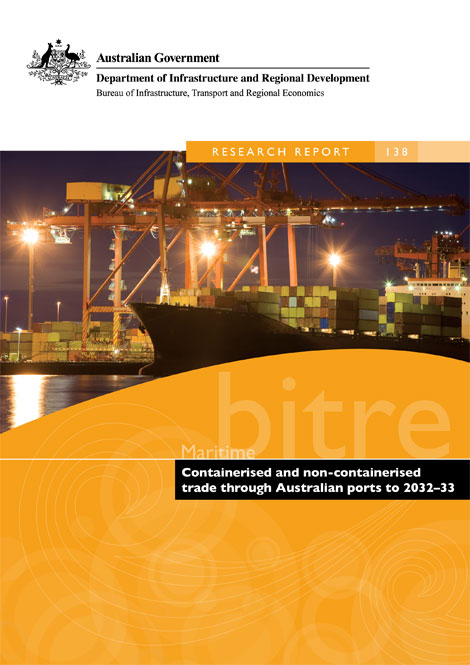
This report presents 20-year forecasts of exports and imports of containerised and non-containerised freight and sea passenger movements through Australia's 5 largest capital city ports and, in aggregation, all other ports. The forecasts, which update those previously published by BITRE in 2002, 2006 and 2010, are driven by population, real income, exchange rates, import prices and export prices. The most recent economic outlook and population growth forecasts for Australia and its major trading partners have been used to derive the forecasts. The forecasts imply that Australia's sea trade will double over the next 20 years, largely due to the continuing positive economic outlook for Australia and its major trading partners. The long-term outlook for the cruise shipping industry is also positive, largely due to the projected economic growth in source countries of cruise passengers, particularly the USA.
Impact of road trauma and measures to improve outcomes
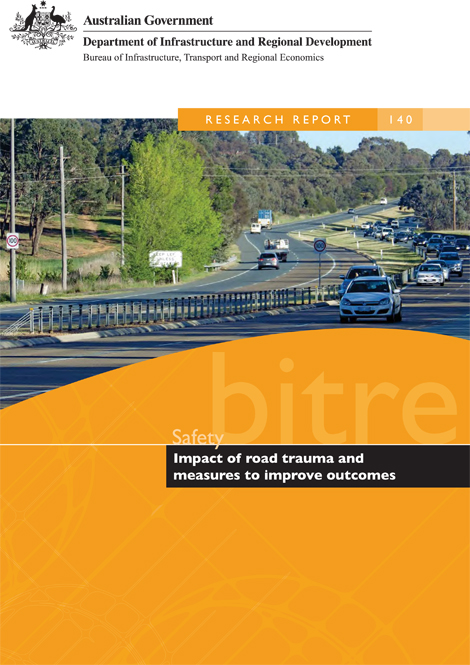
Report 140 presents the results of a BITRE review of the impacts of road trauma. This review evaluated different road safety approaches, both internationally and domestically, and provided a timely stock take of ways that road safety experts believe deaths and serious injuries on our roads can be reduced.
Internationally, the annual number of road deaths fell nearly 40 per cent between 2000 and 2012. However, there has been limited success in saving lives among vulnerable road users, and the share of fatalities among elderly road users is slowly increasing in many countries.
In 2008, International Transport Forum and the Organisation for Economic Co-operation and Development published a research report Towards Zero: ambitious road safety targets and the Safe System approach, which was the first international effort in defining and promoting the adoption by all countries of a Safe System approach.
Australia was amongst the first to adopt a Safe System approach, which underpins the National Road Safety Strategy 2011–2020 (NRSS).
In Australia significant progress has been made towards the NRSS target of a 30 per cent reduction in casualties. While vehicle occupant deaths have trended down, the analysis confirms the relatively high risk for motorcyclists, pedal cyclists, older drivers and remote communities. This, combined with population increases, makes the search for new ways to further reduce road trauma even more challenging.
BITRE has focused on four priorities identified by road safety experts: infrastructure, intersections, distraction from mobile phones, and autonomous emergency braking. The report found:
- Roadside barriers, median barriers and rumble strips reduce road trauma. To maximise road safety benefits they need to be implemented taking account of road conditions.
- Lower speed limits can be a valuable option to help achieve improved road safety outcomes where low traffic volumes mean upgrades are not currently economically justified.
- Intersection treatments can be very effective, with roundabouts particularly effective–reducing casualty crashes by over 70 per cent.
- There is value in a comprehensive mobile phone strategy.
- Autonomous emergency braking will save lives as it is introduced to the vehicle fleet.
The Bureau is grateful for the help of road safety experts who participated in both the survey and workshop to identify new measures with the most potential to further reduce road trauma.
- Impact of road trauma and measures to improve outcomes
A study of the potential for dedicated freight infrastructure in Australia
The National Ports Strategy was developed by Infrastructure Australia (IA) and the National Transport Commission (NTC) in 2010 at the request of the Council of Australian Governments (COAG).
Recommendation 3.10 of the National Ports Strategy is that 'The Bureau of Infrastructure Transport and Regional Economics (BITRE) should assess the conditions under which the introduction of dedicated freight land transport infrastructure segments related to relevant container ports would be justified'. BITRE engaged consultants Ernst & Young to undertake the task.
The project involved a literature search with a review of overseas experiences, stakeholder consultation, identification of potential projects, and rapid cost–benefit and financial analyses of two case study projects to assess their potential viability.
The project concerned access to major Australian container ports only–Sydney, Melbourne, Brisbane, Adelaide and Fremantle. The term 'dedicated freight land transport infrastructure segments' has been interpreted broadly. It encompasses freight-only road and rail segments, tunnels, and lanes, but extends to infrastructure investments with a freight priority, for example, a road open to freight vehicles at all times but open to cars only during peak hours to relieve congestion.
Part A of the report contains the literature review, principles under which dedicated or priority freight infrastructure might be warranted, a survey of the landside access challenges facing major Australian container ports, and identification of potential case studies for further investigation.
Part B consists of the two case studies
- a new road link between the Port of Melbourne precinct and the West Gate Freeway, and
- a new rail link between the Port of Brisbane and the Surat Basin, which would carry coal and containers.
It should be noted that these are concept projects specified for the purposes of the case studies. They are not intended to replicate actual proposals previously or currently under consideration.
- A study of the potential for dedicated freight infrastructure in Australia
Overview of project appraisal for land transport
On 5 September2014, Assistant Minister for Infrastructure and Regional Development, the HonJamie Briggs MP, released for public comment, a proposed project appraisal framework,developed by the Bureau of Infrastructure, Transport and Regional Economics, inconsultation with state and territory governments. BITRE has revised the paperin view of the submissions received. The Assistant Minister released the finalversion on 7 November 2014.
The paper is the outcome of Australian, state and territory governments agreeing to consult todevelop a more sophisticated and consistent framework to assess and evaluatemajor infrastructure projects.
- Overview of project appraisal for land transport
The evolution of Australian towns
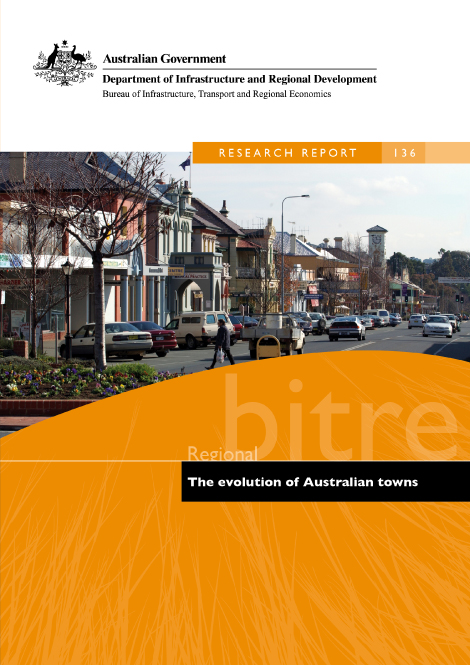
This is a historical, economic analysis of change in Australian settlement patterns over a century. Towns have been subject to significant economic, social and technological changes since 1911. This report examines how Australia's town settlement patterns reacted to that change and examines the underlying factors and processes involved. It examines the interacting effects of geography, history, goods and services markets, industry, amenity and investment. The analysis reveals the important roles of competition, existing infrastructure, improved technology, longer life expectancy and increased wealth. It concludes that a stronger focus on amenity and services are likely potential success factors for modern towns.
- The evolution of Australian towns–full report
- Preliminaries
- Executive Summary
- Chapter 1
- Chapter 2
- Chapter 3
- Chapter 4
- Chapter 5
- Chapter 6
- Chapter 7
- Chapter 8
- Chapter 9
- Chapter 10
- Chapter 11
- Chapter 12
- Appendix A
- Appendix B
- Appendix C
- Appendix D
- Appendix E
- Abbreviations and references
Road safety: modelling a global phenomenon
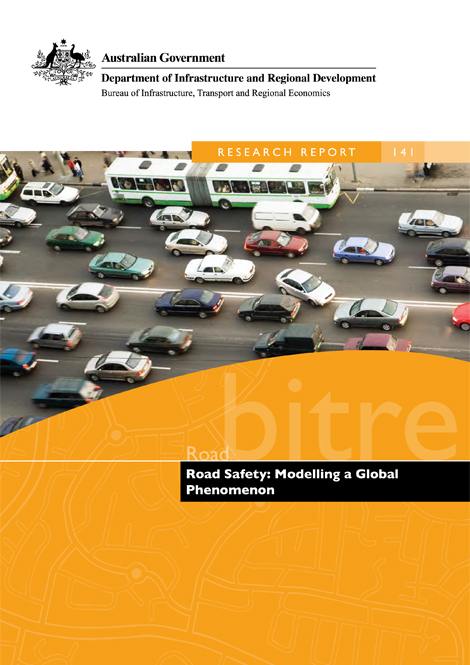
This report provides an overview of the different patterns of road fatality and injury rates in 21 countries, and their determinants.
The main result of the study are models of road fatality rates as a function of seat belt wearing rates, enforcement activities regarding speed (using speed cameras) and alcohol (with random breath testing), and economic influences (principally unemployment). Experience from around the world also shows that laws lowering speed limits and legal blood alcohol limits are effective in saving lives.
- Road safety: modelling a global phenomenon
Population growth, jobs growth and commuting flows—a comparison of Australia's four largest cities
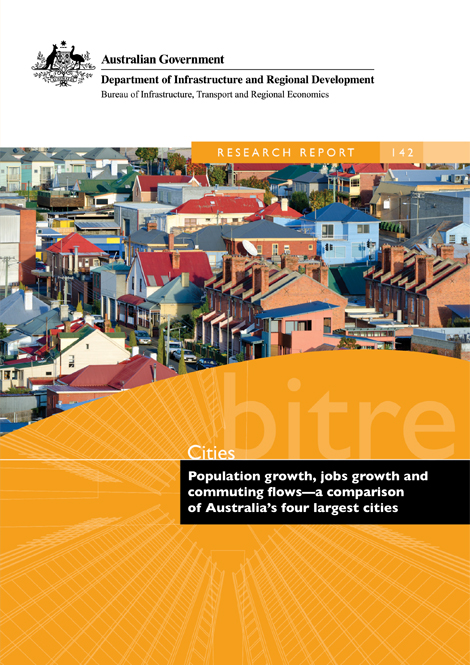
This is the first comparative study of spatial changes in population, jobs and commuting patterns within Australia's largest cities. It focuses on recent patterns of change in Sydney, Melbourne, Brisbane and Perth, while also presenting an overview of change in other capital cities and regional cities between 2001 and 2011. The report identifies some common trends and differences across the cities, and investigates the extent to which these recent spatial changes match up to the stated strategic planning goals for the four largest cities.
- Population growth, jobs growth and commuting flows–a comparison of Australia's four largest cities
The report provides a profile of Australia's principal bulk ports and the logistics chain that delivers commodities through those ports. Efficient logistics are essential for these volumes, requiring substantial investment as well as good co-ordination of the different links in the logistics chain. These factors have been especially important in the last decade, with tonnage rising by over 75%. The report illustrates the tasks performed at each port using the broad range of data and indicators that are published by port authorities and bulk terminal operators.