
Review of the National Cities Performance Framework – Final paper
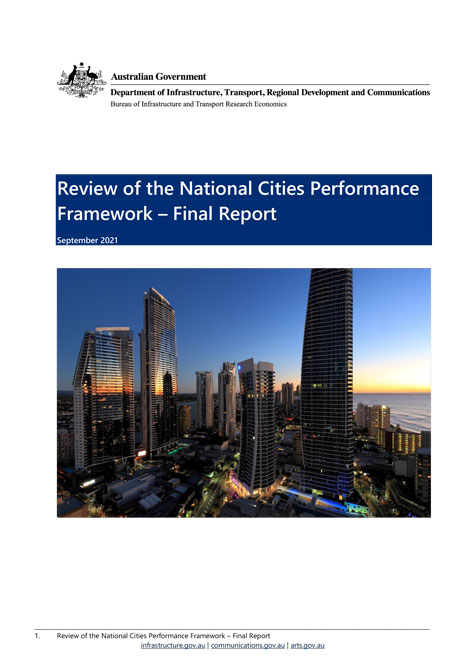
The National Cities Performance Framework (NCPF) was launched in 2017 with the commitment to conduct reviews every 3 years. This report covers the feedback received and the approach for the future of the NCPF. The conclusion of the NCPF review is that alternate departmental data and research products better meet the needs of stakeholders and that the Framework should be phased out. Targeted research will focus on issues of the highest priority to the government and cities’ stakeholders.
Review of the National Cities Performance Framework - Consultation paper
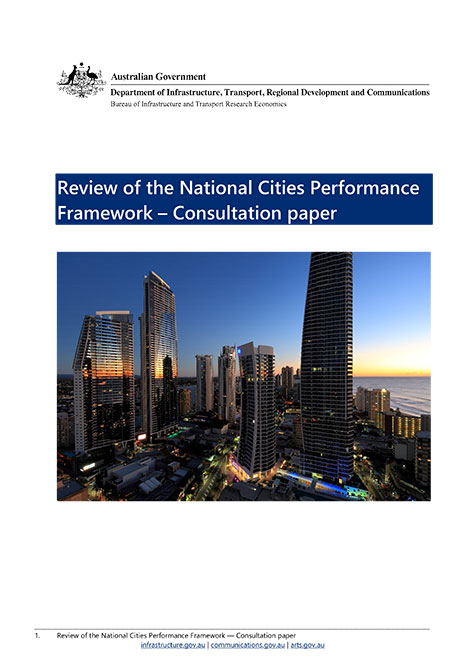
The National Cities Performance Framework (NCPF) was launched in 2017 with the commitment to conduct reviews every 3 years. The first 3 Year Review will examine what improvements can be implemented in the 2021 update and future years. This consultation paper is the start of the public consultation process, conducted over January-February 2021. It details the 3-year review process, the issues being considered, and the proposed approach for each issue. Some of the topics covered include potential new indicators, a review of the geographies, and improving the structure of the framework.
Freight Data Exchange pilot projects—Summary Report 2020
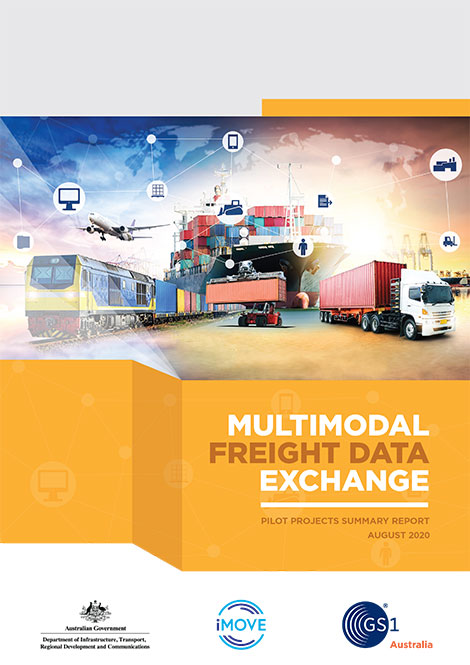
Information technology and data are increasingly essential to modern business operations. The increasing digitalisation of supply chain processes and freight consignment information offers further opportunities to increase the efficiency and productivity of Australian freight supply chains.
For industry, increasing digitalisation can improve visibility of freight consignments and interoperability between supply chain partners, and aid industry in responding to supply chain delays, bottlenecks or errors – and thereby improve overall freight industry efficiency and productivity. For governments and transport planning agencies, the increasing digitalisation of freight supply chain information can potentially provide more timely strategic-level information to help inform planning and investment, and at less cost.
In 2019-20, the Australian Government, in cooperation with iMOVE and selected industry partners, undertook an initial round of Freight Data Exchange pilot projects to investigate, develop and demonstrate the capability for supply chain partners to share freight consignment information in real time and also assess the feasibility of aggregating freight consignment event/message data to produce aggregate outputs that help inform infrastructure planning and policy priorities.
This report briefly outlines some of the key outcomes of the three projects and suggests directions for further work.
The report was produced in collaboration between BITRE and iMOVE Australia, and with the support and assistance of participating industry partners.
Population synthesis for travel demand modelling in Australian capital cities
In this research, the proposed synthesis routine has been used to generate full size synthetic populations of households and individuals for Greater Sydney, Melbourne and Brisbane. Two heuristic algorithms have been formulated for data treatment before and after the synthesis process to improve the representation of the synthesised populations. The procedure proposed for data treatment before the synthesis routine ensures the consistency of the input data, whereas the procedure proposed for data treatment after the synthesis routine extends under-synthesised estimates to a complete synthetic population. The synthesis process was tested for its efficacy and the synthesised populations were validated extensively. This research contributes in setting up a replicable population synthesis routine that can be included into a standard methodological toolbox for transport researchers and mainstream social scientists to produce Australian synthetic populations that is essential to microsimulation analysis.
- Population Synthesis for Travel Demand Modelling in Australian Capital Cities
Population and access to local services
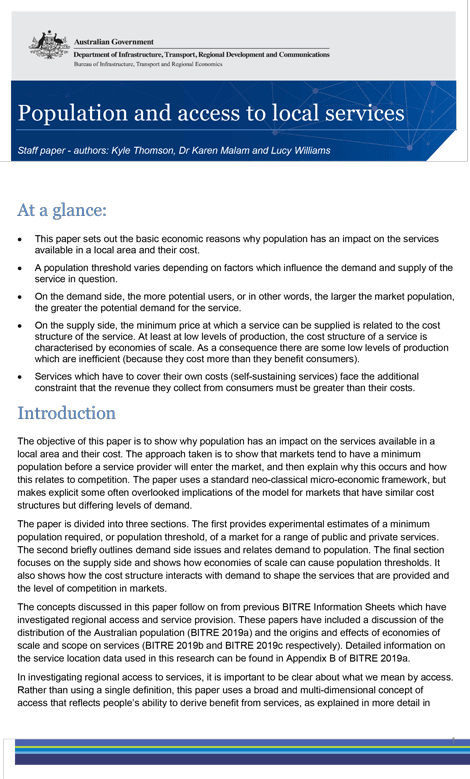
The paper considers the relationship between population and services. The approach taken is to consider the role of population before a service provider will enter a market, and then explain why this occurs and how this relates to competition. This paper applies a standard neo-classical micro-economic framework.
- Population and access to local services
Electric Vehicle Uptake: Modelling a Global Phenomenon
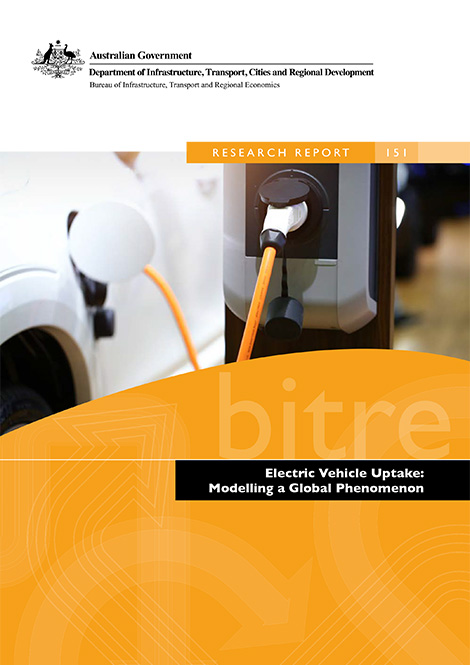
This report describes an approach to estimating likely electric vehicle uptake for each of 22 countries around the world. Models of electric vehicle uptake were derived for Australia, Austria, Belgium, Britain, Canada, China, Denmark, Finland, France, Germany, India, Ireland, Italy, Japan, Korea, the Netherlands, New Zealand, Norway, Spain, Sweden, Switzerland, and the United States (as well as for the 'Rest of Europe').
- Electric Vehicle Uptake: Modelling a Global Phenomenon
- Data
Prices for Petrol and Gasoline—Modelling a Global Phenomenon
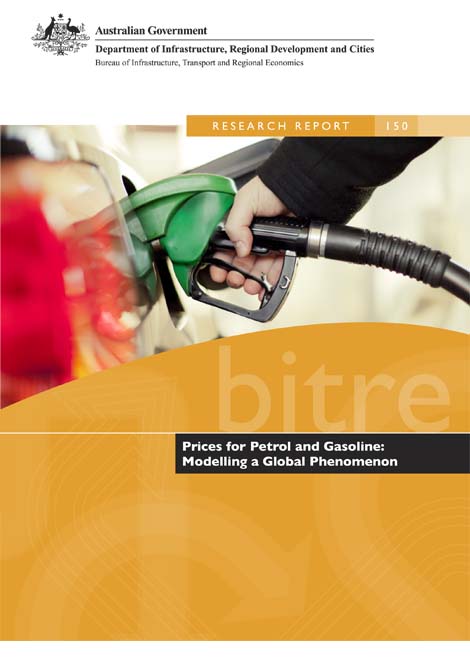
The report models petrol prices in 24 countries around the world - the world oil price determines the energy content of the petrol price, and then adding in taxes produces a prediction of the country's petrol price. The analysis also allows a prediction of how responsive a county's petrol price is to changes in the world oil price.
- Prices for Petrol and Gasoline–Modelling a Global Phenomenon
- World Petrol Prices Model
What are services and who provides them?
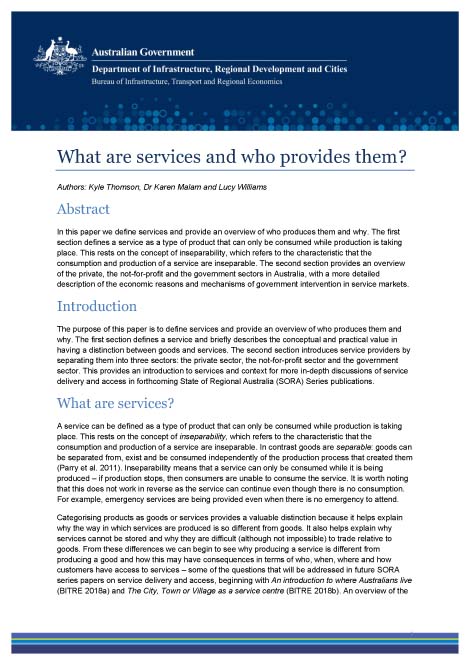
In this paper we define services and provide an overview of who produces them and why. The first section defines a service as a type of product that can only be consumed while production is taking place. This rests on the concept of inseparability, which refers to the characteristic that the consumption and production of a service are inseparable. The second section provides an overview of the private, the not-for-profit and the government sectors in Australia.
- What is Access?
- What is Access?
This paper sets out a framework of access, with a particular focus on access to services. Previous research has examined dimensions of access, often in terms of a particular field and with an emphasis on the consumer. The work of Penchansky and Thomas (1981) has been drawn on for decades, with its 'five As' of access: availability, accessibility, accommodation, affordability and acceptability. In this paper we expand the scope of these access dimensions, consider both the consumer and producer perspectives, and frame the dimensions in terms of a spectrum of accessibility. The framework includes eight dimensions of access: time, space, price, quantity, quality, acceptability, information and awareness.
- What is Access?
- What is Access?
Aviation activity as a leading indicator of economic activity
This study investigates whether data on domestic aviation activity in Australia could be used as an indicator of Australian economic activity–with the view of developing an indicator of regional economic activity should initial tests be successful. Graphical analysis was the predominant method used to test the predictive power of aviation data, which is collected on a monthly basis by the Bureau of Infrastructure, Transport and Regional Economics (BITRE), against Gross Domestic Product (GDP) and employment.
- Aviation activity as a leading indicator of economic activity