
Impact of COVID-19 on petrol prices in Australia
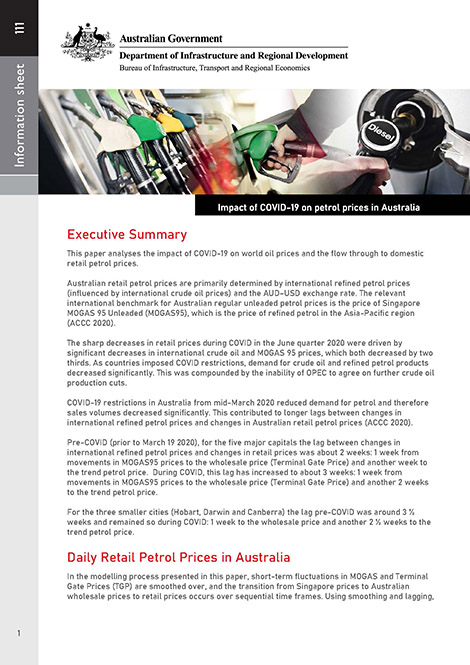
Australian retail petrol prices are primarily determined by international world oil prices and overseas refined petroleum prices, and variations in exchange rates. As a result of COVID-19 restrictions imposed around the wold, demand for crude oil and refined petroleum products decreased significantly from mid-March 2020 onwards, and led to sharp decreases in crude oil and refined product prices.
The analysis presented in this paper outlines the principal components of Australian retail petrol prices, the impact of COVID-19 on weekly petrol prices and also the typically observed time lag between international refined petroleum product prices and domestic retail petrol prices.
Freight route performance under COVID-19
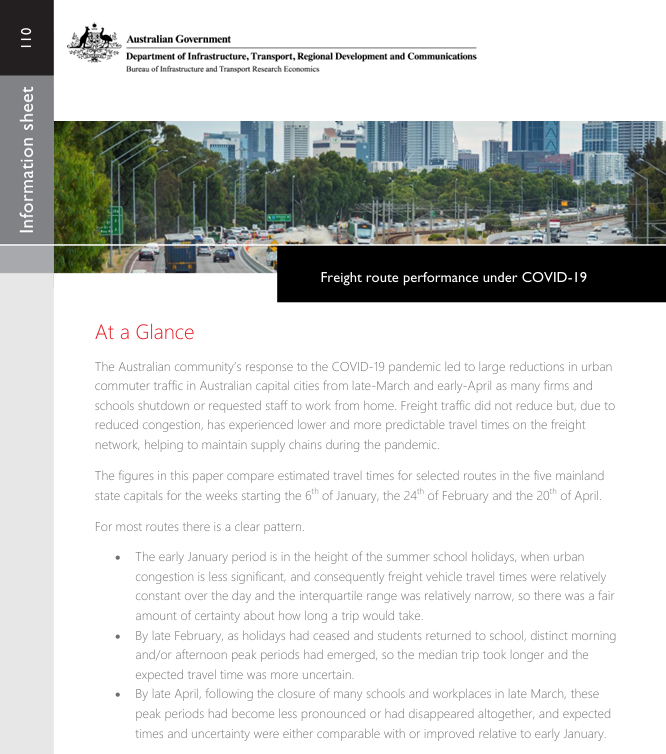
This Information Sheet provides estimates of the impact of the COVID-19 pandemic on freight vehicle travel times for selected routes in Australian major cities in early 2020. The results show that whilst there was no significant change in freight vehicle traffic volumes over that period, freight vehicles experienced shorter and more predictable travel times on many urban freight routes, primarily due to reduced commuting trips. This helped the freight industry to maintain supply chains during the initial stages of the pandemic. The data underlying the estimates is from the BITRE freight telematics program collection, which is sourcing vehicle position data from a small number of road freight operators.
Severe injuries from road crashes—Australia New Zealand Trauma Registry
These data extracts from the Australia New Zealand Trauma Registry provide summary tables of severe injury cases (admitted patients with an Injury Severity Score > 12) from participating hospitals. The report has separate tables for on-road transport, off-road transport, unknown transport and non-transport cases. Data are preliminary and relate to participating hospitals only
These tables are produced under the joint Australian Trauma Registry funding agreement between the Department of Health and the Department of Infrastructure, Transport, Regional Development, Communications and the Arts.
Location and other risk factors in crashes
This information sheet reports results of a study into the risk factors of vehicle crashes given a crash has occurred in terms of whether it results in the death of a person involved. Factors include vehicle type and age, whether a restraint or helmet was worn, nature of crash, time of day and location-specific factors such as the built-up or rural character of an area, the distance to high-care emergency medical facility and environmental conditions i.e. sunrise, sunset or night-time.
- Location and other risk factors in crashes
Modelling Road Safety in Australian States and Territories
This Information Sheet describes modelling of road fatality rates for the eight Australian States and Territories, and fatality and injury rates for Australia as a whole. The models are constructed 1) to allow an understanding of the past forces underlying the fatality rates in each jurisdiction covered, and 2) to allow forecasts of future trends in road safety–or rather its obverse, death and injury.
- Modelling Road Safety in Australian States and Territories
- Modelling Road Safety in Australian States and Territories
Spending by Australian households on owning and operating vehicles in 2015–16
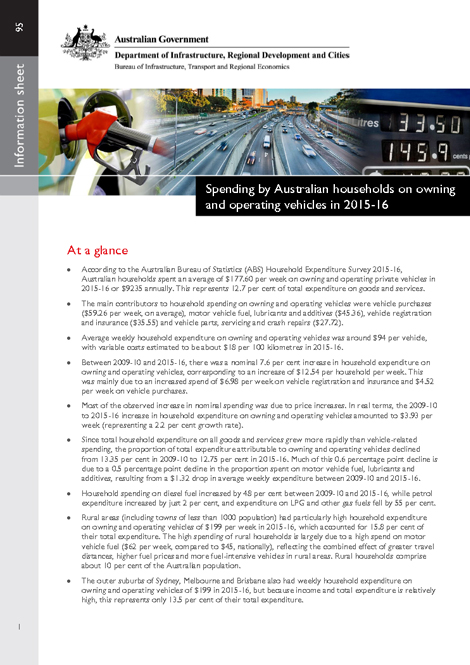
This Information Sheet presents data on Australian households' expenditure patterns, based on the ABS Household Expenditure Survey (HES) for 2015–16. It updates BITRE Information Sheet 86 Spending by Australian households on owning and operating vehicles (BITRE 2017a), which relied on 2009–10 HES data. It details the composition of household expenditure on owning and operating vehicles and explores variation in the incidence of these costs across different types of households, such as capital city and regional households, and high income and low income households. This updated analysis also investigates changes in vehicle-related spending since 2009–10, with the aim of identifying any significant changes that have occurred for particular types of regions or particular demographic groups.
- Spending by Australian households on owning and operating vehicles in 2015–16
Road construction cost and infrastructure procurement benchmarking: 2017 update
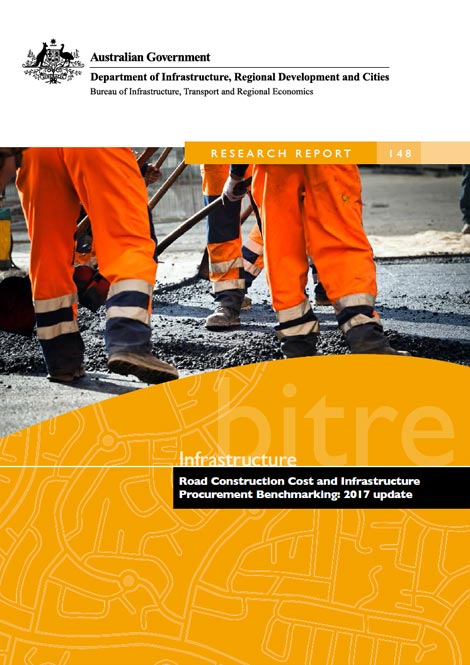
This report benchmarks the costs of road construction and the timeliness of infrastructure procurement processes for projects undertaken by states and territories since 2015. BITRE undertook the analysis under the guidance of the Infrastructure Working Group of the Transport and Infrastructure Council. Road construction costs include total project costs and key cost components such as construction and project management. The procurement timeliness benchmarks cover all stages of procurement from the initial notice of the project to financial completion. This report is an update of the Transport and Infrastructure Council's 2015 Infrastructure Benchmarking Report and contributes to the goal of improving value for money in infrastructure investment.
- Road construction cost and infrastructure procurement benchmarking: 2017 update
Ex-post Economic Evaluation of National Road Investment Projects

BITRE undertook two rounds of ex-post evaluations of national road investment projects: one in 2005–2007 and the other in 2014–2016. Available evidence suggests that there is much room for improvement in the quality of Australian road CBAs if they are to be used as an effective tool for ranking options and prioritising projects. The net present value (NPV) was over-estimated by significant margins in some of the selected case study projects. Over-estimation in NPV was largely caused by over-estimation of road user benefits (up to 500 per cent), with the errors mostly coming from travel time cost saving estimates. Inaccurate traffic forecasts and methodology errors were mostly responsible for the over-estimated road user benefits. There was no evidence of systematic cost overruns for the projects selected for ex-post review. Lessons learned include recommendations for improvements in CBA documentation and review, traffic forecasts, and estimation of road user benefits and residual values.
- Ex-post Economic Evaluation of National Road Investment Projects–Volume 1 Synthesis Report
- Ex-post Economic Evaluation of National Road Investment Projects–Volume 2 Case Studies
Road Safety in Australia–Fact Sheet
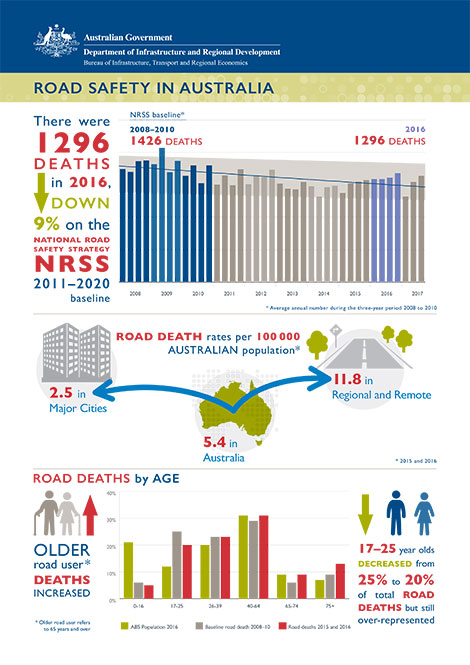
This fact sheet provides key road fatality data for 2015 and 2016, and how some key statistics have changed since the base years (2008 to 2010) of the National Road Safety Strategy 2011–2020.
- Road Safety in Australia–Fact Sheet
Measuring infrastructure asset performance and customer satisfaction: A review of existing frameworks
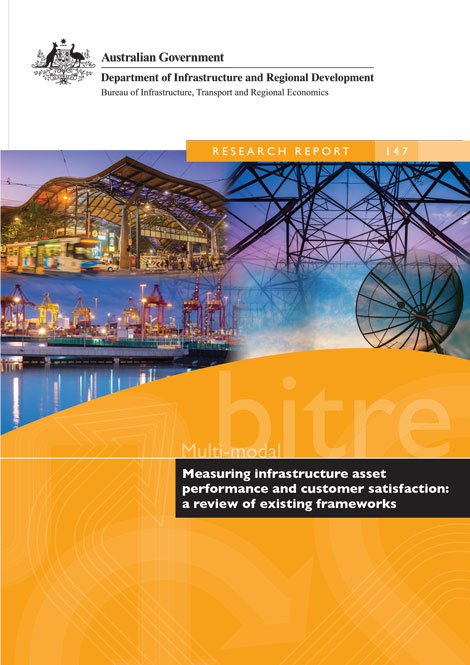
Well-managed, modern and functioning infrastructure underpins much of the economic prosperity of Australia. It is thus crucial that Australia's infrastructure keeps up with the needs of the community.
While some infrastructure asset types, namely public roads and airports, have made significant progress in performance measurement, for others there is a dearth of information or public engagement. The patchwork approach that has resulted means that Australia may be missing out on the potential benefits of consistent and widespread performance measurement: improved accountability, incentivised performance, and better performance evaluation. This report introduces and explores many of the issues surrounding infrastructure performance measurement that should be considered in the context of providing greater consistency across infrastructure asset types.
- Measuring infrastructure asset performance and customer satisfaction: A review of existing frameworks