
The economics of road maintenance
This report discusses the economics of road maintenance. It develops analytical approaches to help ensure that road expenditure is used in the most efficient and cost-effective manner both in terms of dividing funds between construction and maintenance and allocation of maintenance funds between locations, treatment types and treatment timing. The focus is on the impact of timely and adequate maintenance expenditure on the overall costs to society — that is, costs to road agencies, road users and externalities. The analytical approach and case studies demonstrate the potential costs of delayed or deferred maintenance expenditure, which can result in much higher overall costs, reinforcing the adage: ‘a stitch in time save nine’. The report also provides a computer modelling approach to optimising road maintenance expenditure over time so as to minimise the overall cost to society, without and with constraints on road agency spending levels.
Economic Contribution of Transport in Australia, 2020-21
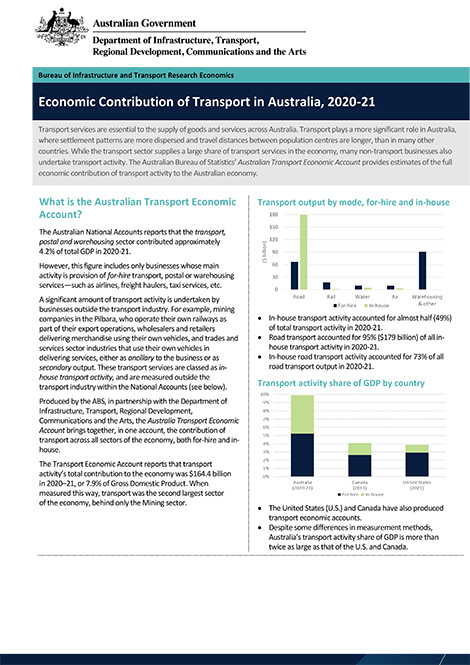
The Australian Bureau of Statistics’ (ABS) Australian Transport Economic Accounts (ATEA) 2020-21 provide estimates of the full economic contribution of transport activity, both for-hire and in-house transport services, to the Australian economy, from 2010-11 to 2020-21.
The ATEA estimates that transport’s total contribution to the economy was $164.4 billion in 2020-21, equivalent to 7.9 per cent of total GDP. Measured in this way, transport was the second largest sector of the economy, behind only the Mining sector.
This release provides a short summary and highlights of the ABS ATEA 2020-21. More detailed ATEA statistics and explanatory notes are available from the ABS website: www.abs.gov.au/statistics/economy/national-accounts/australian-transport-economic-account-experimental-transport-satellite-account
Road Vehicles Australia, January 2023 (Re-issue)
This release provides statistics relating to the number of vehicles registered for road use in Australia on 31st January 2023. The statistics encompass all vehicles that were registered with an Australian state or territory motor vehicle registry for unrestricted use on public roads, and reported by jurisdictions to the National Exchange of Vehicle and Driver Information System (NEVDIS). This is the second annual release of Road Vehicles Australia, which replaces the ABS Motor Vehicle Census, discontinued in 2021. More statistics are available on the BITRE website and data.gov.au.
Freight vehicle congestion in Australia's five major cities – 2022
This publication is the fourth in an annual series that uses vehicle telematics data to provide measures of traffic congestion for freight vehicles for selected routes across Australia’s five mainland state capital cities—Sydney, Melbourne, Brisbane, Adelaide and Perth. The selected routes comprise the major motorways, highways and arterial roads within each city that service both passenger and freight vehicles. This release includes measures for 71 routes. The estimates presented in this report cover calendar year 2022, and include comparisons with 2021 traffic congestion levels.
This is the first year since the initial report, in 2019, where none of Australia’s capital cities experienced major lockdowns as part of the COVID-19 pandemic, and city-wide congestion levels have more or less returned to pre-pandemic levels. In particular, city-wide vehicle congestion, as measured by the mean excess time index, increased (worsened) in Sydney, Melbourne and, to a lesser extent, Adelaide between 2021 and 2022, but decreased (improved) in Brisbane and Perth. Many individual motorway routes exhibit increased congestion at morning and afternoon peaks in 2022, compared to 2020 and 2021. On some routes measured congestion is still lower than the pre-pandemic results in 2019. On other routes, congestion peaks exceed 2019 levels. Copies of the data displayed in the report are available here and on data.gov.au.
Australian Infrastructure and Transport Statistics—Yearbook 2022
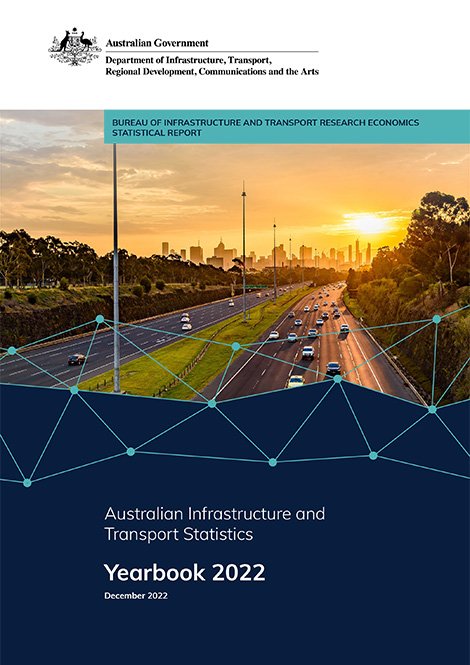
The aim of the Australian Infrastructure Statistics and Transport Yearbook is to provide a single, comprehensive annual source of infrastructure statistics for use by policymakers, industry leaders, transport analysts and the wider Australian community.
The publication is primarily a source of long-term, aggregate time series infrastructure statistics. Most statistics included in the publication are currently collected by BITRE or other Australian, state or territory government agencies.
Australian aggregate freight forecasts – 2022 update
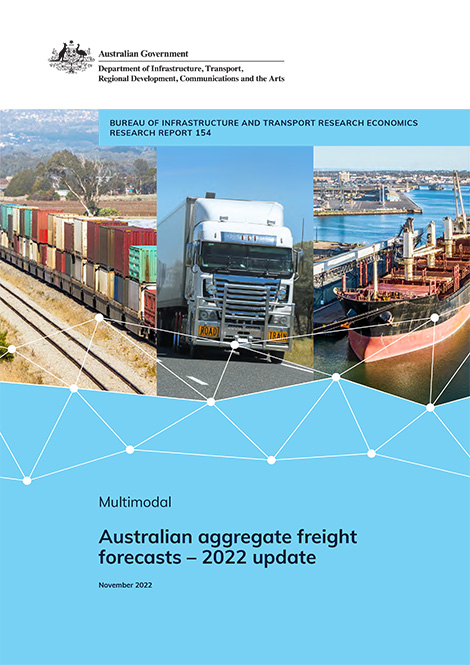
Freight transport plays a significant and wide-ranging role across Australia’s economy. It includes the movement of Australia’s major bulk export commodities to ports for export, the transport of raw materials and semi-processed commodities to businesses for further processing and finished products to household consumers.
This report presents long-term forecasts of total Australian freight volumes for road, rail, coastal shipping and aviation between 2020 and 2050. The forecasts are based on a combination of statistical models relating to historical trends in freight volumes and economic activity and on informed assumptions about likely future long-term economic and demographic trends and international assumptions about likely future world demand for key Australian export commodities. This report updates BITRE 2019 aggregate freight forecasts.
Australian interstate, intrastate and capital city road freight forecasts – 2022 update
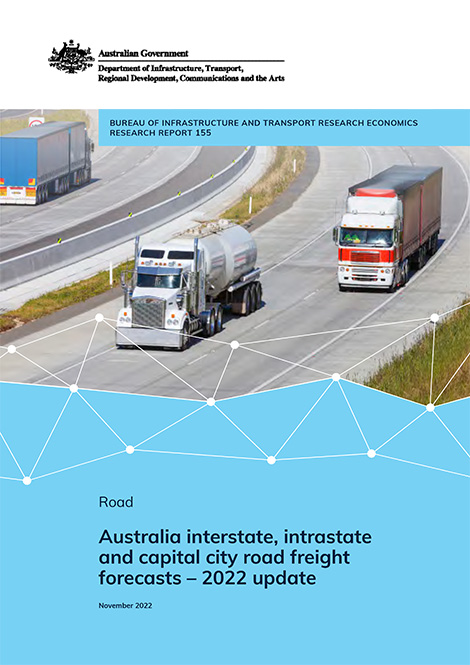
In Australia, road transport is the predominant mode for moving freight between and within states. It is a vital link in various logistics chains, providing access for freight to ports and terminals and urban freight distribution between warehouses and retail outlets. It is also the dominant mode for moving freight over relatively short distances and where other alternatives are not readily available.
This report presents estimates and forecasts of interstate, intrastate and capital cities freight volumes for each state and territory in Australia. Estimates cover the period 1970 to 2020 and forecasts from 2020 to 2040. The forecasts are based on a combination of statistical models relating historical trends in road freight volumes and economic activity, informed by assumptions about likely future long-term economic and demographic trends.
Road Vehicles Australia, January 2022 (re-issue)
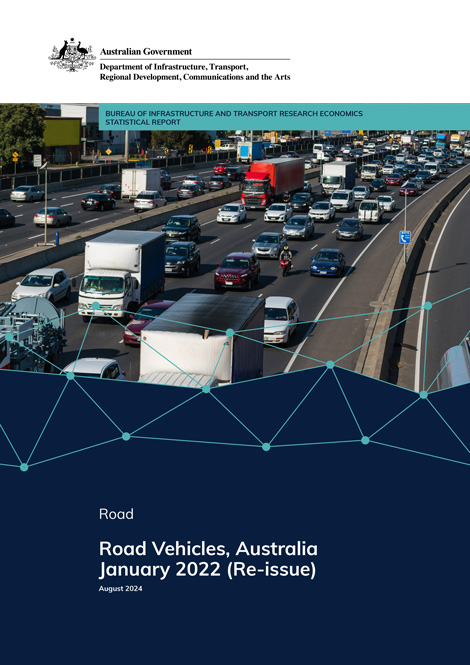
This release provides statistics relating to the number of vehicles registered for road use in Australia on 31st January 2022. The statistics encompass all vehicles that were registered with an Australian state or territory motor vehicle registry for unrestricted use on public roads, and reported by jurisdictions to the National Exchange of Vehicle and Driver Information System (NEVDIS). This is the first annual release of Road Vehicles Australia, which replaces the ABS Motor Vehicle Census, discontinued in 2021. More statistics are available on the BITRE website and data.gov.au.
Social Cost of Road Crashes
Updated content: this report replaces the version uploaded on Friday 14 October. Text and chart changes have been made to the report’s section on age.
The Australian National University (ANU) was engaged by the Bureau of Infrastructure and Transport Research Economics (BITRE) to develop a model to estimate the social cost of road crashes in Australia. The current study replicates and extends the previous BITRE costing study (BITRE, 2009) by using current data, improved methods and broader scope of analysis, including analysis of who bears the burden of road crashes. The current study also set out to aid in addressing three policy questions posed by BITRE by drawing on results of the costing study as well as a rapid review of relevant literature.
The ANU research team members include Emily Lancsar, Ralf Steinhauser, Siobhan Bourke, Robert Breunig, Russell Gruen, Leo Dobes, Liza Munira, Liliana Bulfone, Kathryn Glass, Cameron Gordon, and Jolene Cox.
The BITRE team was Tim Risbey and Dr Gary Dolman, with key contributions from Dr Mark Harvey, Leo Soames and Simon O'Mahony, and Neil Thompson from the Office of Road Safety.
BITRE greatly appreciated the assistance of stakeholders who provided data, participated in the two project workshops, and provided comments on the draft report.
Run-off road crashes in Australia, 2016-2020
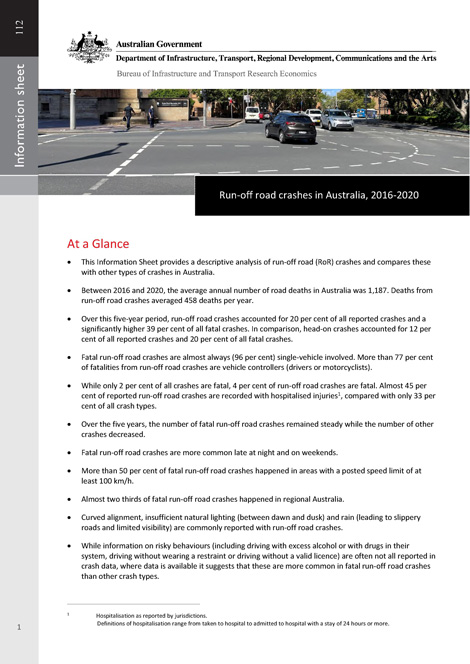
This Information Sheet provides descriptive analysis of run-off road (RoR) crashes and compares these with other types of crashes in Australia. Between 2016 to 2020, the average annual number of road deaths in Australia was 1,187. Deaths from run-off road crashes averaged 458 deaths per year. Run-off road crashes accounted for 20 per cent of all crashes and a significantly higher 39 per cent of all fatal crashes in Australia during the five-year period 2016 to 2020. Run-off road crashes form an important focus area in not only reducing total numbers of crashes but also the severity level of crashes.