
Population synthesis for travel demand modelling in Australian capital cities
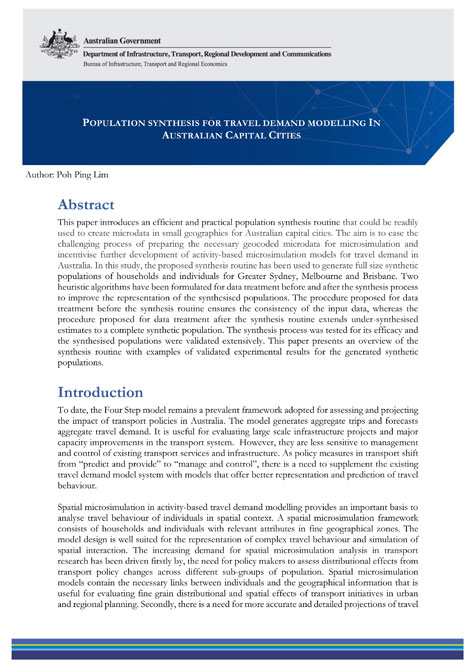
In this research, the proposed synthesis routine has been used to generate full size synthetic populations of households and individuals for Greater Sydney, Melbourne and Brisbane. Two heuristic algorithms have been formulated for data treatment before and after the synthesis process to improve the representation of the synthesised populations. The procedure proposed for data treatment before the synthesis routine ensures the consistency of the input data, whereas the procedure proposed for data treatment after the synthesis routine extends under-synthesised estimates to a complete synthetic population. The synthesis process was tested for its efficacy and the synthesised populations were validated extensively. This research contributes in setting up a replicable population synthesis routine that can be included into a standard methodological toolbox for transport researchers and mainstream social scientists to produce Australian synthetic populations that is essential to microsimulation analysis.
- Population Synthesis for Travel Demand Modelling in Australian Capital Cities
Population and access to local services
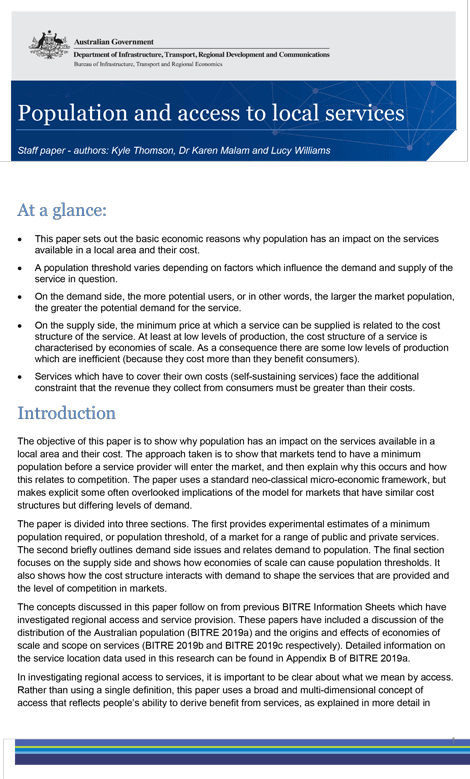
The paper considers the relationship between population and services. The approach taken is to consider the role of population before a service provider will enter a market, and then explain why this occurs and how this relates to competition. This paper applies a standard neo-classical micro-economic framework.
- Population and access to local services
What are services and who provides them?
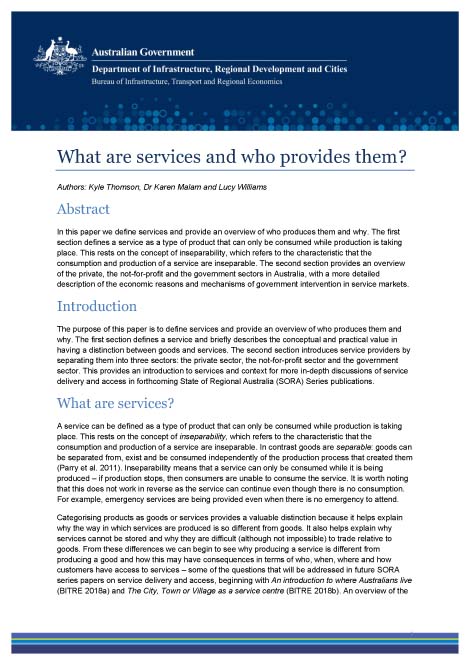
In this paper we define services and provide an overview of who produces them and why. The first section defines a service as a type of product that can only be consumed while production is taking place. This rests on the concept of inseparability, which refers to the characteristic that the consumption and production of a service are inseparable. The second section provides an overview of the private, the not-for-profit and the government sectors in Australia.
- What is Access?
- What is Access?
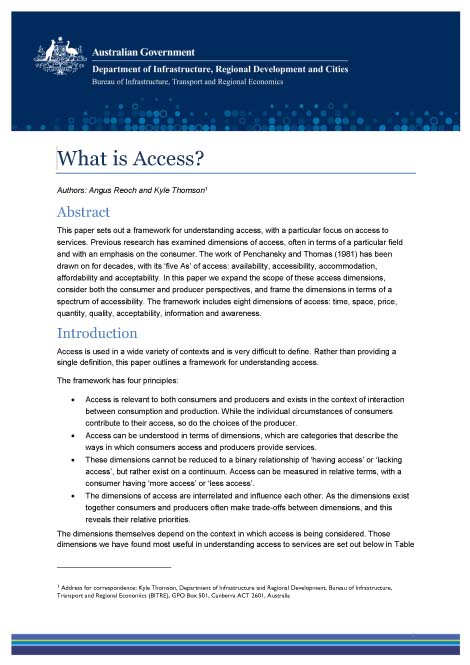
This paper sets out a framework of access, with a particular focus on access to services. Previous research has examined dimensions of access, often in terms of a particular field and with an emphasis on the consumer. The work of Penchansky and Thomas (1981) has been drawn on for decades, with its 'five As' of access: availability, accessibility, accommodation, affordability and acceptability. In this paper we expand the scope of these access dimensions, consider both the consumer and producer perspectives, and frame the dimensions in terms of a spectrum of accessibility. The framework includes eight dimensions of access: time, space, price, quantity, quality, acceptability, information and awareness.
- What is Access?
- What is Access?
Aviation activity as a leading indicator of economic activity
This study investigates whether data on domestic aviation activity in Australia could be used as an indicator of Australian economic activity–with the view of developing an indicator of regional economic activity should initial tests be successful. Graphical analysis was the predominant method used to test the predictive power of aviation data, which is collected on a monthly basis by the Bureau of Infrastructure, Transport and Regional Economics (BITRE), against Gross Domestic Product (GDP) and employment.
- Aviation activity as a leading indicator of economic activity
Introduction to road economics
Paper prepared for the ANZSOG Infrastructure Research Workshop, Canberra, 2015. Author: Mark Harvey
- Shifting the Transport Infrastructure Debate
Paper given to the 33rd Australasian Transport Research Forum, 29 September–1 October 2010, Canberra.
Author: David Gargett.
- Petrol Prices in Australia
Container and Ship Movements Through Australian Ports: 2007–08 to 2029–30, Preliminary Estimates
Paper given to the 31st Australasian Transport Research Forum, 2 October–3 October 2008, Gold Coast. Authors: Godfrey Lubulwa, Rob Bolin, Ben Slatter, Tony Carmody
- Container and Ship Movements Through Australian Ports: 2007–08 to 2029–30, Preliminary Estimates
Road Freight Estimates by State/Territory
Paper given to the 31st Australasian Transport Research Forum, 2 October–3 October 2008, Gold Coast. Authors: David Gargett, Afzal Hossain
- Road Freight Estimates by State/Territory
Probability Based Estimation of Human Productivity Losses from Road Fatalities
Paper given to the 31st Australasian Transport Research Forum, 2 October–3 October 2008, Gold Coast. Authors: Hema de Silva, Tim Risbey, Justin McEvoy, Joel Mallett
- Probability Based Estimation of Human Productivity Losses from Road Fatalities