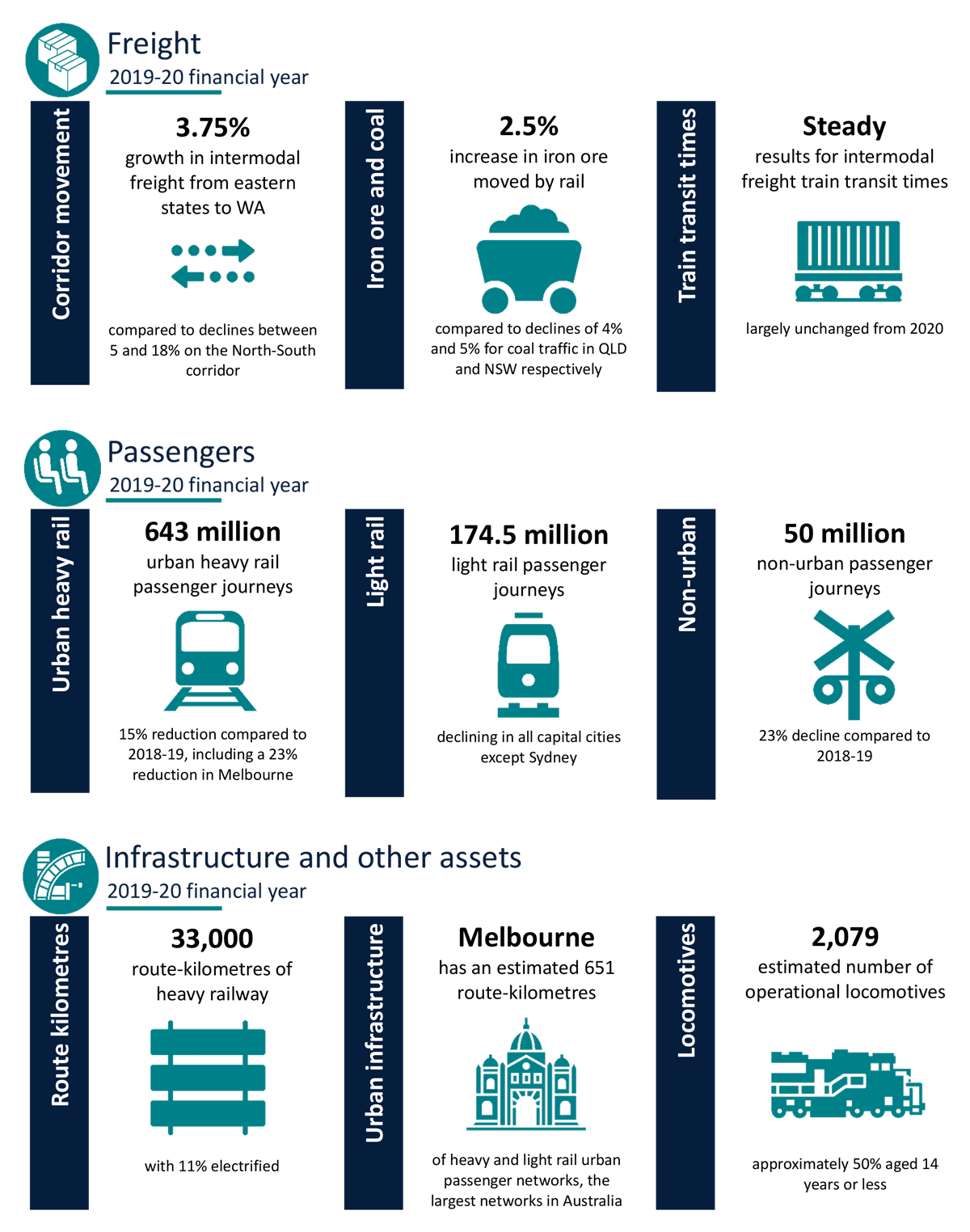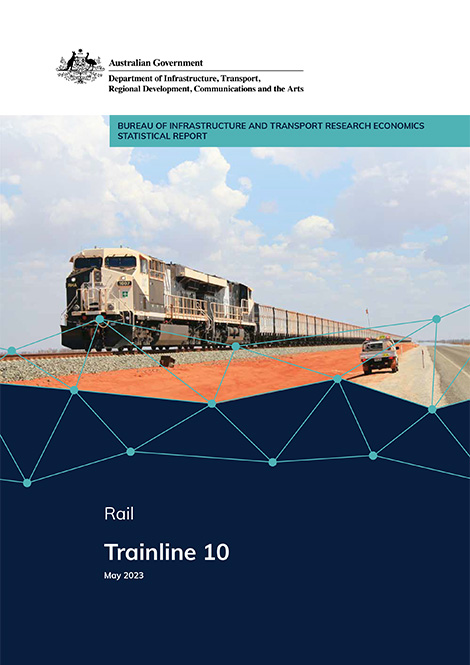
Trainline is a compendium of Australia's railways that provides insights, analysis and an understanding of the railway industry. Australia's railways are evolving, with changes within and outside the industry. These changes include logistics, commodity flows, technology, urban patronage, and regional passenger services. The publication presents an overview and data on railway transport tasks performed; characteristics of the railways and train operators' rolling stock that runs; and aspects of railway performance, including safety, environment and reliability.
Freight vehicle congestion in Australia's five major cities – 2022
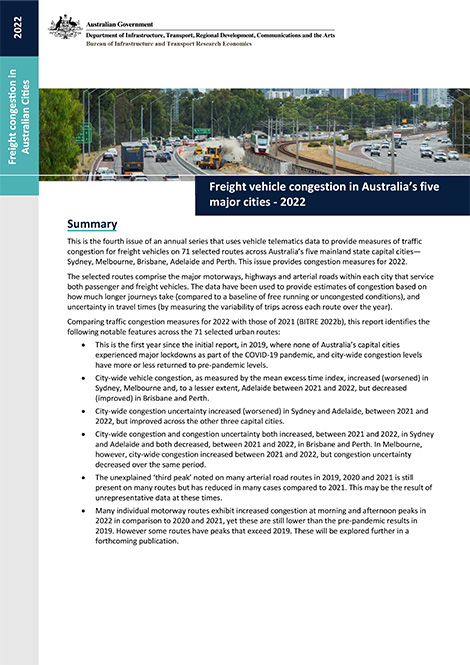
This publication is the fourth in an annual series that uses vehicle telematics data to provide measures of traffic congestion for freight vehicles for selected routes across Australia’s five mainland state capital cities—Sydney, Melbourne, Brisbane, Adelaide and Perth. The selected routes comprise the major motorways, highways and arterial roads within each city that service both passenger and freight vehicles. This release includes measures for 71 routes. The estimates presented in this report cover calendar year 2022, and include comparisons with 2021 traffic congestion levels.
This is the first year since the initial report, in 2019, where none of Australia’s capital cities experienced major lockdowns as part of the COVID-19 pandemic, and city-wide congestion levels have more or less returned to pre-pandemic levels. In particular, city-wide vehicle congestion, as measured by the mean excess time index, increased (worsened) in Sydney, Melbourne and, to a lesser extent, Adelaide between 2021 and 2022, but decreased (improved) in Brisbane and Perth. Many individual motorway routes exhibit increased congestion at morning and afternoon peaks in 2022, compared to 2020 and 2021. On some routes measured congestion is still lower than the pre-pandemic results in 2019. On other routes, congestion peaks exceed 2019 levels. Copies of the data displayed in the report are available here and on data.gov.au.
Australian sea freight 2020-21
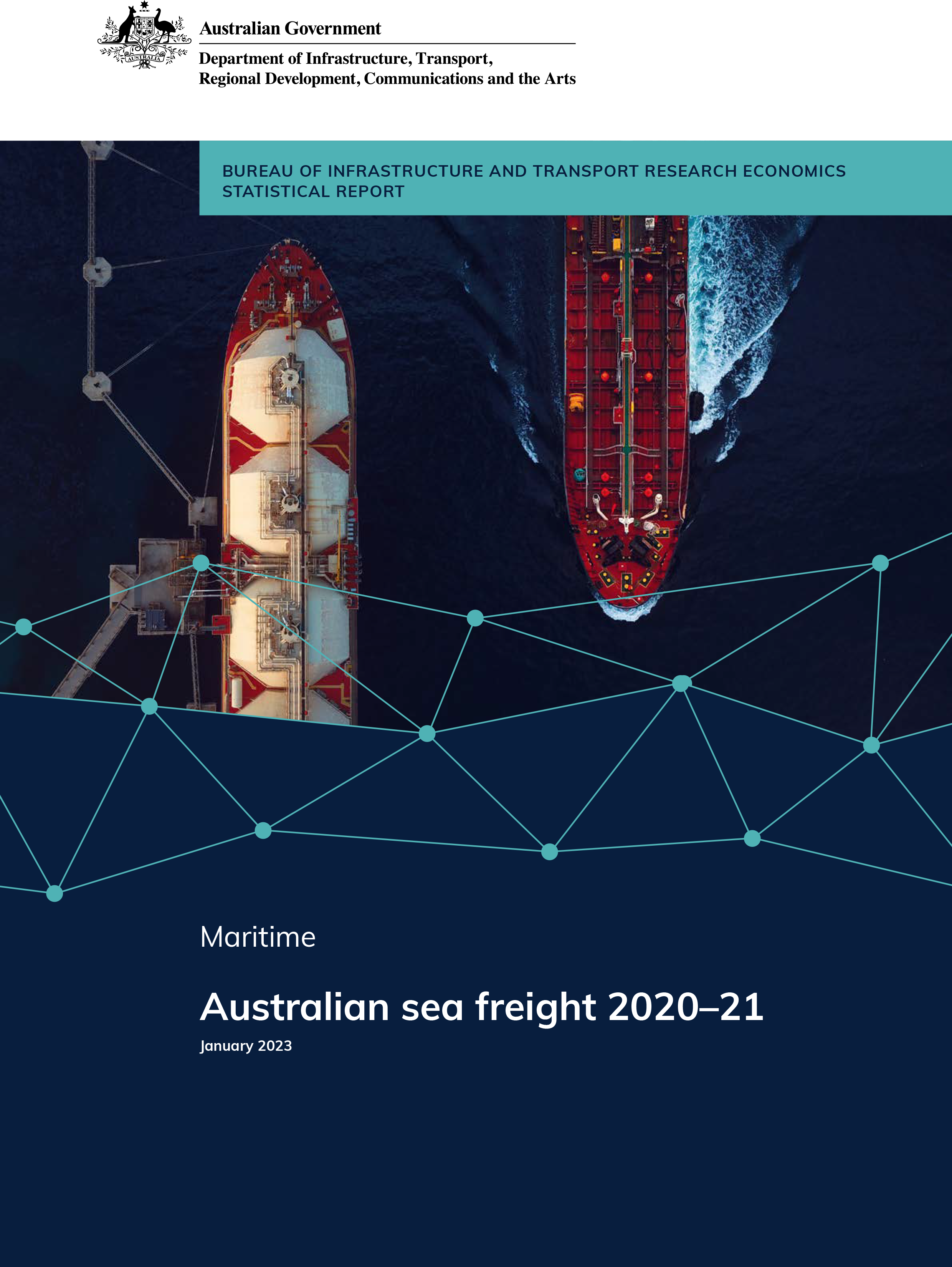
This is the latest in a series of Bureau of Infrastructure and Transport Research Economics (BITRE) reports that provide information on Australian sea freight movements, vessel activity, the use of coastal trading licences, and the size and composition of the Australian trading fleet. This report contains statistics on maritime freight and shipping activities in Australia from 2011–12 to 2020–21.
The latest import and export data has been made available in machine readable form on the National Freight Data catalogue.
Australian Infrastructure and Transport Statistics—Yearbook 2022
The aim of the Australian Infrastructure Statistics and Transport Yearbook is to provide a single, comprehensive annual source of infrastructure statistics for use by policymakers, industry leaders, transport analysts and the wider Australian community.
The publication is primarily a source of long-term, aggregate time series infrastructure statistics. Most statistics included in the publication are currently collected by BITRE or other Australian, state or territory government agencies.
Australian aggregate freight forecasts – 2022 update
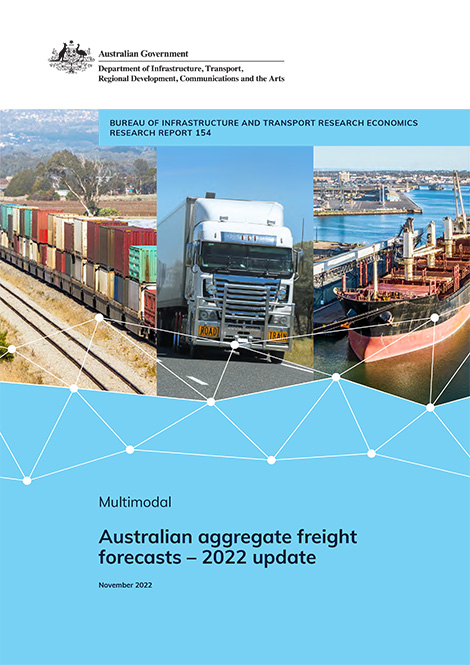
Freight transport plays a significant and wide-ranging role across Australia’s economy. It includes the movement of Australia’s major bulk export commodities to ports for export, the transport of raw materials and semi-processed commodities to businesses for further processing and finished products to household consumers.
This report presents long-term forecasts of total Australian freight volumes for road, rail, coastal shipping and aviation between 2020 and 2050. The forecasts are based on a combination of statistical models relating to historical trends in freight volumes and economic activity and on informed assumptions about likely future long-term economic and demographic trends and international assumptions about likely future world demand for key Australian export commodities. This report updates BITRE 2019 aggregate freight forecasts.
Australian interstate, intrastate and capital city road freight forecasts – 2022 update
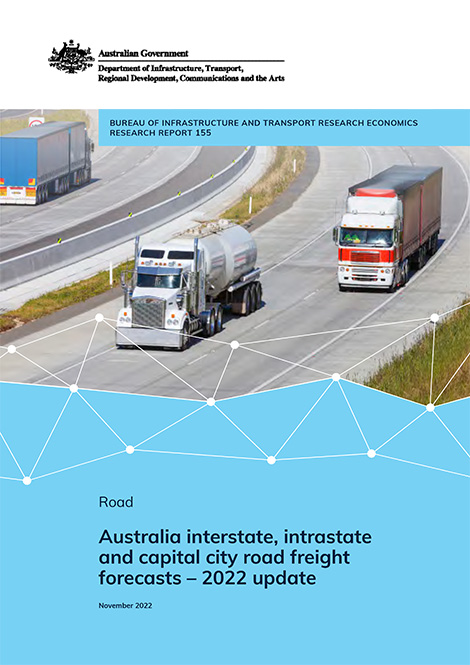
In Australia, road transport is the predominant mode for moving freight between and within states. It is a vital link in various logistics chains, providing access for freight to ports and terminals and urban freight distribution between warehouses and retail outlets. It is also the dominant mode for moving freight over relatively short distances and where other alternatives are not readily available.
This report presents estimates and forecasts of interstate, intrastate and capital cities freight volumes for each state and territory in Australia. Estimates cover the period 1970 to 2020 and forecasts from 2020 to 2040. The forecasts are based on a combination of statistical models relating historical trends in road freight volumes and economic activity, informed by assumptions about likely future long-term economic and demographic trends.
Road Vehicles Australia, January 2022 (re-issue)
This release provides statistics relating to the number of vehicles registered for road use in Australia on 31st January 2022. The statistics encompass all vehicles that were registered with an Australian state or territory motor vehicle registry for unrestricted use on public roads, and reported by jurisdictions to the National Exchange of Vehicle and Driver Information System (NEVDIS). This is the first annual release of Road Vehicles Australia, which replaces the ABS Motor Vehicle Census, discontinued in 2021. More statistics are available on the BITRE website and data.gov.au.
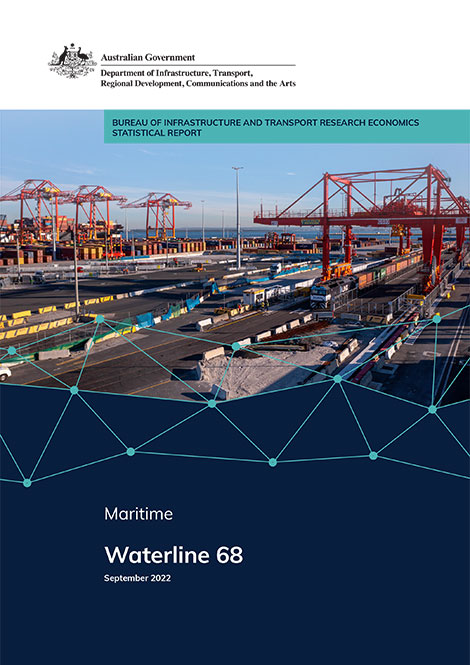
Waterline reports on trends in throughput, container handling productivity on the waterfront and landside of ports in Australia and the cost of importing and exporting containers via 5 container ports. It covers the loading and unloading of container ships and the transport of containers from container terminals.
This issue covers port terminal activity up to the June quarter 2021.
Freight vehicle congestion in Australia’s five major cities – 2021
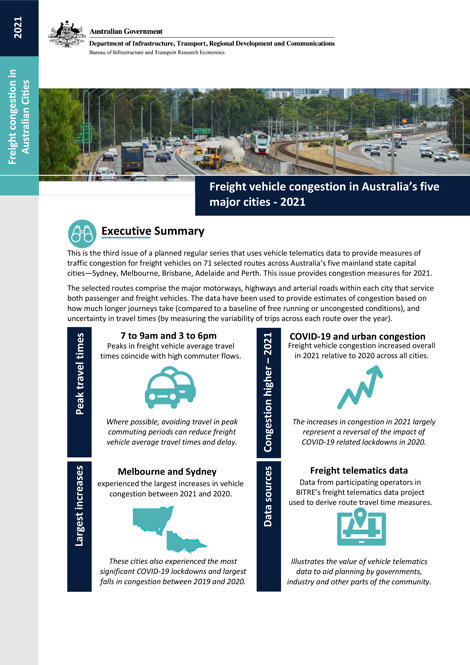
This publication is the third in the series that uses vehicle telematics data to provide measures of traffic congestion for freight vehicles for selected routes across Australia’s five mainland state capital cities—Sydney, Melbourne, Brisbane, Adelaide and Perth. The selected routes comprise the major motorways, highways and arterial roads within each city that service both passenger and freight vehicles. This release includes measures for 71 routes. The estimates presented in this report cover calendar year 2021, and include comparisons with 2020 traffic congestion levels.
The results show that freight vehicle congestion returned to pre-pandemic levels across all five mainland Australian capital cities in 2021, largely due to the return of commuter traffic in our cities, particularly during peak periods, following the impact of COVID-19 lockdowns in 2020. In particular, freight vehicle traffic congestion increases in 2021 were larger in Melbourne, and to a lesser extent Sydney, where lockdown-related reductions in congestion observed in 2020 were most significant. Relative to pre-COVID-19 congestion levels in 2019, freight vehicle congestion increases have been most significant in proportionate terms across Brisbane routes, even higher than experienced across Sydney and Melbourne routes. Brisbane routes also experienced the largest increases in average excess travel time variability (uncertainty) since 2019, greater than in Sydney and Melbourne. Copies of the data displayed in the report are available here and on data.gov.au.
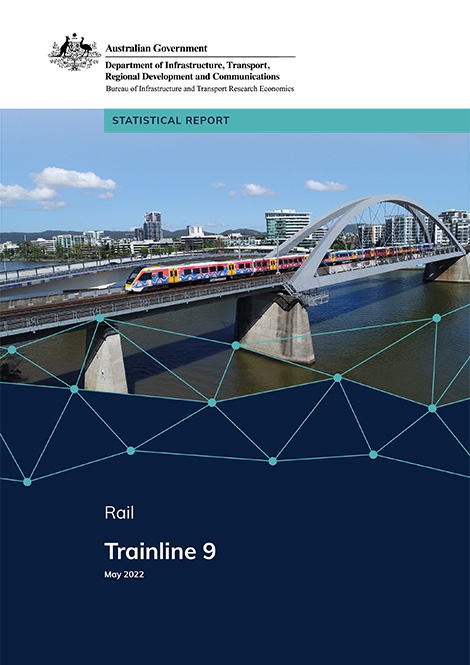
Trainline is a compendium of Australia's railways, providing insights, analysis and an understanding of the railway industry. Australia's railways are evolving, with changes within and outside the industry. These changes include logistics, commodity flows, technology, urban patronage and regional passenger services. The publication presents an overview and data on railway transport tasks performed; characteristics of the railways and train operators' rolling stock that runs; and aspects of railway performance including safety, environment and reliability.