
Developing productivity elasticities for estimating WEBs in Australia—Scoping Study
Estimates of Wider Economic Benefits (WEBs) are increasingly featuring in cost-benefit analyses (CBAs) of major urban transport infrastructure projects. Governments are particularly interested in WEBs because they relate to productivity. The parameters used to estimate WEBs in Australia to date have been estimated using methodologies that are inconsistent and not in line with international best-practice. Thus the reliability and comparability of WEBs estimates in Australian CBAs is questionable. The report proposes a way to develop a robust set of parameters for practitioners to use when estimating WEBs.
The report was commissioned by BITRE on behalf of Steering Committee oversighting the Review of the National Guidelines for Transport System Management. If a robust set of parameters can be developed, it will be published in the Guidelines. BITRE engaged consultants KPMG to undertake the task.
- Developing productivity elasticities for estimating WEBs in Australia–Scoping Study
Changes in Australia's industry structure: cities and regions, 2006–2011
This Information Sheet identifies recent trends (2006 to 2011) in employment by various industries for regional areas, capital cities and non-capital cities. It updates BITRE's previous Information Sheet 32, which focused on employment changes between 2001 and 2006. The information presented in this publication will assist regional communities (including local government and RDAs) to understand how their regions are changing, and help regions map out where their opportunities and challenges might lie.
- Changes in Australia's industry structure: cities and regions, 2006–2011
Australian infrastructure statistics—Yearbook 2014 and key Australian infrastructure statistics booklet
The Yearbook provides a comprehensive evidence base to examine long-term and emerging trends as well as inform policy development and regulatory reform in the transport, energy, water and communications sectors. It is the only comprehensive source of time series statistics for Australia's major areas of economic infrastructure. The Yearbook is accompanied by the Key Australian Infrastructure Statistics booklet which is a summary of statistics from the Yearbook.
- Yearbook 2014–Australian Infrastructure Statistics
- Key Australian Infrastructure Statistics
- Australian Infrastructure Statistics
Yearbook 2014
Part I–Infrastructure and the Economy
- Australian Infrastructure Statistics
Yearbook 2014
Part T–Transport
- Australian Infrastructure Statistics
Yearbook 2014
Part E–Energy
- Australian Infrastructure Statistics
Yearbook 2014
Part C–Communication
- Australian Infrastructure Statistics
Yearbook 2014
Part W–Water
BITRE Road Construction and Maintenance Price Index—2014 update
This Information Sheet presents the quarterly Road Construction and Maintenance Price Index figures for the year 2013–14. Additionally, it presents sub-indexes by activity type for road maintenance and road construction, and by road type for local sealed, local unsealed, and arterial roads.
Traffic on the national road network, 2011–12

This Information Sheet presents recent road traffic volumes across the Australian National Land Transport Network in 2011–12, based on data provided by States and Territories. It includes charts showing volumes of heavy and light vehicle traffic for all 21 non-urban corridors, and maps for the urban corridors.
- Traffic on the national road network, 2011–12
Major transport employment hubs
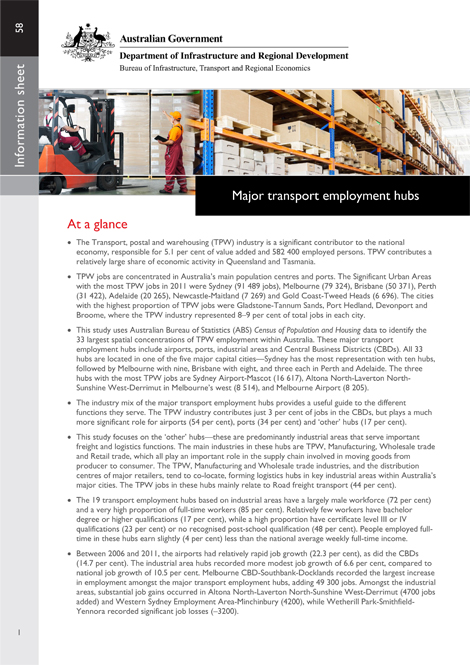
This Information Sheet identifies the 33 largest spatial concentrations of transport industry employment within Australia. These major transport employment hubs are all located within the five most populous capital cities and include airports, ports, CBDs and a range of industrial areas. This study presents evidence on the number of jobs located in each of these transport employment hubs, the industry mix of those jobs, and the characteristics of workers in each location. In particular, it focuses on investigating the nature of employment in the industrial area hubs, many of which serve important freight and logistics functions.
- Major transport employment hubs
National profile of Transport, postal and warehousing workers
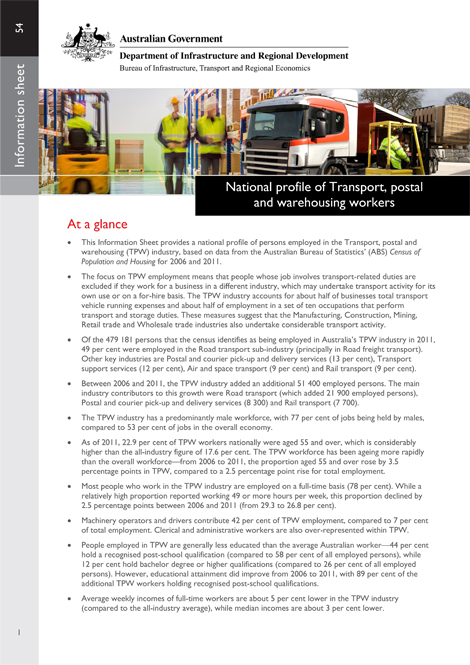
This study aims to improve understanding of the current characteristics of the Transport, postal and warehousing (TPW) workforce and how the workforce is evolving over time. It provides details of the sub-industries in which TPW workers are employed, their hours worked, gender, age, occupation, educational qualifications, income and commuting behaviour. It also describes some of the key changes that occurred between 2006 and 2011, such as the ageing and upskilling of the TPW workforce.
- National profile of Transport, postal and warehousing workers
Long-term trends in urban public transport
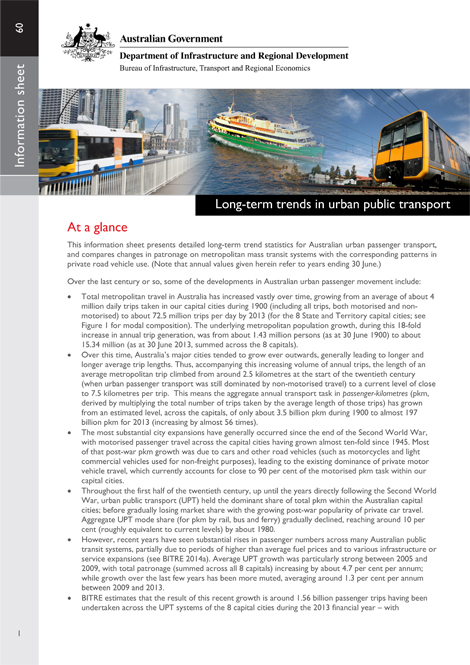
BITRE Information Sheet 60 provides detailed long-term trend statistics for Australian urban passenger transport. Historical time-series on passenger movement within the Australian capital cities, covering more than a century, contrast changes over time in patronage on urban public transport (UPT) systems with the corresponding patterns of private road vehicle use.
- Long-term trends in urban public transport
- Urban Transport Summary for 2013
- Latest urban transport statistics
Urban public transport: updated trends
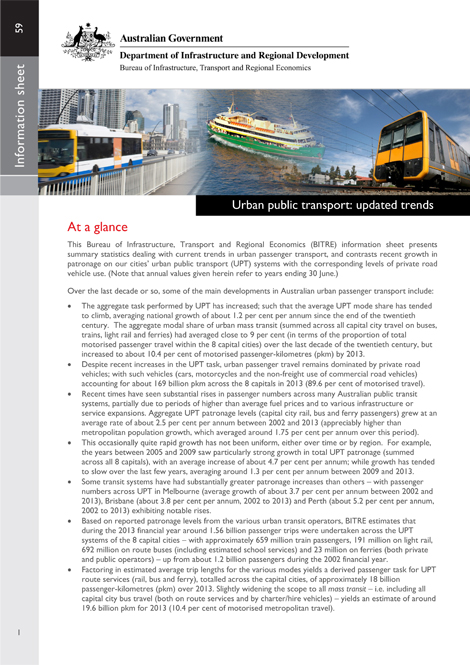
BITRE Information Sheet 59 summarises recent trends in Australian urban passenger transport–contrasting strong growth in urban public transport (UPT) over the last decade (with 2013 task levels almost 30 per cent higher than 2004) with that of private road vehicle use (with car travel in 2013 only about 3 per cent higher than 2004). Details or trend statistics are provided, across the State and Territory capital cities, for modal composition, travel growth rates, UPT cost recovery and transit service levels.
- Urban public transport: updated trends
- Urban Transport Summary for 2013
- Latest urban transport statistics
Saturating daily travel
The Information Sheet models and forecasts urban passenger travel in Australian and American cities from 1921 to present. Passenger travel per person is saturating and so future growth in total urban travel will be closely linked to population growth.
- Saturating daily travel