
Freight Rates in Australia
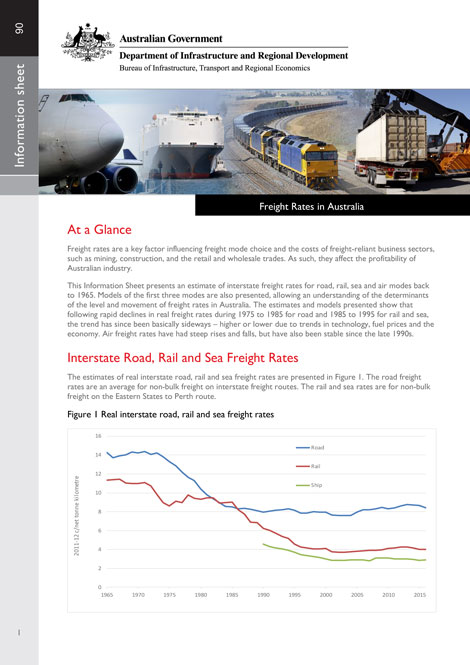
This Information Sheet presents an estimate of interstate freight rates for road, rail, sea and air modes back to 1965. Models of the first three modes are also presented, allowing an understanding of the determinants of the level and movement of freight rates in Australia.
The estimates and models presented show that following rapid declines in real freight rates during 1975 to 1985 for road and 1985 to 1995 for rail and sea, the trend has since been basically sideways–higher or lower due to trends in technology, fuel prices and the economy.
- Freight Rates in Australia
Costs and benefits of emerging road transport technologies
Road transport technologies are evolving rapidly. Recent years have seen the expansion of intelligent transport systems (ITS), such as ramp metering and signal coordination, and low-level vehicle automation. In coming years, communication platforms will connect vehicles, thereby enabling Cooperative-ITS (C-ITS) technologies, such as collision avoidance systems. Car manufacturers and technology companies are actively developing fully automated vehicles. This report summarises estimates of the costs and benefits of ITS, C-ITS and automated vehicles from the existing Australian and international literature. It also provides policy makers with guidance on what further research would improve understanding of the implications of these technologies under Australian conditions.
- Costs and benefits of emerging road transport technologies
Urban Passenger fares
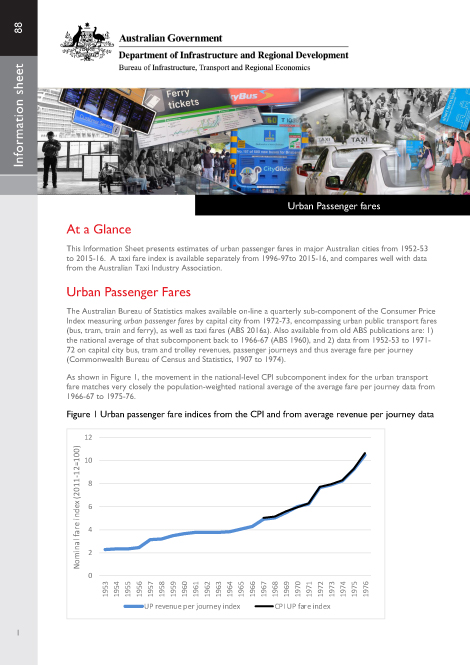
This Information Sheet presents estimates of urban passenger fares in major Australian cities from 1952-53 to 2015-16. A taxi fare index is available separately from 1996-97 to 2015-16. The general trend has been for rising real urban passenger fares, except during the period 1973-74 to 1979-80, when real fares fell as nominal fare levels failed to keep up with higher inflation rates. Rises in both real urban passenger fares and real taxi fares slowed after 2000-01.
- Urban Passenger fares
Australian Infrastructure Statistics—Yearbook 2016
The Australian infrastructure statistics yearbook provides a comprehensive evidence base to examine long-term and emerging trends as well as inform policy development and regulatory reform in the transport, energy, water and communications sectors. It is the only comprehensive source of time series statistics for Australia's major areas of economic infrastructure. The yearbook is accompanied by the Key Australian Infrastructure Statistics Booklet which is a summary of statistics from the yearbook.
- Yearbook 2016–Australian Infrastructure Statistics
- Key Australian Infrastructure Statistics 2016
- Australian Infrastructure Statistics
Yearbook 2016
Part I–Infrastructure and the Economy
- Australian Infrastructure Statistics
Yearbook 2016
Part T–Transport
- Australian Infrastructure Statistics
Yearbook 2016
Part E–Energy
- Australian Infrastructure Statistics
Yearbook 2016
Part C–Communication
- Australian Infrastructure Statistics
Yearbook 2016
Part W–Water
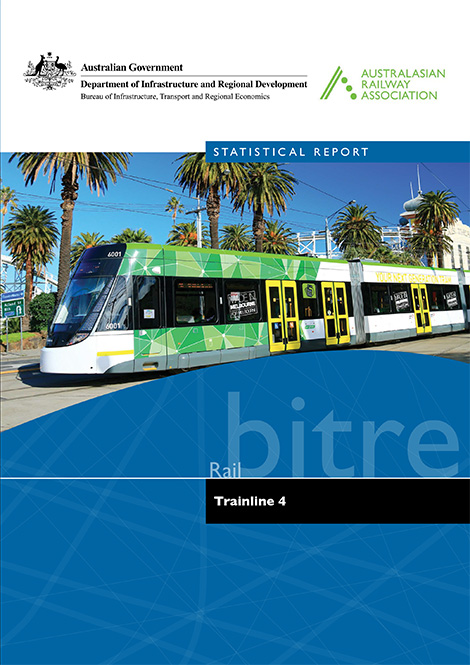
Trainline is a compendium of Australia's railways providing insights, analysis, and an understanding of the railway industry. Australia's railways are evolving via changes within and outside the industry. These changes include logistics, commodity flows, technology, urban patronage and regional passenger services. The publication presents an overview and data on railway transport tasks performed, characteristics of the railways and train operators' rolling stock that runs and aspects of railway performance including safety, environment and reliability.
Australian infrastructure statistics—Yearbook 2015 and key Australian infrastructure statistics booklet 2015
The Yearbook provides a comprehensive evidence base to examine long-term and emerging trends as well as inform policy development and regulatory reform in the transport, energy, water and communications sectors. It is the only comprehensive source of time series statistics for Australia's major areas of economic infrastructure. The Yearbook is accompanied by the key Australian infrastructure statistics booklet which is a summary of statistics from the Yearbook.
- Yearbook 2015–Australian Infrastructure Statistics
- Key Australian Infrastructure Statistics 2015
- Australian Infrastructure Statistics
Yearbook 2015
Part I–Infrastructure and the Economy
- Australian Infrastructure Statistics
Yearbook 2015
Part T–Transport
- Australian Infrastructure Statistics
Yearbook 2015
Part E–Energy
- Australian Infrastructure Statistics
Yearbook 2015
Part C–Communication
- Australian Infrastructure Statistics
Yearbook 2015
Part W–Water
Infrastructure benchmarking report
Australian, State and Territory Governments are committed to improving the infrastructure that is critical to efficient, productive and equitable operations of our economy. Achieving this objective requires efficient procurement processes and careful examination of costs to ensure value for money in infrastructure investments. Governments have cooperated to conclude the first national pilot benchmarking of infrastructure procurement processes and construction costs (as recommended by the 2014 Productivity Commission Inquiry into Public Infrastructure and agreed by the Council on 28 August 2014). This report covers the findings of the initial benchmarking and outlines plans for continued and improved future monitoring of infrastructure procurement performance and construction costs.
The analysis was undertaken by the Bureau of Infrastructure, Transport and Regional Economics (BITRE) for the Infrastructure Working Group of the Transport and Infrastructure Council. The report is also available on the Transport and Infrastructure Council website.
- Infrastructure Benchmarking Report
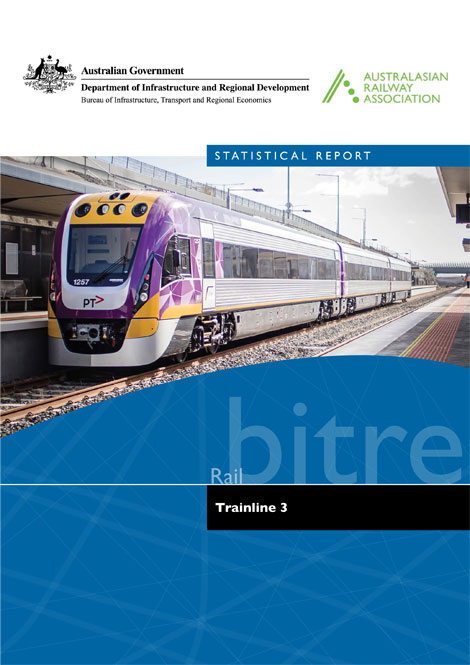
Trainline 3 is a collaborative compendium between the Australasian Railway Association (ARA) and BITRE, providing insights, analysis, and an understanding of the Australian freight and passenger railway industry.
Australia's railways are evolving due to factors within and outside the industry, including changes in bulk and non-bulk logistics, commodity flows, technology, urban rail patronage and regional passenger services. The publication presents an overview and data illustrating these changes in terms of rail tasks performed, characteristics of the railway networks, train operators' rolling stock and aspects of railway performance including safety, environment and reliability.
BITRE road construction and maintenance price index—2015 update
This Information Sheet presents the quarterly road construction and maintenance price index for the year 2014–15. Additionally, it presents sub-indexes by activity type for road construction and road maintenance, and by road type for arterial, sealed local and unsealed local roads.
- BITRE road construction and maintenance price index–2015 update
Transport infrastructure and land value uplift
Users of the transport network are not its only beneficiaries. Land owners can also gain as increased value flows along the network are capitalised into land. Value uplift financing attempts to capture a portion of this by levying the landholders in the catchment areas of new infrastructure. The main problem with this system is that is very difficult to localise benefits in a network. This has led some to propose a broad based land tax instead.
- Transport infrastructure and land value uplift