
Forecasting Australian Transport: A Review of Past Bureau Forecasts
A common rational for the making of transport-related forecasts is the need to anticipate the growth of transport activity and the demand it will place on transport infrastructure. Anticipation of this demand allows for forward planning of needed improvements/additions to key parts of the networks.
As such, it is useful to examine how close past Bureau forecasts were to predicting this growth, and to learn from any obvious errors.
This is the aim of the current report.
- Forecasting Australian Transport: A Review of Past Bureau Forecasts
Road construction cost and infrastructure procurement benchmarking: 2017 update
This report benchmarks the costs of road construction and the timeliness of infrastructure procurement processes for projects undertaken by states and territories since 2015. BITRE undertook the analysis under the guidance of the Infrastructure Working Group of the Transport and Infrastructure Council. Road construction costs include total project costs and key cost components such as construction and project management. The procurement timeliness benchmarks cover all stages of procurement from the initial notice of the project to financial completion. This report is an update of the Transport and Infrastructure Council's 2015 Infrastructure Benchmarking Report and contributes to the goal of improving value for money in infrastructure investment.
- Road construction cost and infrastructure procurement benchmarking: 2017 update
Greenhouse gas abatement potential of the Australian transport sector—Summary report
In recognition of both the progress of climate science and the need to manage the risks faced by future generations, the majority of the world's governments are implementing programs for the long term reduction of greenhouse gas emissions. Accordingly, the Australian government has committed to an 80 per cent reduction on the 2000 levels of emissions for the Australian economy by 2050.
As the second largest greenhouse gas emission contributing sector in the economy at 16% of national emissions, transport will need to make a significant contribution to the abatement target. The question then arises as to the potential greenhouse gas abatement options available to the sector.
The Australian transport industry, researchers and government have in many cases deep knowledge about the issues of environmental sustainability, and individual transport sector greenhouse gas abatement options. However, that knowledge is fragmented due to the diversity and complexity of transport.
There are existing studies of transport abatement options but they are limited to a narrow subset of the available options. As a consequence no single document is available to provide an overview of the options and potential for abatement in the transport sector. With this background the ARRB Group, BITRE and CSIRO formed the Australian Low Carbon Transport Forum (ALCTF) in July 2011 to bring together knowledge on the options for greenhouse gas abatement in transport and explore how deeply emissions could be cut in the sector.
- Greenhouse gas abatement potential of the Australian transport sector–Summary report
Greenhouse gas abatement potential of the Australian transport sector—Technical report
The Australian Low Carbon Transport Forum (ALCTF) was initiated by a project secretariat comprising ARRB Group, BITRE and CSIRO. It was organised to bring together knowledge on the options for greenhouse gas abatement in transport and explore how deeply emissions could be cut in the sector.
A report describing the main findings of the study has been published under the title Greenhouse gas abatement potential of the Australian transport sector: Summary report.
This current Technical Report is a companion document to the Summary Report, and aims to detail the methodology and results of the ALCTF process. That is, it describes how the estimated levels of abatement were calculated for each of the abatement options considered in the ALCFT workshops, and how the various abatement potentials were aggregated into an estimate for the maximal potential reduction.
- Greenhouse gas abatement potential of the Australian transport sector–Technical report
Australian Infrastructure Statistics—Yearbook 2017
The Australian infrastructure statistics yearbook provides a comprehensive evidence base to examine long-term and emerging trends as well as inform policy development and regulatory reform in the transport, energy, water and communications sectors. It is the only comprehensive source of time series statistics for Australia's major areas of economic infrastructure. The yearbook is accompanied by the Key Australian Infrastructure Statistics Booklet which is a summary of statistics from the yearbook.
- Yearbook 2017–Australian Infrastructure Statistics
- Key Australian Infrastructure Statistics 2017
- Australian Infrastructure Statistics Yearbook 2017 Part I–Infrastructure and the Economy

- Australian Infrastructure Statistics Yearbook 2017 Part T–Transport
- Australian Infrastructure Statistics Yearbook 2017 Part E–Energy
- Australian Infrastructure Statistics Yearbook 2017 Part C–Communication
- Australian Infrastructure Statistics Yearbook 2017 Part W–Water
Trainline is a compendium of Australia's railways providing insights, analysis, and an understanding of the railway industry. Australia's railways are evolving via changes within and outside the industry. These changes include logistics, commodity flows, technology, urban patronage, and regional passenger services. The publication presents an overview and data on railway transport tasks performed, characteristics of the railways and train operators' rolling stock that runs and aspects of railway performance including safety, environment and reliability.
Measuring infrastructure asset performance and customer satisfaction: A review of existing frameworks
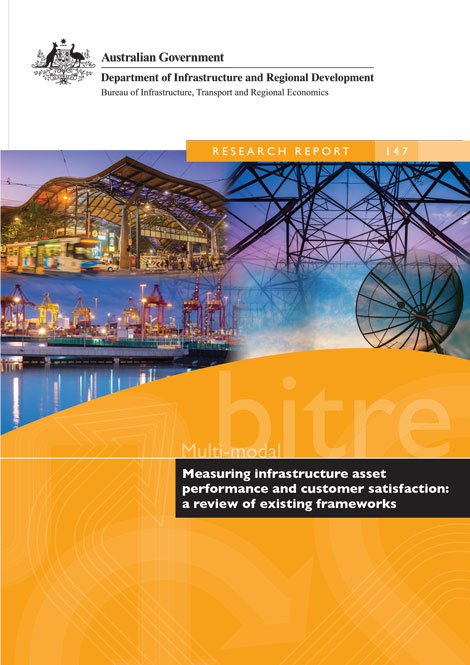
Well-managed, modern and functioning infrastructure underpins much of the economic prosperity of Australia. It is thus crucial that Australia's infrastructure keeps up with the needs of the community.
While some infrastructure asset types, namely public roads and airports, have made significant progress in performance measurement, for others there is a dearth of information or public engagement. The patchwork approach that has resulted means that Australia may be missing out on the potential benefits of consistent and widespread performance measurement: improved accountability, incentivised performance, and better performance evaluation. This report introduces and explores many of the issues surrounding infrastructure performance measurement that should be considered in the context of providing greater consistency across infrastructure asset types.
- Measuring infrastructure asset performance and customer satisfaction: A review of existing frameworks
Fuel economy of Australian passenger vehicles—a regional perspective
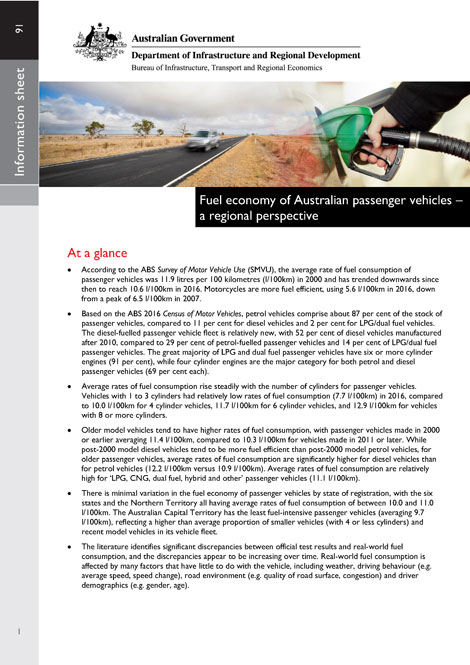
This information sheet presents Australian data on how realised rates of fuel consumption vary over time, and how the rates depend on key vehicle characteristics such as number of cylinders, fuel type and vehicle age. It also investigates state/territory differences in fuel economy and presents new small area estimates of the average rate of fuel consumption for Australia's regions.
These small area estimates are based on the composition of the passenger vehicle and motorcycle fleet in the region, and are derived at both the Statistical Area Level 3 (SA3) and Statistical Area Level 4 (SA4) scale. The key data sources are the Australian Bureau of Statistics (ABS) Survey of Motor Vehicle Use (SMVU) 2016 and the ABS Census of Motor Vehicles 2016.
- Fuel economy of Australian passenger vehicles–a regional perspective
Growth in the Australian Road System
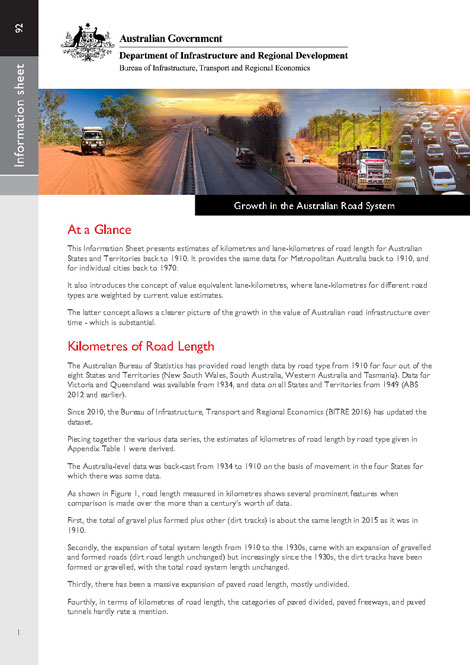
This information sheet presents estimates of Kilometres and lane-kilometres of road length for Australian States and Territories back to 1910. It provides the same data for Metropolitan Australia back to 1910, and for individual cities back to 1970.
It also introduces the concept of value equivalent lane-kilometres, where lane-kilometres for different road types are weighted by current value estimates.
The latter concept allows a clearer picture of the growth in the value of Australian road infrastructure over time–which is substantial.
- Growth in the Australian Road System
Infrastructure and Transport PPPs and Privatisation in Australia
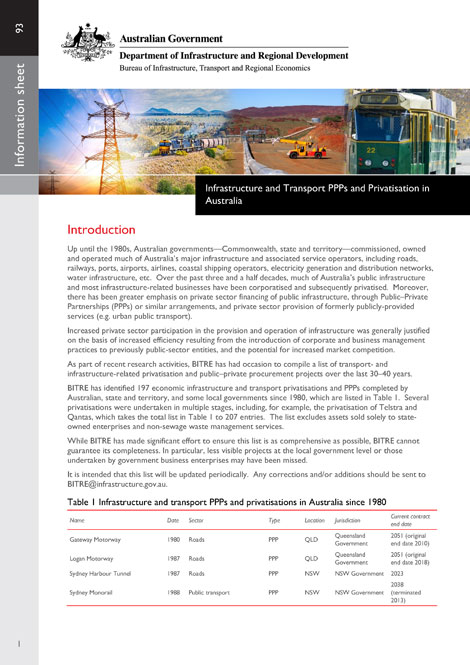
This information sheet provides a list of infrastructure and transport-related Public Private Partnerships and privatisations in Australia since 1980. To the Bureau of Infrastructure Transport and Regional Economics' (BITRE) knowledge, this is the most comprehensive list on the subject to date.
One hundred and ninety seven economic infrastructure assets have been privatised or procured through PPPs since 1980. Several privatisations were undertaken in multiple stages, including, for example, the privatisations of Telstra and Qantas. Including all these stages takes the total list to 207 entries. The list excludes assets sold solely to state-owned enterprises, and non-sewage waste management services.
- Infrastructure and Transport PPPs and Privatisation in Australia