
This report is the third in a series covering the socio-economic costs of transport accidents in Australia. Transport accidents impose a significant burden on the Australian community. Not all of their consequences can be expressed in financial terms. However, to weigh up options for minimising and dealing with this burden, it is important to know the costs of transport accidents.
- Rail Accident Costs in Australia
Rail Infrastructure Pricing: Principles and Practice
Since the early 1990s, railway operations in Australia and in many overseas countries have been radically reformed. One reform has been widespread outsourcing of railway activities such as infrastructure maintenance, to encourage efficient provision through competitive tendering for services. In some cases, entire rail operations have been contracted out or privatised. The major reform, however, has been to introduce regulations to require access to rail infrastructure by outside ("third-party") train operators. This mandated access also supports rail interoperability objectives facilitating train service coordination by streamlining the logistics chain across infrastructure networks.
Prior to these regulations, there were no access charges because the track use was an internal transaction within the railway company the company maintaining the infrastructure had exclusive use of the tracks for its own trains. In essence, the railway's revenue was generated only from tariffs for transporting goods and passengers. However, with mandatory access, rail infrastructure owners offer an additional service non-track owners' access to the infrastructure.
What are fair, equitable and efficient charges for that access? We know that the level and structure of these charges matter, for they account for, perhaps, one-third of the train operator's total operating costs. This report focuses on the rail infrastructure pricing structures that have developed with mandated access around the world, and the lessons that can be drawn from the subsequent experiences.
Our analysis involves consideration of the benefits and costs of mandatory access; the principles of efficient access charges; Australia's systems of access and pricing; international pricing and access systems and the lessons from the experiences with them. While principles of access charges apply equally to freight and passenger trains, mandated access is generally directed only at freight operations. For that reason, in this report we consider only freight operations.
- Rail Infrastructure Pricing: Principles and Practice
Risk in Cost-Benefit Analysis
For cost-benefit analyses (CBA) of public-sector projects, a common misconception is that the discount rate should include a risk premium in consonance with the private-sector practice of doing so. In examining the issue, this report addresses different types of risk separately including downside risk, which arises from optimistic bias in forecasts and pure risk, which is the variation remaining around the mean after removing downside biases.
- Risk in Cost-Benefit Analysis
General Aviation: An Industry Overview
This report profiles significant sectors of the general aviation industry, identifying the major changes in the operating environment affecting general aviation, identifying and explaining where possible the trends in sector activity.
- General Aviation: An Industry Overview
Freight measurement and modelling in Australia
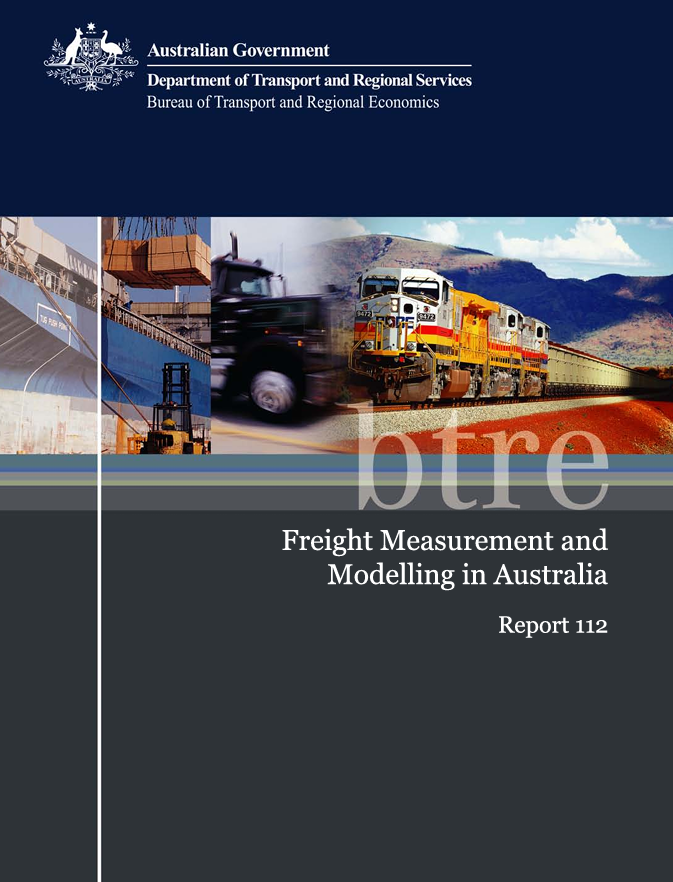
This report summarises the existing knowledge of freight in Australia and presents the time series data, analysis and sources which underpin the BTRE's long-term freight forecasts. Consistently measured time series data are required to model and forecast freight flows. The report describes the methodologies evolved by the BTRE to do this. It includes the results of modelling and forecasting undertaken using the derived series. Non-bulk freight is projected to increase by 82% in tonne-kilometre terms between 2003 and 2020 (average 3.6% per year).
The expected rate of growth in gross domestic product and reductions in freight rates are the key drivers of this growth as well as a continuing trend to national distribution by manufacturers, wholesalers and importers. With Treasury projecting some fall-off in the long-term economic growth, the non-bulk growth rate is slightly lower than in the recent past. Based on past trends, road's share of national non-bulk freight is projected to increase marginally from 74% to 76%, with the rail share declining from 21% to 17% and sea freight making up the balance (with air freight vanishingly small in tonne-kilometre terms, albeit not in value).
These mode share projections do not take account of the potential for rejuvenation of rail on north-south routes, in somewhat the same manner as has already occurred on east-west routes. Capital city freight tonne-kilometres are projected to grow by 3.0% a year between 2003 and 2020 (compared with a 1971–2003 average of 5.0%). While heavy vehicles comprise only 4% of the metropolitan traffic stream, growth of this level implies a slight increase in the heavy vehicle proportion (to 4.2% in 2020).
Rail is expected to remain the largest mode in shipping bulk freight (46% share in 2003, 45% in 2020), followed by sea freight (30% and 29% shares respectively). Rail is well suited for transporting Australia's large export tonnages in coal, other minerals and grains to port. Rail freight has fallen in most other bulk commodities.
Cost of Aviation Accidents and Incidents
This report provides estimates of the total cost to Australia of aviation related accidents and incidents that occurred in the financial year 2003–04. It also reports the cost per accident and the cost attributable to a fatality. It is an update of Cost of Civil Aviation Accidents and Incidents published by the Bureau of Transport Economics in 1998, which estimated costs for 1996.
- Cost of Aviation Accidents and Incidents
Optimising Harmonisation in the Australian Railway Industry
In the last decade, Australia's railways have undergone an ownership, operational and technological revolution. The establishment of national public and private train operators has finally brought seamless rail freight services across the country. There has been a complementary development in track management, with one manager (Australian Rail Track Corporation) rather than five, now controlling most of the interstate track.
The standardisation of the Melbourne-Adelaide railway in 1995 removed the break-of-gauge on the East-West Corridor. This has facilitated the subsequent more than doubling of rail freight task between those cities.
Infrastructure investments and complementary funding of new generation locomotives have enabled train operators to harness train economics of heavier, longer trains, for instance, with Melbourne-Adelaide trains now 50 per cent longer than a decade ago.
These changes are transforming the industry. However, the perception is that the legacy of the separate State-based networks may still draw a long shadow over the performance of the network. This report investigates the extent to which physical, operational and regulatory breaks-of-gauge impede the industry. The report provides guidance to policy makers and industry on those issues.
- Optimising Harmonisation in the Australian Railway Industry
Air transport services in regional Australia: trends and access
The report details trends in air transport services in regional Australia between 1984 and 2005. It presents numerous aspects of the regional aviation industry over time. This report has been updated several times since publication.
- Air transport services in regional Australia: trends and access
The files available from this website may not be suitable for users of assistive technology on all devices.
If you experience difficulties and require assistance, please contact us using the feedback page. Please include which device and assistive technology you are using.
A regional economy: a case study of Tasmania
The Department of Infrastructure, Transport, Regional Development and Local Government is committed to the prosperity of Australia's regions. In order to promote economic and social development it is important that we understand the environment in which regional economies operate. This study provides an analytical investigation of the challenges facing regional Australia. BITRE's study takes a multifaceted and holistic approach. The underlying principle is that economies do not work in isolation and a complex mix of interacting drivers affects a region's economic performance. Tasmania's economic performance has experienced changing fortunes over the past two decades. This development provided a unique opportunity to investigate the drivers of this change and to find out if there are lessons for regional policy.
- A regional economy: a case study of Tasmania
The files available from this website may not be suitable for users of assistive technology on all devices.
If you experience difficulties and require assistance, please contact us using the feedback page. Please include which device and assistive technology you are using.
Aircraft movements through capital city airports to 2029–30
This report presents forecasts of air passenger and aircraft movements through Australia's eight capital city airports (Adelaide, Brisbane, Canberra, Darwin, Hobart, Melbourne, Perth and Sydney) to 2030.
- Aircraft movements through capital city airports to 2029–30