
Experimental analysis of networked service provision and hierarchies
Understanding the role of a given place in the network of human activities is critical when considering regional policies or local strategies. This paper applies a network lens to the spatial pattern of service provision in Australia. It considers the locations of services and their distribution in order to approximate catchment populations, develop population thresholds for each service, and order each service type. From there, the paper establishes a hierarchy of cities, towns and villages and uses this to explore connections between them.
- Experimental analysis of networked service provision and hierarchies
National profile of Transport, postal and warehousing workers in 2016
This information sheet is an update of BITRE's previous study on the same subject (BITRE Information Sheet 54) which used ABS 2011 census data. This study used ABS 2016 census data and provides details of the sub-industries in which TPW workers are employed, their employment status, hours worked, gender, age, occupation, educational qualifications, income, work location and commuting behaviour. It also describes some of the key changes that have occurred since 2011, such as the ageing and upskilling of the TPW workforce.
- National profile of Transport, postal and warehousing workers in 2016 [PDF: 863 KB]
National profile of Heavy and civil engineering construction workers in 2016
This study explores details of the sub-industries in which HCEC workers are employed, their employment status, hours worked, gender, age, occupation, educational qualifications, income, work location and commuting behaviour. It also describes some of the key changes that have occurred since 2011, including the changing gender mix and the upskilling of the HCEC workforce.
- National profile of Heavy and civil engineering construction workers in 2016
Electric Vehicle Uptake: Modelling a Global Phenomenon
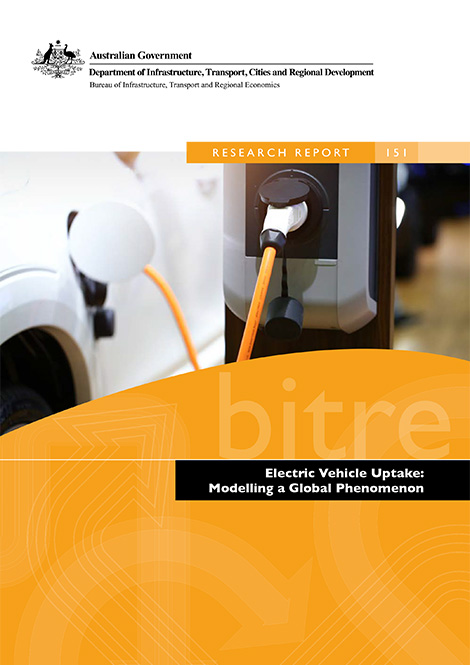
This report describes an approach to estimating likely electric vehicle uptake for each of 22 countries around the world. Models of electric vehicle uptake were derived for Australia, Austria, Belgium, Britain, Canada, China, Denmark, Finland, France, Germany, India, Ireland, Italy, Japan, Korea, the Netherlands, New Zealand, Norway, Spain, Sweden, Switzerland, and the United States (as well as for the 'Rest of Europe').
- Electric Vehicle Uptake: Modelling a Global Phenomenon
- Data
Prices for Petrol and Gasoline—Modelling a Global Phenomenon
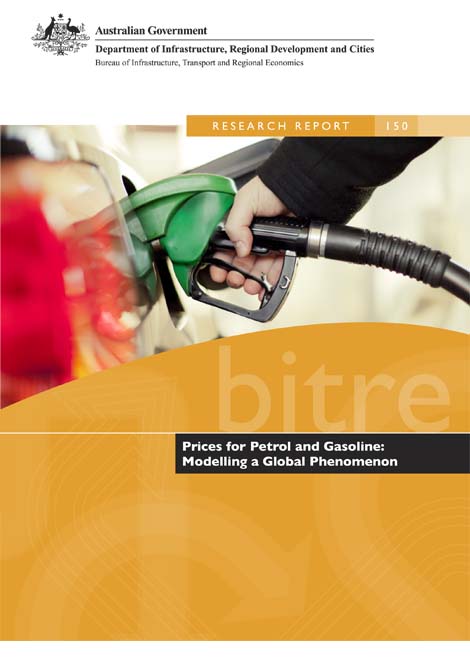
The report models petrol prices in 24 countries around the world - the world oil price determines the energy content of the petrol price, and then adding in taxes produces a prediction of the country's petrol price. The analysis also allows a prediction of how responsive a county's petrol price is to changes in the world oil price.
- Prices for Petrol and Gasoline–Modelling a Global Phenomenon
- World Petrol Prices Model
BITRE summary—Economic Contribution of Transport in Australia
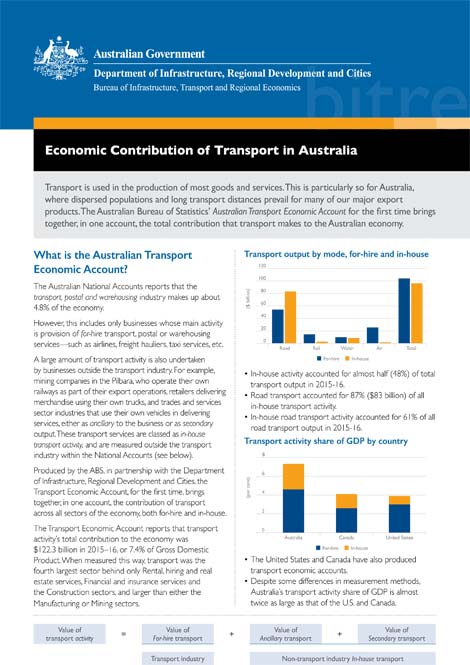
Experimental estimates of the economic contribution of all transport activity to the Australian economy.
- BITRE summary–Economic Contribution of Transport in Australia
Forecasting Australian Transport: A Review of Past Bureau Forecasts
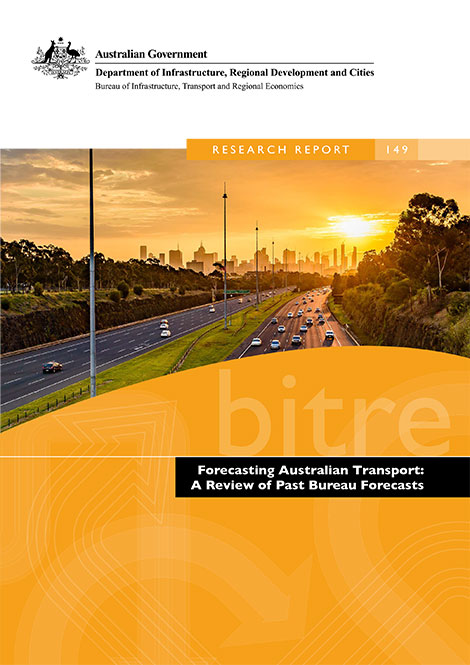
A common rational for the making of transport-related forecasts is the need to anticipate the growth of transport activity and the demand it will place on transport infrastructure. Anticipation of this demand allows for forward planning of needed improvements/additions to key parts of the networks.
As such, it is useful to examine how close past Bureau forecasts were to predicting this growth, and to learn from any obvious errors.
This is the aim of the current report.
- Forecasting Australian Transport: A Review of Past Bureau Forecasts
Ex-post Economic Evaluation of National Road Investment Projects

BITRE undertook two rounds of ex-post evaluations of national road investment projects: one in 2005–2007 and the other in 2014–2016. Available evidence suggests that there is much room for improvement in the quality of Australian road CBAs if they are to be used as an effective tool for ranking options and prioritising projects. The net present value (NPV) was over-estimated by significant margins in some of the selected case study projects. Over-estimation in NPV was largely caused by over-estimation of road user benefits (up to 500 per cent), with the errors mostly coming from travel time cost saving estimates. Inaccurate traffic forecasts and methodology errors were mostly responsible for the over-estimated road user benefits. There was no evidence of systematic cost overruns for the projects selected for ex-post review. Lessons learned include recommendations for improvements in CBA documentation and review, traffic forecasts, and estimation of road user benefits and residual values.
- Ex-post Economic Evaluation of National Road Investment Projects–Volume 1 Synthesis Report
- Ex-post Economic Evaluation of National Road Investment Projects–Volume 2 Case Studies
Greenhouse gas abatement potential of the Australian transport sector—Summary report
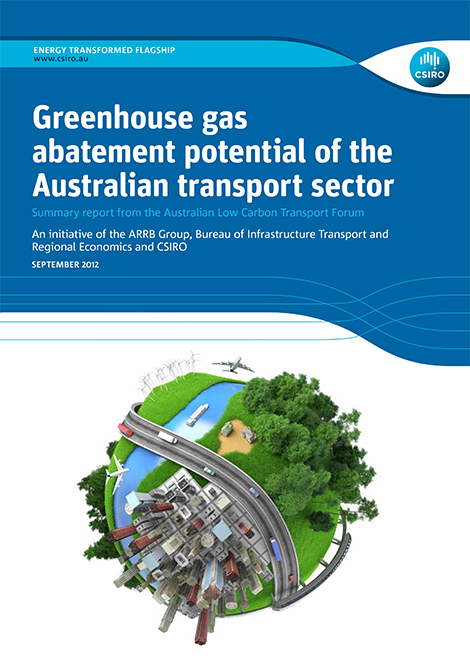
In recognition of both the progress of climate science and the need to manage the risks faced by future generations, the majority of the world's governments are implementing programs for the long term reduction of greenhouse gas emissions. Accordingly, the Australian government has committed to an 80 per cent reduction on the 2000 levels of emissions for the Australian economy by 2050.
As the second largest greenhouse gas emission contributing sector in the economy at 16% of national emissions, transport will need to make a significant contribution to the abatement target. The question then arises as to the potential greenhouse gas abatement options available to the sector.
The Australian transport industry, researchers and government have in many cases deep knowledge about the issues of environmental sustainability, and individual transport sector greenhouse gas abatement options. However, that knowledge is fragmented due to the diversity and complexity of transport.
There are existing studies of transport abatement options but they are limited to a narrow subset of the available options. As a consequence no single document is available to provide an overview of the options and potential for abatement in the transport sector. With this background the ARRB Group, BITRE and CSIRO formed the Australian Low Carbon Transport Forum (ALCTF) in July 2011 to bring together knowledge on the options for greenhouse gas abatement in transport and explore how deeply emissions could be cut in the sector.
- Greenhouse gas abatement potential of the Australian transport sector–Summary report
Greenhouse gas abatement potential of the Australian transport sector—Technical report
The Australian Low Carbon Transport Forum (ALCTF) was initiated by a project secretariat comprising ARRB Group, BITRE and CSIRO. It was organised to bring together knowledge on the options for greenhouse gas abatement in transport and explore how deeply emissions could be cut in the sector.
A report describing the main findings of the study has been published under the title Greenhouse gas abatement potential of the Australian transport sector: Summary report.
This current Technical Report is a companion document to the Summary Report, and aims to detail the methodology and results of the ALCTF process. That is, it describes how the estimated levels of abatement were calculated for each of the abatement options considered in the ALCFT workshops, and how the various abatement potentials were aggregated into an estimate for the maximal potential reduction.
- Greenhouse gas abatement potential of the Australian transport sector–Technical report