
A dozen facts about transport in Australia
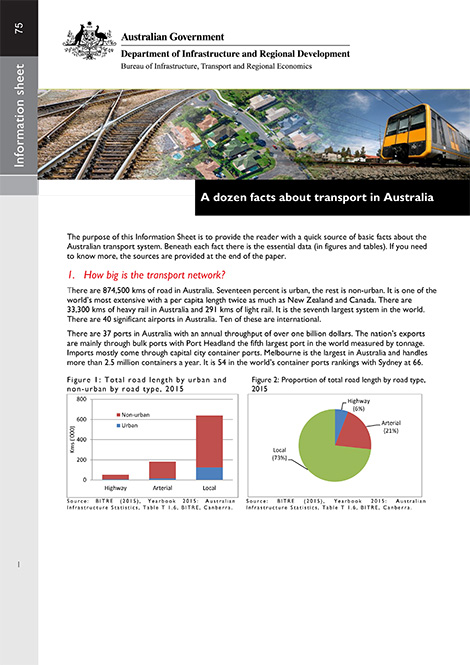
This information sheet covers a wide range of subjects, including commuting, freight, rail, energy and safety. The following 12 facts are included:
- How big is the transport network?
- How far do we travel?
- Is this increasing?
- How do we travel?
- Are we changing how we travel?
- Why do we travel like this?
- What about freight?
- Is freight transport increasing?
- Are we commuting longer?
- How do we pay for transport?
- Is transport becoming more energy efficient and causing less emissions? and
- Is transport safety improving?
- A dozen facts about transport in Australia
Infrastructure benchmarking report
Australian, State and Territory Governments are committed to improving the infrastructure that is critical to efficient, productive and equitable operations of our economy. Achieving this objective requires efficient procurement processes and careful examination of costs to ensure value for money in infrastructure investments. Governments have cooperated to conclude the first national pilot benchmarking of infrastructure procurement processes and construction costs (as recommended by the 2014 Productivity Commission Inquiry into Public Infrastructure and agreed by the Council on 28 August 2014). This report covers the findings of the initial benchmarking and outlines plans for continued and improved future monitoring of infrastructure procurement performance and construction costs.
The analysis was undertaken by the Bureau of Infrastructure, Transport and Regional Economics (BITRE) for the Infrastructure Working Group of the Transport and Infrastructure Council. The report is also available on the Transport and Infrastructure Council website.
- Infrastructure Benchmarking Report
Transport infrastructure and land value uplift
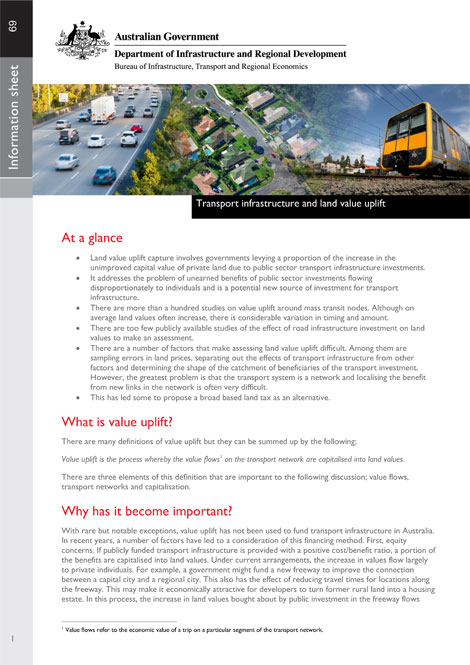
Users of the transport network are not its only beneficiaries. Land owners can also gain as increased value flows along the network are capitalised into land. Value uplift financing attempts to capture a portion of this by levying the landholders in the catchment areas of new infrastructure. The main problem with this system is that is very difficult to localise benefits in a network. This has led some to propose a broad based land tax instead.
- Transport infrastructure and land value uplift
Developing productivity elasticities for estimating WEBs in Australia—Scoping Study
Estimates of Wider Economic Benefits (WEBs) are increasingly featuring in cost-benefit analyses (CBAs) of major urban transport infrastructure projects. Governments are particularly interested in WEBs because they relate to productivity. The parameters used to estimate WEBs in Australia to date have been estimated using methodologies that are inconsistent and not in line with international best-practice. Thus the reliability and comparability of WEBs estimates in Australian CBAs is questionable. The report proposes a way to develop a robust set of parameters for practitioners to use when estimating WEBs.
The report was commissioned by BITRE on behalf of Steering Committee oversighting the Review of the National Guidelines for Transport System Management. If a robust set of parameters can be developed, it will be published in the Guidelines. BITRE engaged consultants KPMG to undertake the task.
- Developing productivity elasticities for estimating WEBs in Australia–Scoping Study
A study of the potential for dedicated freight infrastructure in Australia
The National Ports Strategy was developed by Infrastructure Australia (IA) and the National Transport Commission (NTC) in 2010 at the request of the Council of Australian Governments (COAG).
Recommendation 3.10 of the National Ports Strategy is that 'The Bureau of Infrastructure Transport and Regional Economics (BITRE) should assess the conditions under which the introduction of dedicated freight land transport infrastructure segments related to relevant container ports would be justified'. BITRE engaged consultants Ernst & Young to undertake the task.
The project involved a literature search with a review of overseas experiences, stakeholder consultation, identification of potential projects, and rapid cost–benefit and financial analyses of two case study projects to assess their potential viability.
The project concerned access to major Australian container ports only–Sydney, Melbourne, Brisbane, Adelaide and Fremantle. The term 'dedicated freight land transport infrastructure segments' has been interpreted broadly. It encompasses freight-only road and rail segments, tunnels, and lanes, but extends to infrastructure investments with a freight priority, for example, a road open to freight vehicles at all times but open to cars only during peak hours to relieve congestion.
Part A of the report contains the literature review, principles under which dedicated or priority freight infrastructure might be warranted, a survey of the landside access challenges facing major Australian container ports, and identification of potential case studies for further investigation.
Part B consists of the two case studies
- a new road link between the Port of Melbourne precinct and the West Gate Freeway, and
- a new rail link between the Port of Brisbane and the Surat Basin, which would carry coal and containers.
It should be noted that these are concept projects specified for the purposes of the case studies. They are not intended to replicate actual proposals previously or currently under consideration.
- A study of the potential for dedicated freight infrastructure in Australia
Major transport employment hubs
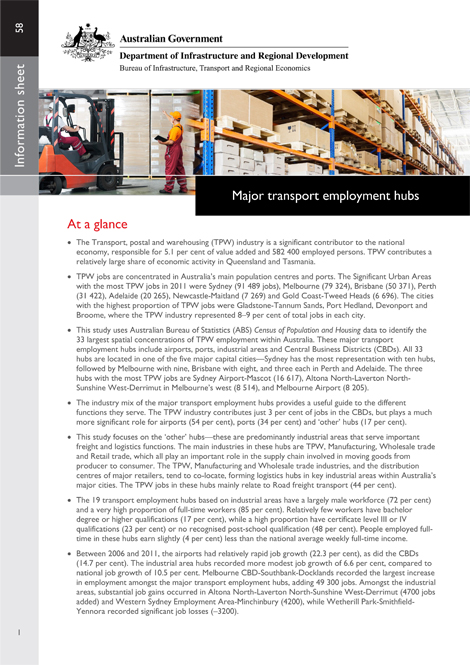
This Information Sheet identifies the 33 largest spatial concentrations of transport industry employment within Australia. These major transport employment hubs are all located within the five most populous capital cities and include airports, ports, CBDs and a range of industrial areas. This study presents evidence on the number of jobs located in each of these transport employment hubs, the industry mix of those jobs, and the characteristics of workers in each location. In particular, it focuses on investigating the nature of employment in the industrial area hubs, many of which serve important freight and logistics functions.
- Major transport employment hubs
National profile of Transport, postal and warehousing workers
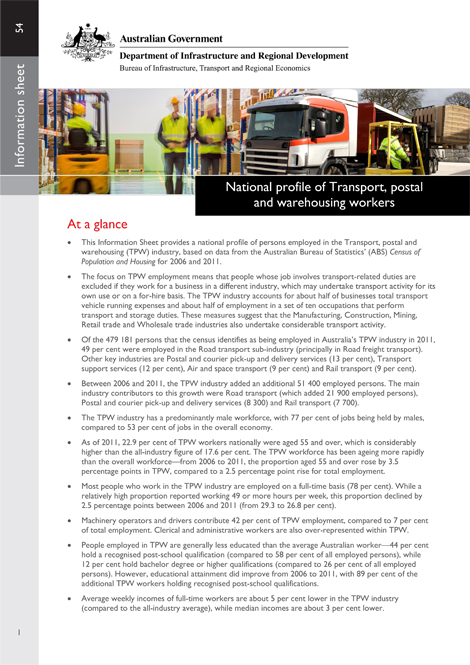
This study aims to improve understanding of the current characteristics of the Transport, postal and warehousing (TPW) workforce and how the workforce is evolving over time. It provides details of the sub-industries in which TPW workers are employed, their hours worked, gender, age, occupation, educational qualifications, income and commuting behaviour. It also describes some of the key changes that occurred between 2006 and 2011, such as the ageing and upskilling of the TPW workforce.
- National profile of Transport, postal and warehousing workers
Long-term trends in urban public transport
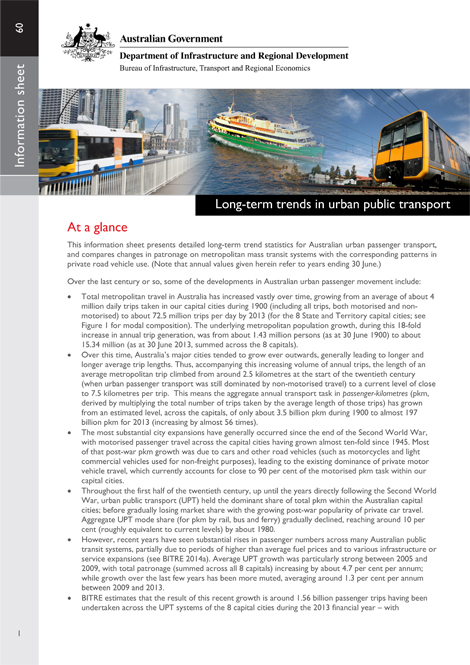
BITRE Information Sheet 60 provides detailed long-term trend statistics for Australian urban passenger transport. Historical time-series on passenger movement within the Australian capital cities, covering more than a century, contrast changes over time in patronage on urban public transport (UPT) systems with the corresponding patterns of private road vehicle use.
- Long-term trends in urban public transport
- Urban Transport Summary for 2013
- Latest urban transport statistics
Saturating daily travel
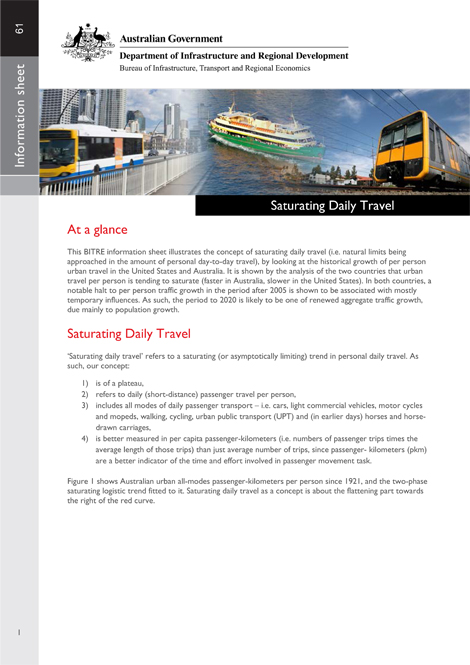
The Information Sheet models and forecasts urban passenger travel in Australian and American cities from 1921 to present. Passenger travel per person is saturating and so future growth in total urban travel will be closely linked to population growth.
- Saturating daily travel
Overview of project appraisal for land transport
On 5 September2014, Assistant Minister for Infrastructure and Regional Development, the HonJamie Briggs MP, released for public comment, a proposed project appraisal framework,developed by the Bureau of Infrastructure, Transport and Regional Economics, inconsultation with state and territory governments. BITRE has revised the paperin view of the submissions received. The Assistant Minister released the finalversion on 7 November 2014.
The paper is the outcome of Australian, state and territory governments agreeing to consult todevelop a more sophisticated and consistent framework to assess and evaluatemajor infrastructure projects.
- Overview of project appraisal for land transport