
Infrastructure, transport and productivity
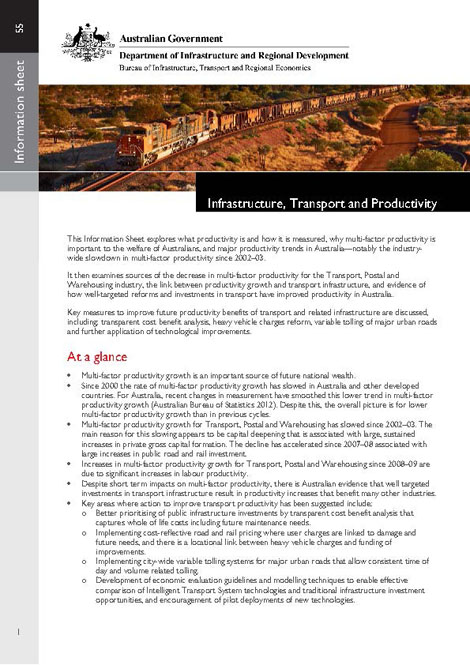
This information sheet reviews trends in Australian productivity with a focus on the transport sector.
Well targeted investments in transport infrastructure result in productivity increases that benefit many other industries. The paper provides for specific examples that cover trucks, freight, waterfront and rail productivity enhancements.
- Infrastructure, transport and productivity
Infrastructure Investment Macromonitor
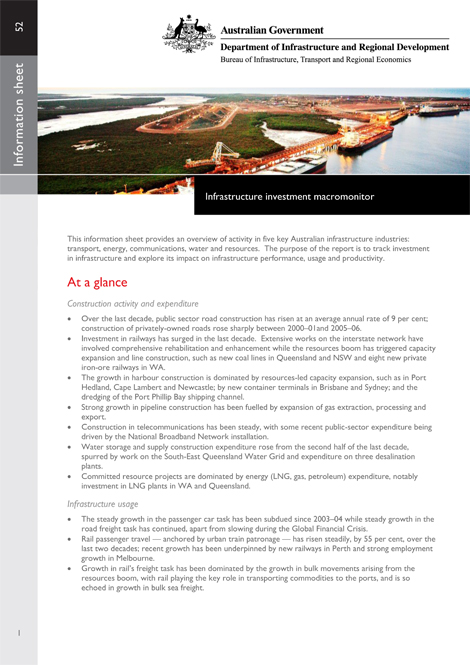
This information sheet provides an overview of activity in five key Australian infrastructure industries: transport, energy, communications, water and resources.
The purpose of the report is to track investment in infrastructure and explore its impact on infrastructure performance, usage and productivity.
- Infrastructure Investment Macromonitor
Australian infrastructure statistics—Yearbook 2013 and Key Australian infrastructure statistics booklet
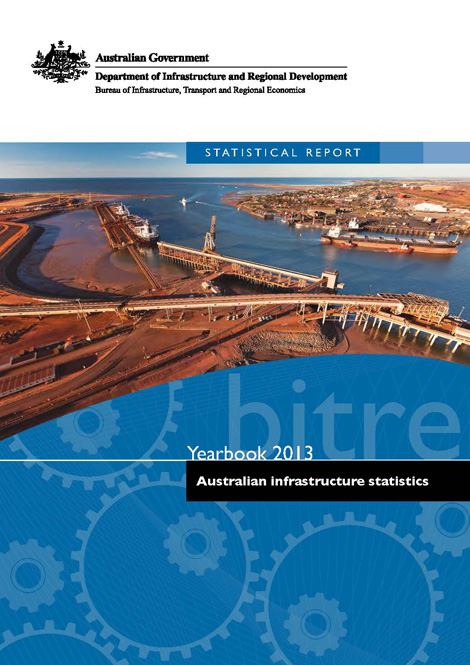
The Yearbook is an important piece of work for the Department and provides a comprehensive evidence base to examine long-term and emerging trends as well as inform policy development and regulatory reform in the transport, energy, water and communications sectors. It is the only comprehensive source of time series statistics for Australia's major areas of economic infrastructure. The Yearbook is accompanied by the first Key Australian Infrastructure Statistics booklet which is a summary of statistics from the Yearbook.
- Yearbook 2013–Australian Infrastructure Statistics
- Key Australian Infrastructure Statistics
- Australian Infrastructure Statistics
Yearbook 2013
Part 1–Infrastructure and the Economy
- Australian Infrastructure Statistics
Yearbook 2013
Part T–Transport
- Australian Infrastructure Statistics
Yearbook 2013
Part E–Energy
- Australian Infrastructure Statistics
Yearbook 2013
Part C–Communication
- Australian Infrastructure Statistics
Yearbook 2013
Part W–Water
Long-Term Emission Trends for Australian Transport
Paper given to the 31st Australasian Transport Research Forum, 2 October–3 October 2008, Gold Coast. Author: David Cosgrove.
- Long-Term Emission Trends for Australian Transport
Long-Term Patterns of Australian Public Transport Use
Paper given to the 34th Australasian Transport Research Forum, 28–30 September 2011, Adelaide. Author: David Cosgrove.
- Long-Term Patterns of Australian Public Transport Use
Investigating the Relationships Between Travel Patterns and Social Exclusion of Children in Sydney
Paper given to the 34th Australasian Transport Research Forum, 28–30 September 2011, Adelaide. Authors: Anatoli Lightfoot, Leanne Johnson.
- Investigating the Relationships Between Travel Patterns and Social Exclusion of Children in Sydney
Transport and Handling of Australia's Wool Production
The general approach in this Report is to concentrate on the costs directly borne by wool at the various stages of ownership from grower to mill. However, these costs are reflected in income accruing to others and the conflicts of interest this fact creates are not lost sight of in the report.
- Transport and Handling of Australia's Wool Production
Economic Evaluation of Capital Investment in Urban Public Transport
This Report was prepared as the basis for the Standing Committee of Advisers report to the Australian Transport Advisory Council on urban public transport needs in this decade.
- Economic Evaluation of Capital Investment in Urban Public Transport
This Report presents the evaluations of alternative public transport improvements in the urban corridor between Perth and Fremantle. The alternatives considered are a continuation of existing services, electrification of the existing rail service, and replacement of the railway with a busway.
- Perth Fremantle Corridor Study
Review of Public Transport Investment Proposals for Australian Capital Cities, 1973–74
This is the second Report by the BTE on capital investment in urban public transport, the previous Report having been produced in June 1972.
- Review of Public Transport Investment Proposals for Australian Capital Cities, 1973–74