
Interstate Freight on States Roads
Paper given to the 29th Australasian Transport Research Forum, 27–29 September 2006, Crowne Plaza Surfers Paradise, Gold Coast. Authors: David Gargett, Afzal Hossain and David Cosgrove.
- Interstate Freight on States Roads
Passenger Movements between Australian Cities, 1970–71 to 2030–31
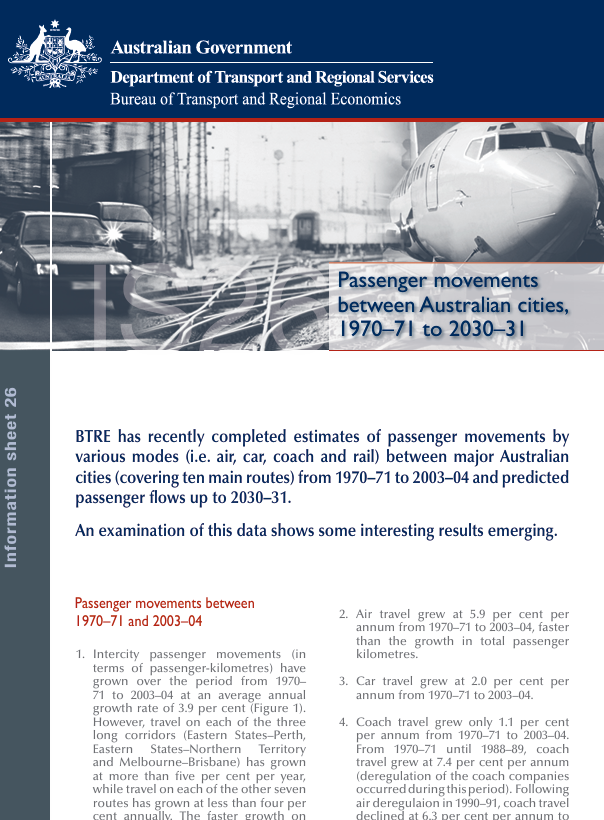
BTRE has recently completed estimates of passenger movements by various modes (i.e. air, car, coach and rail) between major Australian cities (covering ten main routes) from 1970–71 to 2003–04 and predicted passenger flows up to 2030–31.
Sales of New Motor Vehicles
This publication presents monthly information on sales of new motor vehicles in each state/territory in original, seasonally adjusted and trend estimated terms. The original data are sourced from the Federal Chamber of Automotive Industries. Sales data are available for passenger vehicles, sports utility vehicles (SUVs), other vehicles and total vehicles at the state/territory and national levels.
COAG commissioned the Review in February 2006 with a focus on national freight corridors but also examining local networks where they interact with, and impact on, these corridors. The Review report was prepared by a working group of representatives from the Department of Transport and Regional Services, State and Territory government transport and planning agencies and the Australian Local Government Association. The Review was overseen by the COAG Competition and Regulation Working Group. The BTRE provided the Secretariat to the Review.
- COAG Urban Congestion Review Report
- Congestion Management Approaches
- Freight Smart
- Traffic Management Systems (Urban Motorways)
- TMS Urban Non Motorway
Ex-post economic evaluation of National Highway projects, Case Study 1: Wallaville Bridge
This analysis is the first in a series of case studies undertaken for the BTRE ex-post road investments evaluation project. The project complements the recent implementation by juristictions of the Australian Transport Council endorsed National Guidelines for Transport System Management in Australia. In particular the project is intended to benefit both future project appraisal and future ex-post evaluation under Auslink and more generally.
- Ex-post economic evaluation of National Highway projects, Case Study 1: Wallaville Bridge
Estimating urban traffic and congestion cost trends for Australian cities
The study deals with the eight Australian capital cities, and presents base case (or business-as-usual) projections to 2020 of avoidable social costs of congestion for Australian metropolitan traffic. This work updates and revises previous congestion cost projections published by the Bureau (such as Information Sheet 14, BTE 1999), and has been completed to inform the Urban Congestion Review, which was commissioned by the Council of Australian Governments (COAG).
- Estimating urban traffic and congestion cost trends for Australian cities
Ex-post economic evaluation of National Highway projects, Case Study 2: Northam Bypass
BTRE's ex-post road investments evaluation project involves systematically reviewing after the fact the projected costs and benefits of major investments. The project complements the recent implementation by jurisdictions of the ATC-endorsed National Guidelines for Transport System Management in Australia. In particular, the project is intended to benefit both future project appraisal and future ex-post evaluation under AusLink and more generally. This analysis was one of the case studies undertaken for the BTRE ex-post road investments evaluation project. The case study provided an example of how to undertake an evaluation of a bypass project involving an improved treatment of delay effects at intersections using the Main Roads Western Australia's WARES evaluation software.
- Ex-post economic evaluation of National Highway projects, Case Study 2: Northam Bypass
Road Crash Cost Estimation: A Proposal Incorporating a Decade of Conceptual and Empirical Developments
Paper given to the 30th Australasian Transport Research Forum, 25–27 September 2007, Langham Hotel, Melbourne. Authors: Tim Risbey, Hema de Silva, Alicia Tong.
- Road Crash Cost Estimation: A Proposal Incorporating a Decade of Conceptual and Empirical Developments
How do fuel use and emissions respond to price changes? Briefing—1
The first in a new series of BITRE publications, this briefing reviews the responses that have been seen in Australian transport to recent fuel price rises (vehicle sales moving to smaller, more fuel efficient cars, more urban public transport, etc). The responsiveness of the various transport sectors is reviewed, as is the responsiveness of Australia relative to the United States.
- How do fuel use and emissions respond to price changes?
Moving urban Australia: can congestion charging unclog our roads?
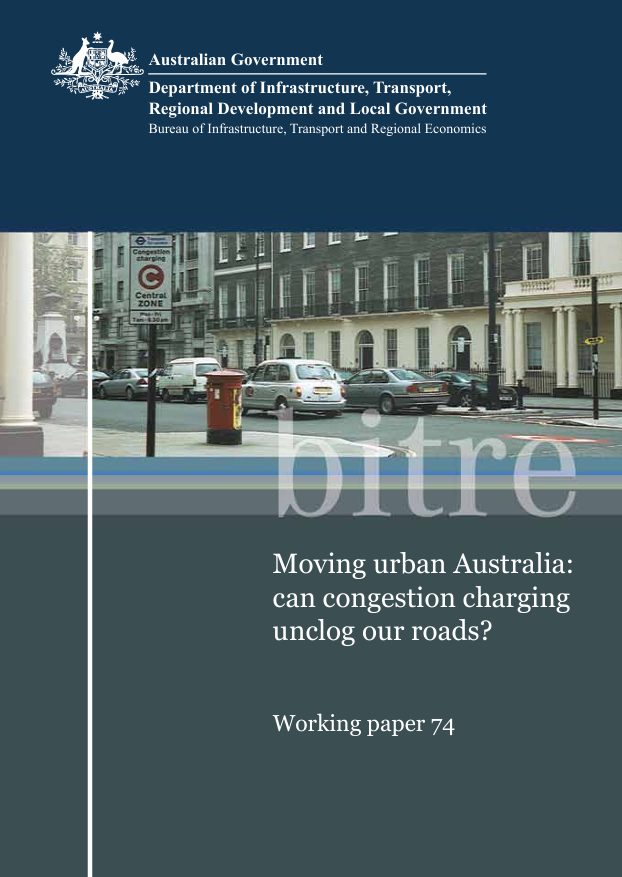
This report reviews the case for congestion charging and provides a policy framework for assessing charging systems. Congestion charging schemes are still in their infancy and evolving in concert with changing policy priorities and system technologies. While individual circumstances determine when and where congestion charging is in the interest of the wider community, some important general lessons can be drawn.
Update August 2009
Responses to the discussion of personalised promotion of alternatives to solo driving (pages 26–7), as one of the existing strategies to manage congestion, have drawn our attention, firstly, to some larger-scale current initiatives of Australian jurisdictions and, secondly, to more recent literature on the effectiveness of the travel behaviour change approach in relation to its various objectives, particularly reducing motorised trips and reducing greenhouse gas emissions.
For information on existing activities in 2 states, see About Travelsmart and Travelsmart General Information. On the effectiveness and impact of the travel behaviour approach, as implemented in Australia and the United Kingdom, see in particular: Australian Greenhouse Office, Evaluation of TravelSmart Projects in the ACT, South Australia, Queensland, Victoria and Western Australia 2001–2005, Department of Environment and Heritage 2006; Brog W. And Ker I., Myths, (Mis)perceptions and reality in measuring voluntary behaviour change, 8th International Conference on Survey Methods in Transport, Annecy, France, May 2008; Department for Transport (United Kingdom), Making Personal Travel Planning Work: Research Report, Integrated Transport Planning Ltd, December 2007; Department for Transport (United Kingdom), Impact assessment of the carbon reduction strategy for transport, July 2009; and Stopher P., Clifford E., Halling B., Evaluating a voluntary travel behaviour change by means of a 3-year GPS panel, Proceedings of the TDM2008 Conference, Vienna, Austria (forthcoming).