
Modelling the Road Transport Sector
This report was prepared by BITRE and CSIRO, in discussion with Treasury, to provide additional information on the road transport sector modelling carried out jointly by the two agencies in support of Treasury's broader modelling of the introduction of emissions trading in Australia.
- Modelling the Road Transport Sector
Improving urban congestion information for decision making: report to COAG from the Australian Transport Council
In April 2007, COAG considered the Urban Congestion Review it had commissioned in February 2006, and tasked the Australian Transport Council (ATC) with establishing arrangements to improve urban congestion data, modelling and performance information for decision-making. The following document, 'Improving Urban Congestion Information for Decision-Making', is a progress report to COAG of mid-2008. At its 7 November 2008 meeting, ATC noted further progress with implementing agreed approaches, including establishing a National Transport Modelling Working Group, progressing improved consistency between road-based and public transport congestion indicators, a survey of business sector travel, and analyses of specific congestion initiatives.
- Improving urban congestion information for decision making: report to COAG from the Australian Transport Council
National road network intercity traffic projections to 2030
This report provides long-term passenger and freight vehicle traffic projections for intercity corridors of the National Land Transport Network (NLTN) between 2005 and 2030.
- National road network intercity traffic projections to 2030
Urban Congestion Working Group: Australian Capital City Congestion Management Case Studies
This document presents a number of case studies by Australian jurisdictions on interventions they have undertaken to alleviate urban congestion pressures across their transport systems. Good congestion interventions can lead to significant improvements in congestion management and economic, environmental and social savings.
- Urban Congestion Working Group: Australian Capital City Congestion Management Case Studies
Road and Rail Freight: Competitors or Complements?
Up until the early 1960s, railways dominated all but the shortest land-based freight task. Since then, vast improvements in road vehicle productivity and road infrastructure quality, the gradual removal of regulations restricting road freight carriage and the exponential growth in interstate trade has broadened the range of freight tasks for which road is better suited than rail.
Fuel Consumption by New Passenger Vehicles in Australia 1979–2008

BITRE has examined trends in the fuel consumption of new passenger vehicles sold in Australia. Up to 2001, technological advances in engine technology, which improved fuel efficiency, were offset by increases in power, weight and the popularity of 4WD vehicles. Since 2001 the overall trend in fuel consumption has continued to decrease with average new light vehicle fuel consumption down 8.4 per cent to 8.14 litres per 100 kilometres (L/100 km).
- Fuel Consumption by New Passenger Vehicles in Australia 1979-2008
Urban Public Transport: Recent Bus Transport Statistics
This information sheet compiles data on urban public bus services by government and outsourced private sector providers in Australia's capital cities. Statistics examined include: total passenger boardings; passenger kilometres; in-service bus kilometres; boardings per service kilometre; bus services by capital city; and an overview of Australia's current bus systems.
- Urban Public Transport: Recent Bus Transport Statistics
Road Deaths in Australia 1925–2008
This information sheet contains a historical overview of road death statistics in Australian from 1925, when road deaths were first recorded, to 2008.
- Road Deaths in Australia 1925–2008
Cost of road crashes in Australia 2006
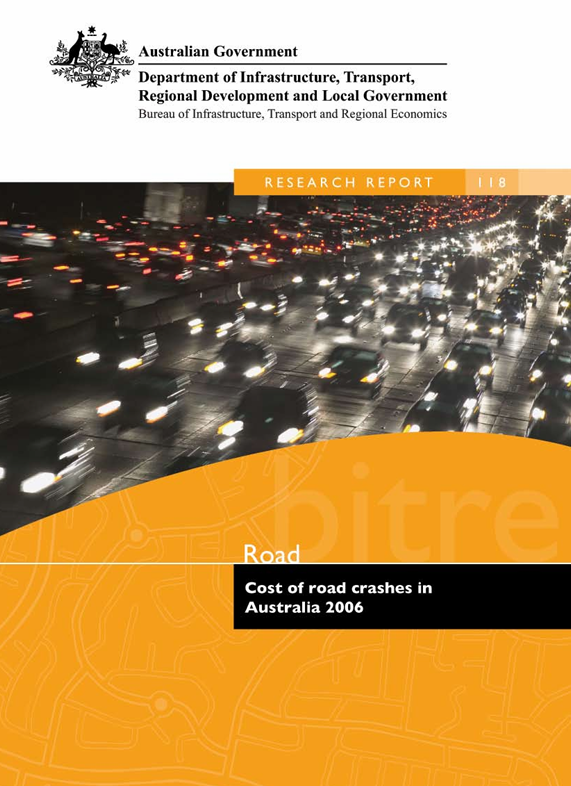
Road crashes impose large human and financial costs on society and substantial investments are made in infrastructure and safety programs to reduce road trauma. The cost of road crashes is important to the safety debate in Australia, and the unit values particularly for a fatality, injury or cost of a fatal crash are key inputs into policy development and cost-benefit analysis for safety programs and infrastructure projects. The social cost of road crashes in 2006 was an estimated $17.85 billion (1.7 per cent of GDP). This was a real decrease of 7.5 per cent compared to 1996 (2006 dollars). Estimated human losses were approximately $2.4 million per fatality, losses for a hospitalised injury were approximately $214 000 per injury (including disability-related costs), and losses for non-hospitalised injury were approximately $2200 per injury. These new estimates of the cost of road crashes update previous estimates for 1996 (Bureau of Transport Economics (BTE) Road crash costs in Australia, Report 102).
Road freight estimates and forecasts in Australia: interstate, capital cities and rest of state
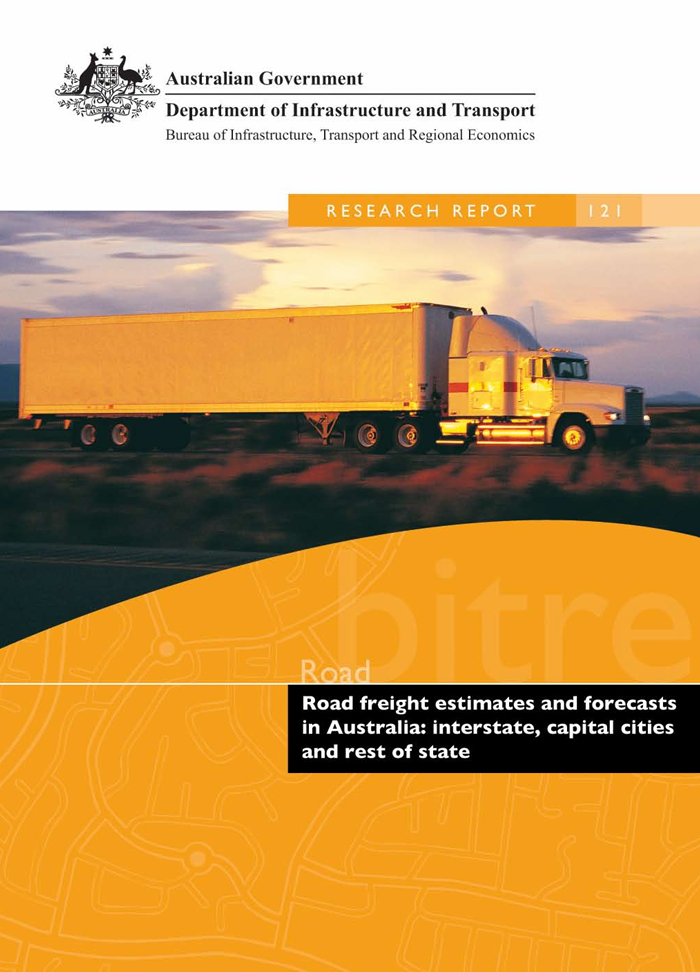
In Australia, road transport is the predominant mode for moving freight within the country, especially interstate and within capital cities. It represents a vital link in various logistics chains, providing access for freight to ports and terminals and urban freight distribution between warehouses and retail outlets. It is also the dominant mode for moving freight over relatively short distances and where alternatives are not readily available.