
Effectiveness of Measures to Reduce Road Fatality Rates

An earlier paper (Gargett et al 2009) showed, by very preliminary analysis of the Victorian road fatality rate, that a combination of increased seat belt wearing, random breath testing (RBT) and speed cameras explained almost all of the reduction in the Victorian road fatality rate since the late 1960s. The current analysis 1) extends the analysis to all states, 2) uses new estimates of vehicle kilometres travelled to derive an "exposure to death" variable and 3) includes actual measurements of state rates of seat belt wearing, as well as RBT and speed camera enforcement back to the inception of the programs in each state. The results of the analysis confirm the findings of the earlier paper seat belt wearing, RBT and speed cameras can explain almost all of the variation in fatality rates in all states since the late 1960s.
- Effectiveness of Measures to Reduce Road Fatality Rates
Fatal Road Crashes in Australia in the 1990s and 2000s: Crash Types and Major Factors
This information sheet aims to provide some statistical snapshots of the characteristics of fatal road crashes in Australia in the last two decades, 1990 to 2009, and complements the road safety statistical summary produced by BITRE each year which presents other key time series. It includes some insights into the types of crashes prevalent during this period, the major factors and the road user groups most frequently involved.
- Fatal Road Crashes in Australia in the 1990s and 2000s: Crash Types and Major Factors
Truck productivity: sources, trends and future prospects
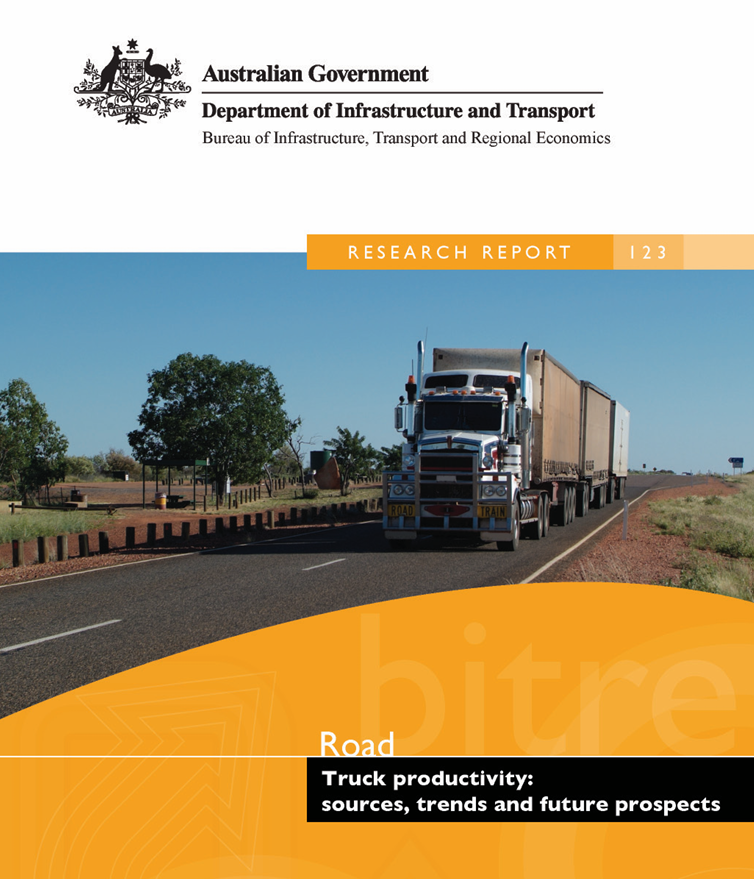
Analysis of the impact of past heavy vehicle reforms on truck productivity and projected future productivity trends.
Road vehicle-kilometres travelled: estimation from state and territory fuel sales
This report develops a methodology for estimating traffic levels for each of the eight states and territories in Australia from March 1965 to June 2010. This method is based on state and territory fuel sales data. Quarterly traffic on capital city roads was also estimated. The motor vehicle types used were passenger vehicles (i.e. cars), motorcycles, light commercial vehicles, rigid trucks, articulated trucks and buses, while three different types of fuel were considered, i.e. petrol, diesel and liquefied petroleum gas.
- Road vehicle-kilometres travelled: estimation from state and territory fuel sales
- Data for figures

- Data for tables
BITRE Road Construction and Maintenance Price Index—2011 update
This publication provides the 2011 update of BITRE's Road Construction and Maintenance Price Index.
- BITRE Road Construction and Maintenance Price Index–2011 update
Road Construction Price Indexes 1969–70 to 1980–81
This Report presents input-price indexes for national road construction activity for the period 1969–70 to 1980–81.
- Road Construction Price Indexes 1969–70 to 1980–81
BTE Road Construction Price Indexes 1971–72 to 1981–82
This Information Paper presents input-price indexes for national road construction activity for the period 1971–72 to 1981–82. This is part of a series which commenced in 1969–70.
- BTE Road Construction Price Indexes 1971–72 to 1981–82
BTE Road Construction Price Indexes: 1972–73 to 1982–83
This Information Paper presents input-price indexes for national road construction activity for the period 1972–73 to 1982–83. This is part of a series which commenced in 1969–70.
- BTE Road Construction Price Indexes: 1972–73 to 1982–83
BTE Road Construction Price Indexes: 1973–74 to 1983–84
This Information Paper presents input-price indexes for national road construction activity for the period 1973–74 to 1983–84. Earlier values of the indexes going back to 1969–70, can be found in BTE Report 49, Road Construction Price Indexes: 1969–70 to 1980–81. The BTE has compiled these indexes for use in its studies of the Australian road system. The indexes are also being published to assist those who require up-to-date information on movements in the prices of inputs to road construction.
- BTE Road Construction Price Indexes: 1973–74 to 1983–84
BTE Road Construction Price Indexes: 1974–75 to 1984–85
This Information Paper presents input-price indexes for national road construction activity for the period 1974–75 to 1984–85. Earlier values of the indexes, going back to 1969–70, can be found in BTE Report 49, Road Construction Price Indexes: 1969–70 to 1980–81. The BTE has compiled these indexes for use in its studies of the Australian road system. The indexes are also being published to assist those who require up-to-date information on movements in the prices of inputs to road construction.
- BTE Road Construction Price Indexes: 1974–75 to 1984–85