
Demand Projections for Auslink Non-Urban Corridors: Methodology and Projections
The Australian Government's AusLink initiative represents a new approach to planning and funding Australia's land transport infrastructure. Under AusLink the Australian Government will fund projects that have the greatest contribution to Australia's long-term economic prosperity, irrespective of the transport mode. AusLink will involve an integrated approach to planning, with three complementary levels of analysis:
- strategic network assessment;
- corridor assessments and;
- detailed project assessments.
Projections of future transport demand are a critical input into these assessments. In order to undertake more informed strategic network assessments, the BTRE has developed two models for projecting future non-urban passenger and freight transport demand: OZPASS non-urban passenger travel forecasting model; and FreightSim inter-regional freight forecasting model. This paper outlines the structure of these models and demonstrates their application to projecting future passenger and freight movements across the non-urban sections of the AusLink National Network. Readers should note that the road traffic projections presented in this paper are based on passenger travel and freight movement data for 1999 and road traffic data for various years between 1993 and 1996. These data sets were the most up-to-date data available to the BTRE when the analysis was undertaken. The BTRE intends to update these projections, using more current passenger and freight movements data, more recent regional population estimates and, in cooperation with the States and Territories, more recent road traffic data, when this data becomes available.
- Demand Projections for Auslink Non-Urban Corridors: Methodology and Projections
Freight measurement and modelling in Australia
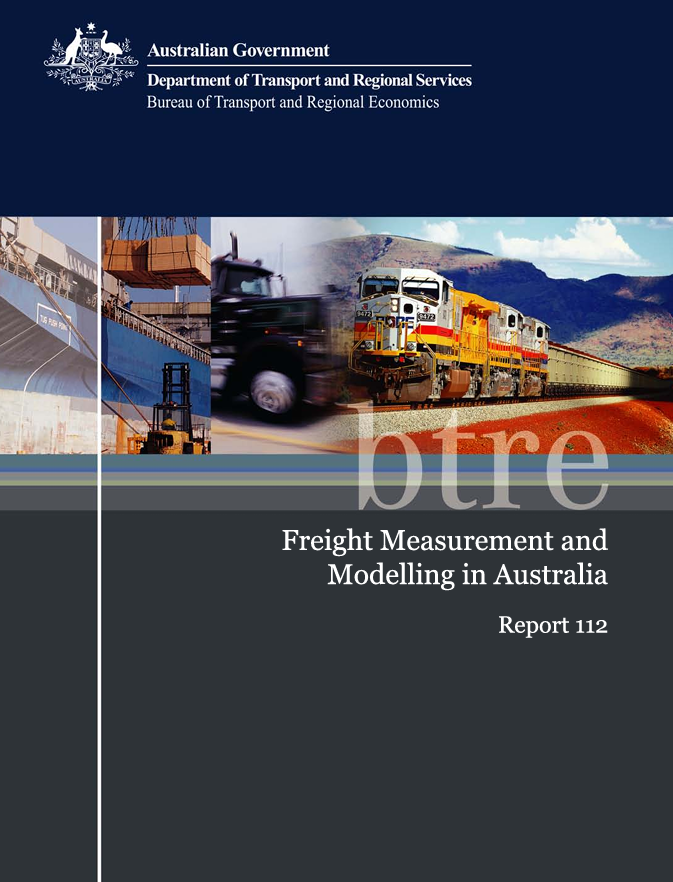
This report summarises the existing knowledge of freight in Australia and presents the time series data, analysis and sources which underpin the BTRE's long-term freight forecasts. Consistently measured time series data are required to model and forecast freight flows. The report describes the methodologies evolved by the BTRE to do this. It includes the results of modelling and forecasting undertaken using the derived series. Non-bulk freight is projected to increase by 82% in tonne-kilometre terms between 2003 and 2020 (average 3.6% per year).
The expected rate of growth in gross domestic product and reductions in freight rates are the key drivers of this growth as well as a continuing trend to national distribution by manufacturers, wholesalers and importers. With Treasury projecting some fall-off in the long-term economic growth, the non-bulk growth rate is slightly lower than in the recent past. Based on past trends, road's share of national non-bulk freight is projected to increase marginally from 74% to 76%, with the rail share declining from 21% to 17% and sea freight making up the balance (with air freight vanishingly small in tonne-kilometre terms, albeit not in value).
These mode share projections do not take account of the potential for rejuvenation of rail on north-south routes, in somewhat the same manner as has already occurred on east-west routes. Capital city freight tonne-kilometres are projected to grow by 3.0% a year between 2003 and 2020 (compared with a 1971–2003 average of 5.0%). While heavy vehicles comprise only 4% of the metropolitan traffic stream, growth of this level implies a slight increase in the heavy vehicle proportion (to 4.2% in 2020).
Rail is expected to remain the largest mode in shipping bulk freight (46% share in 2003, 45% in 2020), followed by sea freight (30% and 29% shares respectively). Rail is well suited for transporting Australia's large export tonnages in coal, other minerals and grains to port. Rail freight has fallen in most other bulk commodities.
Port Level Forecasts of Container and Ship Movements in Australia: 2004–05 to 2024–25
Paper given to the 29th Australian Transport Research Forum conference to be held from 27 to 29 September 2006 in Gold Coast. Authors: Krishna Hamal, Benjamin James, Mark Cregan.
- Port Level Forecasts of Container and Ship Movements in Australia: 2004–05 to 2024–25
Passenger Movements between Australian Cities, 1970–71 to 2030–31
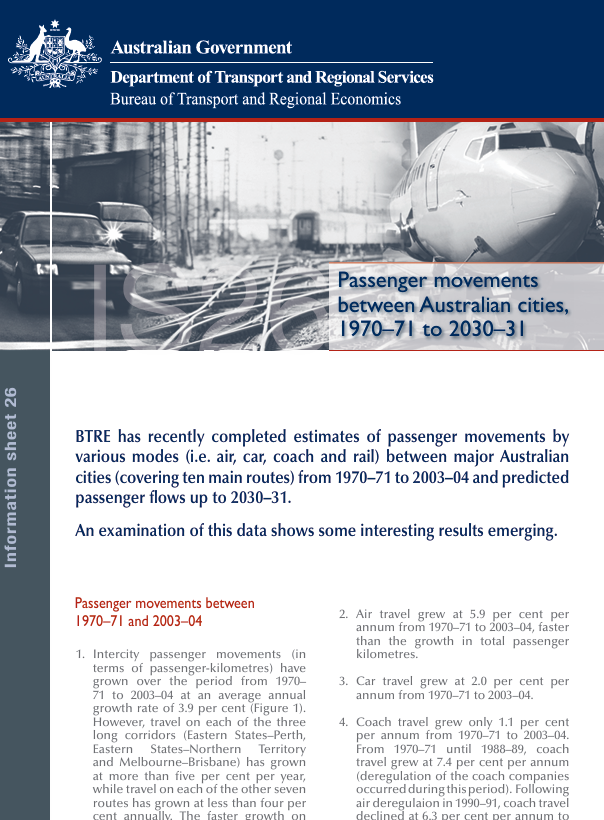
BTRE has recently completed estimates of passenger movements by various modes (i.e. air, car, coach and rail) between major Australian cities (covering ten main routes) from 1970–71 to 2003–04 and predicted passenger flows up to 2030–31.
Container and Ship Movements Through Australian Ports 2004–05 to 2024–25
This report presents the national and port level forecasts of container and ship movements through Australian ports over the next twenty years.
- Container and Ship Movements Through Australian Ports 2004–05 to 2024–25
National Workshop on Urban Transport Modelling
In order to maximise the value of urban transport modelling as a tool for improving urban congestion interventions, a National Workshop on Urban Transport Modelling was held in Canberra on 5 March 2008. It was co-convened by the Urban Congestion Management Working Group and the Bureau of Infrastructure, Transport and Regional Economics.The workshop brought together nearly 60 participants, including urban transport modellers, decision-makers, research bodies and transport and planning agencies.
The initiative to organise a national workshop on urban transport modelling derives from COAG's consideration of the Urban Congestion Review in April 2007. COAG tasked the Australian Transport Council of Ministers (ATC) with establishing arrangements to improve urban congestion data, modelling and performance information for decision-making and to report back to COAG by June 2008.ATC subsequently asked the Standing Committee on Transport (SCOT), through the SCOT Urban Congestion Management Working Group, to progress this agenda. The proposal for a national urban transport modelling workshop was one ofa small number of actions endorsed by SCOT to assist in developing improving information for urban congestion decision-making.
Presentations
The morning consisted of a series of papers presented by experts in six key urban congestion management intervention areas. Keynote papers were also given by the Department of Infrastructure, Transport, Regional Development and Local Government Secretary, Michael Taylor AO, and Professor David Hensher. The afternoon consisted of a series of small group workshops to propose a number of possible future action areas.
Presentations in the morning sessions were as follows:
- Professor David Hensher, Keynote Address, Institute of Transport and Logistics Studies, Faculty of Economics and Business, The University of Sydney
- Rod Tudge, Traffic Management and Microsimulation, Traffic and Transport Modelling, Roads and Traffic Authority, New South Wales
- Lindsay Oxlad, Road Pricing, Road Transport Policy and Investment, Department for Transport, Energy and Infrastructure, South Australia
- Professor Graham Currie, Public Transport, Public Transport, Civil Engineering, Monash University
- Associate Professor Geoff Rose, Passenger Travel Demand Management, Institute of Transport Studies, Civil Engineering, Monash University
- Fotios Spiridonos, Freight and Business Sector Transport and Victoria's Freight Movement Model (VicFMM), Transport Modelling and Analysis Policy, Intergovernmental Relations Division, Department of Infrastructure, Victoria
- Frank Milthorpe, Integrated Transport and Land Use, Transport Model Development, Transport Data Centre, Ministry of Transport, New South Wales
Please see below for links to presentation slides and photos of the day.
Outcomes
The workshop recognised that modelling is capable of informing urban congestion management interventions but that currently policy and modelling are not well coordinated. Improvements need to be made for policy makers and modellers to work collaboratively in framing appropriate urban congestion management questions. The socio-economic impact of urban congestion interventions, for example, is an area which needs to be better modelled and understood.
The following five key areas summarise the proposed areas which received most support for further action:
- Time of travel and behaviour shifts (i.e. how people make travel decisions) are not adequately modelled: New models need to be developed for peak spreading/time of day choice. Current models often exaggerate modal shift, compared to changing time of travel.
- Socio-economic impacts of various interventions are not modelled to an adequate level: For example the distributional impacts of road pricing on different socio-economic groups; willingness to pay; ability to pay and access to alternatives, need to be captured.
- Freight/Light Commercial Vehicles: A cost-effective way of getting data for freight and business sector transport modelling needs to be found. The establishment of a Freight Movement Working Group to develop and implement a better data framework for freight and business sector transport was recommended.
- Reliability modelling: Better modelling is needed to assess the role reliability plays in mode choice and how reliability affects patronage, compared to other aspects of travel choice.
- Collaboration to improve methodologies: There has been a lack of communication and collaboration between agencies, academics and decision makers and this makes maximising the uses of modelling for national urban congestion strategy difficult. Informal networks need to be strengthened and 'best Australian practice' needs to be documented. A clearing house for modelling resources needs to be established.
- David Hensher

- Rod Tudge
- Graham Currie
- Geoff Rose
- Fotios Spiridonos
- Frank Milthorpe
- Photos from the workshop
Air passenger movements through capital city airports to 2025–26
This report presents the forecasts of passenger and aircraft traffic at capital city airports over the next 20 years. The forecasts have been developed on the basis of the estimated econometric models of passenger demand and the most recent economic outlook for Australia and its major trading partners. Australia's eight capital city airports (Adelaide, Brisbane, Canberra, Darwin, Hobart, Melbourne, Perth and Sydney) are included in the development of the forecasts. The report has been updated to 2029–30 in Aircraft movements through capital city airports to 2029–30 in Research report 117.
- Air passenger movements through capital city airports to 2025–26
Modelling the Road Transport Sector
This report was prepared by BITRE and CSIRO, in discussion with Treasury, to provide additional information on the road transport sector modelling carried out jointly by the two agencies in support of Treasury's broader modelling of the introduction of emissions trading in Australia.
- Modelling the Road Transport Sector
National road network intercity traffic projections to 2030

This report provides long-term passenger and freight vehicle traffic projections for intercity corridors of the National Land Transport Network (NLTN) between 2005 and 2030.
- National road network intercity traffic projections to 2030
Urban Congestion Working Group: Critical transport modelling reviews
Reports commissioned in 2009 by the National Transport Modelling Working Group (NTMWG) critically reviewed the current status of the modelling tools available through each of the government agencies in relation to the various models' capability in each capital city. The work identified a number of enhancements for measuring the potential impacts of demand management approaches on road outcomes such as urban congestion. The NTMWG comprises members from each of the government agencies with ownership of the transport models for the respective capital cities; the Department of Infrastructure, Transport, Regional Development and Local Government; and the Bureau of Infrastructure, Transport and Regional Economics.
- Critical Review of Transport Modelling Tools
- Implementation Options Report