
Forecasting Light Vehicle Traffic
The Bureau of Transport Economics (BTE) has developed and applied methods for forecasting light vehicle traffic on the nation's roads. This paper describes the methods and provides estimates and projections of light vehicle traffic within major Australian cities and on Australia's principal non-urban highways. A simple model was developed to predict the growth of total light vehicle traffic in each of Australia's major cities. When linked to congestion models, the BTE results presage a looming congestion problem in our cities. The most significant contribution of the Working Paper is the development of new models for long-term forecasting of light vehicle traffic on Australia's non-urban highways. As far as the BTE is aware, its methodology has not previously been used in Australian studies. Data from a number of different sources have been utilised to estimate interregional passenger travel by domestic residents and light vehicle highway traffic. The traffic projections indicate that growth in traffic volumes on the National Highway system will be greatest on those sections linking the major capitals; Adelaide Melbourne, Sydney, Brisbane and regional centres in between.
- Forecasting Light Vehicle Traffic
Urban Transport: Looking Ahead
Australian cities have been transformed from fairly tightly knit core-and-spoke configurations, to sprawling suburban low-density configurations. This transformation of urban land use has been accompanied and made possible by a rapid improvement and spread of the road system, and an even more rapid expansion in per person car ownership.
- Urban Transport: Looking Ahead
Freight Between Australian Cities
This information sheet provides estimates of non-bulk freight flows over seven intercity corridors for the 25 years from 1970 to 1995.
- Freight Between Australian Cities
Brisbane to Melbourne Rail Link: Economic Analysis
Historically, railways have provided the means to open up new areas for economic development. When built to link existing centres of economic activity, they have given rise to greatly increased opportunities for trade and travel.
- Brisbane to Melbourne Rail Link: Economic Analysis
Australia's Seaborne Containerised Freight: Forecasts to 2010–11
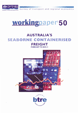
This study analyses and forecasts trends in the usage of containers for the carriage of Australia's seaborne freight over the period 2001–02 to 2010–11. The study also estimates the proportion of 40-foot containers used in Australia's inbound and outbound seaborne trade and assesses the implications of their increasing use over time.
- Australia's Seaborne Containerised Freight: Forecasts to 2010–11
Australia's Seaborne Containerised Freight
This publication forecasts container movements into and out of Australia. Combined Australian containerised imports and exports are expected to increase at an average annual rate of 5 per cent over the period 2001–02 to 2010–11.
- Australia's Seaborne Containerised Freight
Greenhouse Gas Emissions from Transport: Australian Trends to 2020
This report presents the results of a BTRE study to update base case (or 'business-as-usual') projections of greenhouse gas emissions from the transport sector. The work was undertaken on behalf of the Australian Greenhouse Office (AGO).
The work updates previous Bureau projections of transport sector greenhouse gas emissions published in Bureau of Transport and Communications Economics (BTCE) Report 88 (Greenhouse Gas Emissions from Australian Transport: Long-term projections) and BTCE Report 94 (Transport and Greenhouse: Costs and options for reducing emissions).
- Greenhouse Gas Emissions from Transport: Australian Trends to 2020
Freight Between Australian Cities 1972 to 2001
This paper provides estimates of non-bulk freight flows over seven intercity corridors for three decades from 1972 to 2001. Earlier estimates to 1995 were published in Information Sheet 17.
- Freight Between Australian Cities 1972 to 2001
Greenhouse Gas Emissions From Australian Transport: Base Case Projections to 2020
This report presents the results of a Bureau of Transport and Regional Economics (BTRE) study to update base case projections of greenhouse gas emissions from the Australian transport sector. This work updates previous projections provided to the Australian Greenhouse Office (AGO) in July 2003 as an unpublished consultancy report–Aggregate Greenhouse Gas Emissions from Australian Transport: Base Case Projections (Bottom-Up Approach) to 2020.
- Greenhouse Gas Emissions From Australian Transport: Base Case Projections to 2020
Risk in Cost-Benefit Analysis
For cost-benefit analyses (CBA) of public-sector projects, a common misconception is that the discount rate should include a risk premium in consonance with the private-sector practice of doing so. In examining the issue, this report addresses different types of risk separately including downside risk, which arises from optimistic bias in forecasts and pure risk, which is the variation remaining around the mean after removing downside biases.
- Risk in Cost-Benefit Analysis