
Cost of Aviation Accidents and Incidents
This report provides estimates of the total cost to Australia of aviation related accidents and incidents that occurred in the financial year 2003–04. It also reports the cost per accident and the cost attributable to a fatality. It is an update of Cost of Civil Aviation Accidents and Incidents published by the Bureau of Transport Economics in 1998, which estimated costs for 1996.
- Cost of Aviation Accidents and Incidents
Skill Shortages in Australia's Regions
Skill shortages are a well documented issue both in Australia and overseas, but the problem itself is not well defined. Most of the previously published work has been conducted on a national or industry wide scale. The BTRE approach focused on the relationship between skill shortages and location, using local skill audits, commissioned reports and industry focused studies.
- Skill Shortages in Australia's Regions
Drivers of Economic Growth in the Greater Sydney Metropolitan Region

The Greater Sydney Metropolitan Region is one of the fastest growing metropolitan areas of Australia. This project improves our understanding of socio-economic drivers of growth in this region. 54 Statistical Local Areas (SLAs) in the region were analysed, and the study covers the period 1991 to 2001. The paper is accompanied by the Drivers of Economic Growth in the Greater Sydney Metropolitan Region database.
- Drivers of Economic Growth in the Greater Sydney Metropolitan Region
- Statistical Index

Submission to the Productivity Commission Road and Rail Freight Infrastructure Pricing Inquiry
The submission commences with a brief general discussion of the economics of road and rail infrastructure and some implications for pricing; examines the relationship between estimates of road infrastructure costs attributable to Australian heavy vehicle operators and charges paid, both at the aggregate level and for particular road corridors; discusses issues in improving the efficiency of both road and rail freight infrastructure pricing, and finally considers the question of charging for freight externalities.
- Submission to the Productivity Commission Road and Rail Freight Infrastructure Pricing Inquiry
Interstate Freight on States Roads
Paper given to the 29th Australasian Transport Research Forum, 27–29 September 2006, Crowne Plaza Surfers Paradise, Gold Coast. Authors: David Gargett, Afzal Hossain and David Cosgrove.
- Interstate Freight on States Roads
Optimising Harmonisation in the Australian Railway Industry
In the last decade, Australia's railways have undergone an ownership, operational and technological revolution. The establishment of national public and private train operators has finally brought seamless rail freight services across the country. There has been a complementary development in track management, with one manager (Australian Rail Track Corporation) rather than five, now controlling most of the interstate track.
The standardisation of the Melbourne-Adelaide railway in 1995 removed the break-of-gauge on the East-West Corridor. This has facilitated the subsequent more than doubling of rail freight task between those cities.
Infrastructure investments and complementary funding of new generation locomotives have enabled train operators to harness train economics of heavier, longer trains, for instance, with Melbourne-Adelaide trains now 50 per cent longer than a decade ago.
These changes are transforming the industry. However, the perception is that the legacy of the separate State-based networks may still draw a long shadow over the performance of the network. This report investigates the extent to which physical, operational and regulatory breaks-of-gauge impede the industry. The report provides guidance to policy makers and industry on those issues.
- Optimising Harmonisation in the Australian Railway Industry
National guidelines for transport system management in Australia
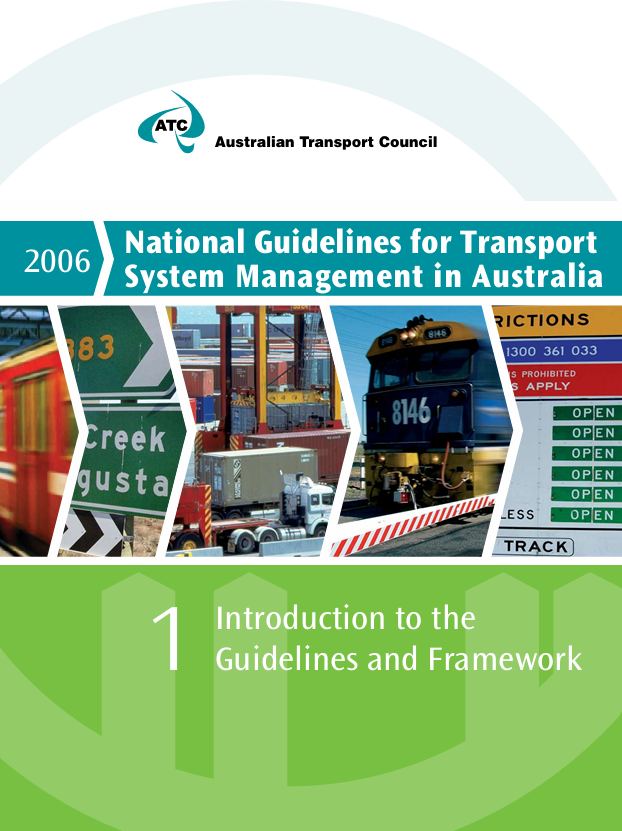
The first edition of the Guidelines (ATC 2004a) was produced by the Guidelines Assessment Methodology Working Group (endorsed by the Standing Committee on Transport). It incorporated a generic framework with an initial focus on non-urban land transport (road, rail, inter-modal).
In 2005, The Australian Transport Council (ATC) established a Guidelines Implementation Committee (GIC) to review, update and improve the Guidelines in line with learnings and feedback received during their implementation. The ATC also asked the GIC to extend the Guidelines to urban transport.
This second edition of the Guidelines has been produced by the GIC in response to the directive of the ATC. The Guidelines have been restructured to make them more concise, accessible and user-friendly, while maintaining rigour. The Guidelines have also been extended to urban transport.
Filling a gap in rail data: an investigation of the Gheringhap Loop train sightings
This paper analyses train sightings data collected at Gheringhap, Victoria, located on the Melbourne to Adelaide main line. These sightings provide an independent source of information on train movements, train lengths, and reliability, and, given knowledge of freight volumes, can be used to estimate average wagon loads. In cases where trains are not scheduled, sightings such as these are presently the only publicly available source of data for freight volumes on specific routes.
Following the growth in private train operations since the mid-1990s and the privatisation of National Rail in 2002, rail freight activity data became increasingly scarce. The lack of data can be a challenge for the BTRE in providing the government with timely and accurate information about trends in Australian freight transport. The rail industry has recognised this deficiency: the Australasian Railway Association and its members are working with the BTRE to produce the first public report on the performance of the Defined Interstate Rail Network and to supply data for AusLink planning.
In the meantime, the BTRE has investigated other potential data sources, including information from railway enthusiasts. This paper presents an analysis of one such source of rail data that is reported online, from video-taped observations made and collated by Graham Elliott at Gheringhap Loop, Victoria, on the mainline between Adelaide and Melbourne. The paper provides a short review of the reliability of the data, makes observations about trends in freight activity from the data set, and draws some conclusions about the value of the data collection method.
- Filling a gap in rail data: an investigation of the Gheringhap Loop train sightings
Sales of New Motor Vehicles
This publication presents monthly information on sales of new motor vehicles in each state/territory in original, seasonally adjusted and trend estimated terms. The original data are sourced from the Federal Chamber of Automotive Industries. Sales data are available for passenger vehicles, sports utility vehicles (SUVs), other vehicles and total vehicles at the state/territory and national levels.
COAG commissioned the Review in February 2006 with a focus on national freight corridors but also examining local networks where they interact with, and impact on, these corridors. The Review report was prepared by a working group of representatives from the Department of Transport and Regional Services, State and Territory government transport and planning agencies and the Australian Local Government Association. The Review was overseen by the COAG Competition and Regulation Working Group. The BTRE provided the Secretariat to the Review.
- COAG Urban Congestion Review Report
- Congestion Management Approaches
- Freight Smart
- Traffic Management Systems (Urban Motorways)
- TMS Urban Non Motorway