
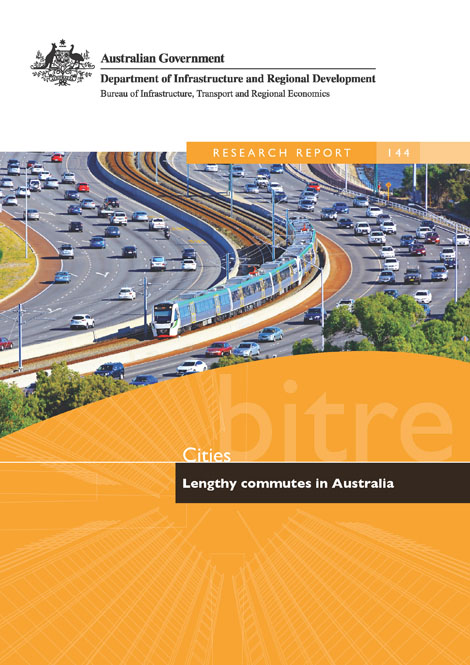
The research provides a solid evidence-base to understand who is undertaking lengthy commutes (those longer than 45 minutes one way), their prevalence and trends. It also explores whether some individuals undertake lengthy commutes for long periods or whether it tends to be temporary.
- Lengthy commutes in Australia
- Data figures from report 144
Australia's commuting distance: cities and regions
The 2011 average commuting distances reflect recent evidence on commuting from home to a place of work at a range of spatial classifications or localities. The main interest is in understanding the patterns and average commuting distances under current land use and availability of transport infrastructure.
- Australia's commuting distance: cities and regions
National profile of Transport, postal and warehousing workers
This study aims to improve understanding of the current characteristics of the Transport, postal and warehousing (TPW) workforce and how the workforce is evolving over time. It provides details of the sub-industries in which TPW workers are employed, their hours worked, gender, age, occupation, educational qualifications, income and commuting behaviour. It also describes some of the key changes that occurred between 2006 and 2011, such as the ageing and upskilling of the TPW workforce.
- National profile of Transport, postal and warehousing workers
Ports: job generation in the context of regional development
This paper presents recent evidence on jobs at Australian ports, based on ABS Census of Population and Housing data. It examines 17 major ports that are of national economic significance, based on the level of activity as measured by ship visits, throughput and the value of trade. It presents the number of jobs located at port precinct, the industry structure, median age, educational qualifications and skill mix of that employment.
- Ports: job generation in the context of regional development
The evolution of Australian towns

This is a historical, economic analysis of change in Australian settlement patterns over a century. Towns have been subject to significant economic, social and technological changes since 1911. This report examines how Australia's town settlement patterns reacted to that change and examines the underlying factors and processes involved. It examines the interacting effects of geography, history, goods and services markets, industry, amenity and investment. The analysis reveals the important roles of competition, existing infrastructure, improved technology, longer life expectancy and increased wealth. It concludes that a stronger focus on amenity and services are likely potential success factors for modern towns.
- The evolution of Australian towns–full report
- Preliminaries
- Executive Summary
- Chapter 1
- Chapter 2
- Chapter 3
- Chapter 4
- Chapter 5
- Chapter 6
- Chapter 7
- Chapter 8
- Chapter 9
- Chapter 10
- Chapter 11
- Chapter 12
- Appendix A
- Appendix B
- Appendix C
- Appendix D
- Appendix E
- Abbreviations and references
Air transport service trends in regional Australia (2013 update)
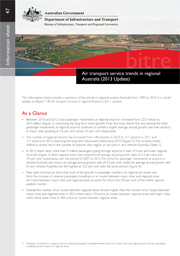
This information sheet provides a summary of key trends in regional aviation Australia from 1984 to 2012. It is a brief update to Report 130 on Air transport services in regional Australia (2011 update).
- Air transport service trends in regional Australia (2013 update)
Air Transport Service Trends in Regional Australia—2011 update
This report updates and supersedes the time series statistics presented in Report 115 and Information sheet 35 on Air transport services in regional Australia: trends and access. It updates the data (to 2012) and the geographic basis of the analysis.
- Air Transport Service Trends in Regional Australia–2011 update
Long Distance Commuters in Australia: A Socio-Economic and Demographic Profile
Paper given to the 34th Australasian Transport Research Forum, 28–30 September 2011, Adelaide. Authors: Hema de Silva, Leanne Johnson, Karen Wade.
- Long Distance Commuters in Australia: A Socio-Economic and Demographic Profile
Freight Transport to North West Australia, 1975–1990
The rapid development of mining in the Pilbara region of north west Australia has already increased the transport task in the region and is expected to increase it much more. In the past, there has been little land transport to the north west, and the major service has been by sea.
In the fluid situation generated by rapid development, it is important to ask how the freight task should be performed in future, whether the shares carried by the various transport modes should be changed and whether there should be radical changes in the whole transport system to the region. These are the questions that this report sets out to answer.
- Freight Transport to North West Australia, 1975–1990
Eastern By-Pass Routes for Launceston: Evaluation
In April, 1976, the Minister for Transport, requested the Commonwealth Bureau of Roads to report on "the justification and timing for the construction of an Eastern by-pass of Launceston, including the question of whether such a bypass would warrant inclusion in the Declared National Highway System". After identifying the most desirable of a number of alternative Eastern by-pass routes, the report states that at this time there is no economic warrant for an Eastern by-pass.
- Eastern By-Pass Routes for Launceston: Evaluation