
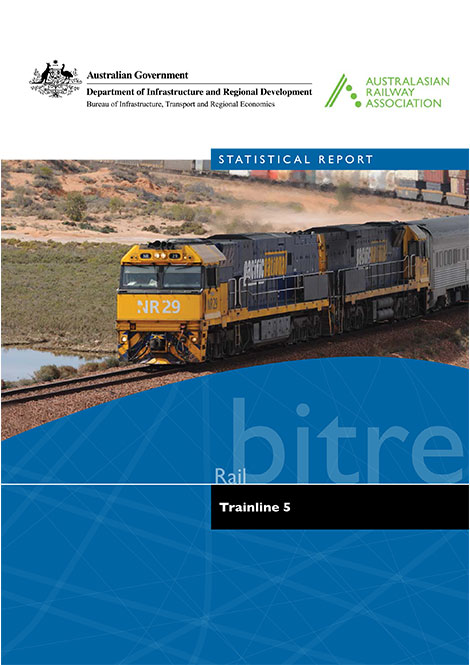
Trainline is a compendium of Australia's railways providing insights, analysis, and an understanding of the railway industry. Australia's railways are evolving via changes within and outside the industry. These changes include logistics, commodity flows, technology, urban patronage, and regional passenger services. The publication presents an overview and data on railway transport tasks performed, characteristics of the railways and train operators' rolling stock that runs and aspects of railway performance including safety, environment and reliability.
Measuring infrastructure asset performance and customer satisfaction: A review of existing frameworks
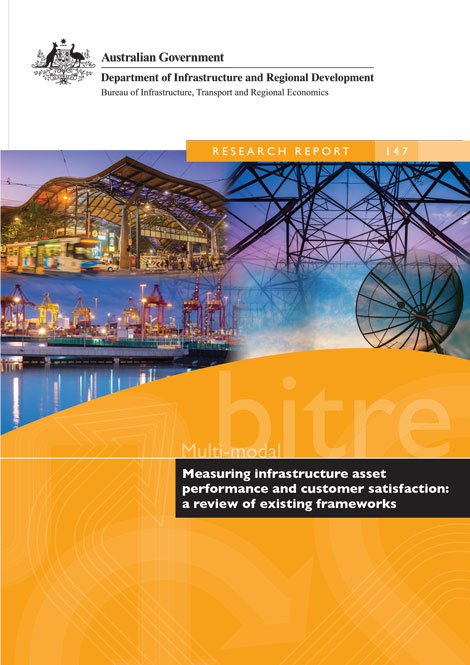
Well-managed, modern and functioning infrastructure underpins much of the economic prosperity of Australia. It is thus crucial that Australia's infrastructure keeps up with the needs of the community.
While some infrastructure asset types, namely public roads and airports, have made significant progress in performance measurement, for others there is a dearth of information or public engagement. The patchwork approach that has resulted means that Australia may be missing out on the potential benefits of consistent and widespread performance measurement: improved accountability, incentivised performance, and better performance evaluation. This report introduces and explores many of the issues surrounding infrastructure performance measurement that should be considered in the context of providing greater consistency across infrastructure asset types.
- Measuring infrastructure asset performance and customer satisfaction: A review of existing frameworks
Fuel economy of Australian passenger vehicles—a regional perspective
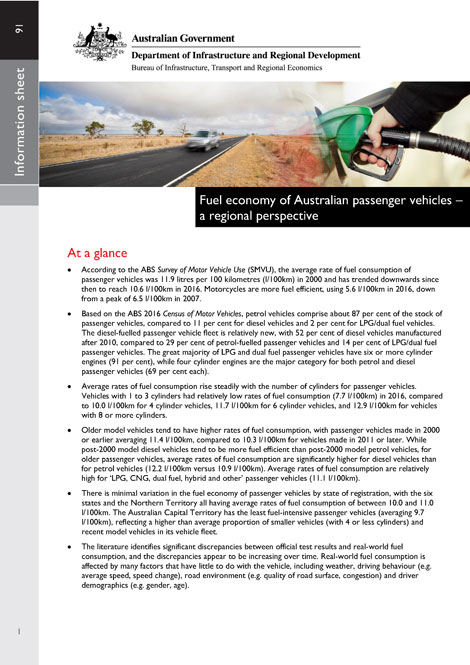
This information sheet presents Australian data on how realised rates of fuel consumption vary over time, and how the rates depend on key vehicle characteristics such as number of cylinders, fuel type and vehicle age. It also investigates state/territory differences in fuel economy and presents new small area estimates of the average rate of fuel consumption for Australia's regions.
These small area estimates are based on the composition of the passenger vehicle and motorcycle fleet in the region, and are derived at both the Statistical Area Level 3 (SA3) and Statistical Area Level 4 (SA4) scale. The key data sources are the Australian Bureau of Statistics (ABS) Survey of Motor Vehicle Use (SMVU) 2016 and the ABS Census of Motor Vehicles 2016.
- Fuel economy of Australian passenger vehicles–a regional perspective
Growth in the Australian Road System
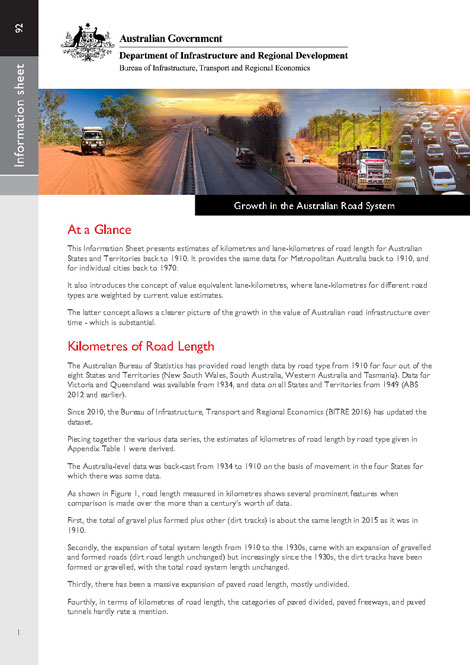
This information sheet presents estimates of Kilometres and lane-kilometres of road length for Australian States and Territories back to 1910. It provides the same data for Metropolitan Australia back to 1910, and for individual cities back to 1970.
It also introduces the concept of value equivalent lane-kilometres, where lane-kilometres for different road types are weighted by current value estimates.
The latter concept allows a clearer picture of the growth in the value of Australian road infrastructure over time–which is substantial.
- Growth in the Australian Road System
Infrastructure and Transport PPPs and Privatisation in Australia
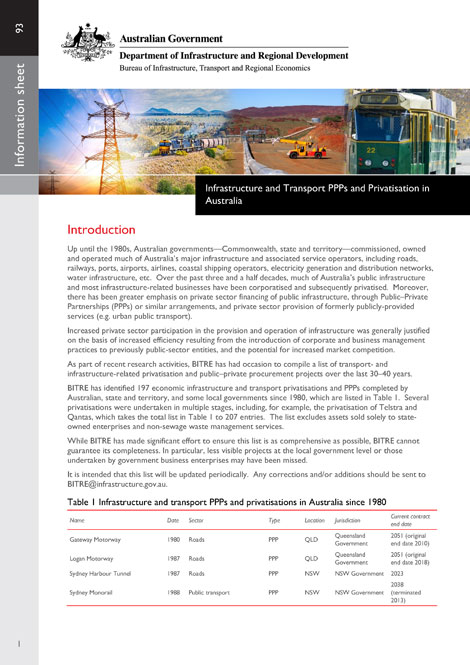
This information sheet provides a list of infrastructure and transport-related Public Private Partnerships and privatisations in Australia since 1980. To the Bureau of Infrastructure Transport and Regional Economics' (BITRE) knowledge, this is the most comprehensive list on the subject to date.
One hundred and ninety seven economic infrastructure assets have been privatised or procured through PPPs since 1980. Several privatisations were undertaken in multiple stages, including, for example, the privatisations of Telstra and Qantas. Including all these stages takes the total list to 207 entries. The list excludes assets sold solely to state-owned enterprises, and non-sewage waste management services.
- Infrastructure and Transport PPPs and Privatisation in Australia
Freight Rates in Australia
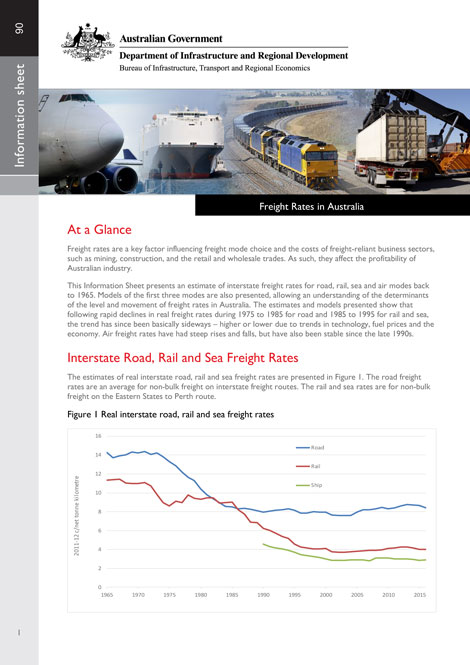
This Information Sheet presents an estimate of interstate freight rates for road, rail, sea and air modes back to 1965. Models of the first three modes are also presented, allowing an understanding of the determinants of the level and movement of freight rates in Australia.
The estimates and models presented show that following rapid declines in real freight rates during 1975 to 1985 for road and 1985 to 1995 for rail and sea, the trend has since been basically sideways–higher or lower due to trends in technology, fuel prices and the economy.
- Freight Rates in Australia
Costs and benefits of emerging road transport technologies
Road transport technologies are evolving rapidly. Recent years have seen the expansion of intelligent transport systems (ITS), such as ramp metering and signal coordination, and low-level vehicle automation. In coming years, communication platforms will connect vehicles, thereby enabling Cooperative-ITS (C-ITS) technologies, such as collision avoidance systems. Car manufacturers and technology companies are actively developing fully automated vehicles. This report summarises estimates of the costs and benefits of ITS, C-ITS and automated vehicles from the existing Australian and international literature. It also provides policy makers with guidance on what further research would improve understanding of the implications of these technologies under Australian conditions.
- Costs and benefits of emerging road transport technologies
Urban Passenger fares
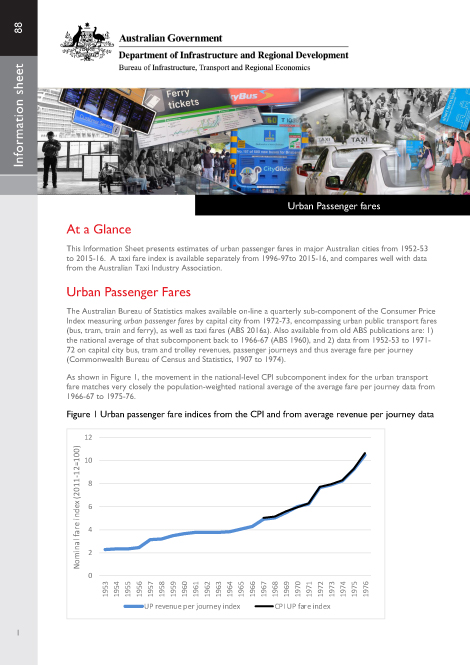
This Information Sheet presents estimates of urban passenger fares in major Australian cities from 1952-53 to 2015-16. A taxi fare index is available separately from 1996-97 to 2015-16. The general trend has been for rising real urban passenger fares, except during the period 1973-74 to 1979-80, when real fares fell as nominal fare levels failed to keep up with higher inflation rates. Rises in both real urban passenger fares and real taxi fares slowed after 2000-01.
- Urban Passenger fares
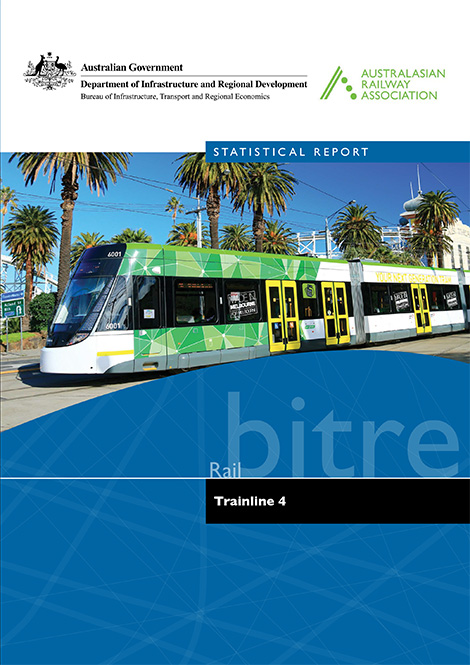
Trainline is a compendium of Australia's railways providing insights, analysis, and an understanding of the railway industry. Australia's railways are evolving via changes within and outside the industry. These changes include logistics, commodity flows, technology, urban patronage and regional passenger services. The publication presents an overview and data on railway transport tasks performed, characteristics of the railways and train operators' rolling stock that runs and aspects of railway performance including safety, environment and reliability.
Infrastructure benchmarking report
Australian, State and Territory Governments are committed to improving the infrastructure that is critical to efficient, productive and equitable operations of our economy. Achieving this objective requires efficient procurement processes and careful examination of costs to ensure value for money in infrastructure investments. Governments have cooperated to conclude the first national pilot benchmarking of infrastructure procurement processes and construction costs (as recommended by the 2014 Productivity Commission Inquiry into Public Infrastructure and agreed by the Council on 28 August 2014). This report covers the findings of the initial benchmarking and outlines plans for continued and improved future monitoring of infrastructure procurement performance and construction costs.
The analysis was undertaken by the Bureau of Infrastructure, Transport and Regional Economics (BITRE) for the Infrastructure Working Group of the Transport and Infrastructure Council. The report is also available on the Transport and Infrastructure Council website.
- Infrastructure Benchmarking Report