
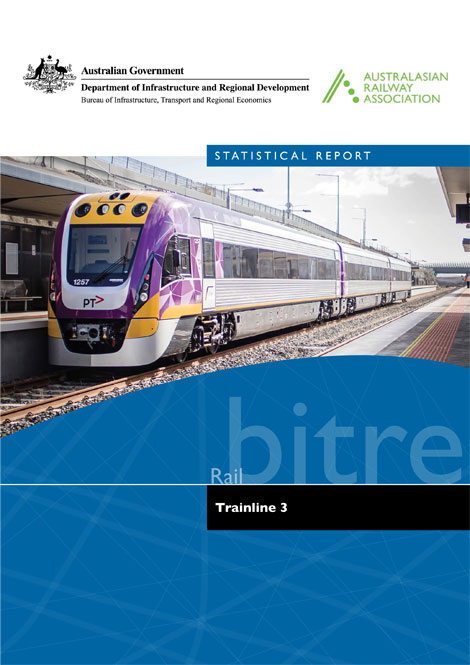
Trainline 3 is a collaborative compendium between the Australasian Railway Association (ARA) and BITRE, providing insights, analysis, and an understanding of the Australian freight and passenger railway industry.
Australia's railways are evolving due to factors within and outside the industry, including changes in bulk and non-bulk logistics, commodity flows, technology, urban rail patronage and regional passenger services. The publication presents an overview and data illustrating these changes in terms of rail tasks performed, characteristics of the railway networks, train operators' rolling stock and aspects of railway performance including safety, environment and reliability.
BITRE road construction and maintenance price index—2015 update
This Information Sheet presents the quarterly road construction and maintenance price index for the year 2014–15. Additionally, it presents sub-indexes by activity type for road construction and road maintenance, and by road type for arterial, sealed local and unsealed local roads.
- BITRE road construction and maintenance price index–2015 update
Transport infrastructure and land value uplift
Users of the transport network are not its only beneficiaries. Land owners can also gain as increased value flows along the network are capitalised into land. Value uplift financing attempts to capture a portion of this by levying the landholders in the catchment areas of new infrastructure. The main problem with this system is that is very difficult to localise benefits in a network. This has led some to propose a broad based land tax instead.
- Transport infrastructure and land value uplift
Developing productivity elasticities for estimating WEBs in Australia—Scoping Study
Estimates of Wider Economic Benefits (WEBs) are increasingly featuring in cost-benefit analyses (CBAs) of major urban transport infrastructure projects. Governments are particularly interested in WEBs because they relate to productivity. The parameters used to estimate WEBs in Australia to date have been estimated using methodologies that are inconsistent and not in line with international best-practice. Thus the reliability and comparability of WEBs estimates in Australian CBAs is questionable. The report proposes a way to develop a robust set of parameters for practitioners to use when estimating WEBs.
The report was commissioned by BITRE on behalf of Steering Committee oversighting the Review of the National Guidelines for Transport System Management. If a robust set of parameters can be developed, it will be published in the Guidelines. BITRE engaged consultants KPMG to undertake the task.
- Developing productivity elasticities for estimating WEBs in Australia–Scoping Study
Changes in Australia's industry structure: cities and regions, 2006–2011
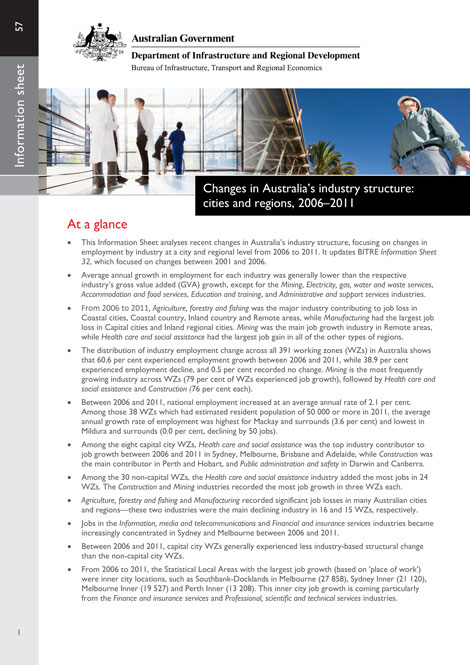
This Information Sheet identifies recent trends (2006 to 2011) in employment by various industries for regional areas, capital cities and non-capital cities. It updates BITRE's previous Information Sheet 32, which focused on employment changes between 2001 and 2006. The information presented in this publication will assist regional communities (including local government and RDAs) to understand how their regions are changing, and help regions map out where their opportunities and challenges might lie.
- Changes in Australia's industry structure: cities and regions, 2006–2011
BITRE Road Construction and Maintenance Price Index—2014 update
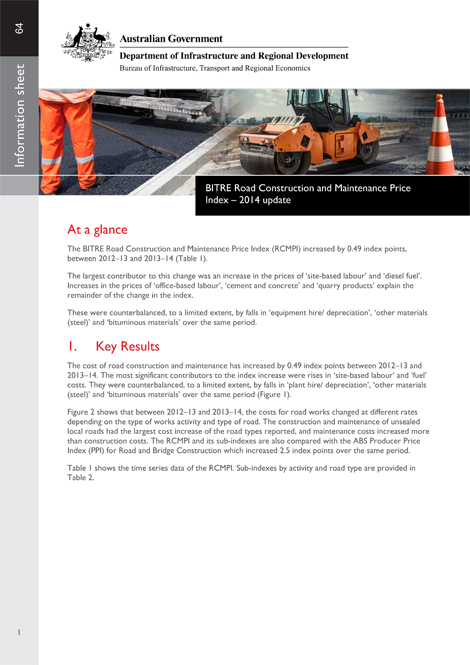
This Information Sheet presents the quarterly Road Construction and Maintenance Price Index figures for the year 2013–14. Additionally, it presents sub-indexes by activity type for road maintenance and road construction, and by road type for local sealed, local unsealed, and arterial roads.
A study of the potential for dedicated freight infrastructure in Australia
The National Ports Strategy was developed by Infrastructure Australia (IA) and the National Transport Commission (NTC) in 2010 at the request of the Council of Australian Governments (COAG).
Recommendation 3.10 of the National Ports Strategy is that 'The Bureau of Infrastructure Transport and Regional Economics (BITRE) should assess the conditions under which the introduction of dedicated freight land transport infrastructure segments related to relevant container ports would be justified'. BITRE engaged consultants Ernst & Young to undertake the task.
The project involved a literature search with a review of overseas experiences, stakeholder consultation, identification of potential projects, and rapid cost–benefit and financial analyses of two case study projects to assess their potential viability.
The project concerned access to major Australian container ports only–Sydney, Melbourne, Brisbane, Adelaide and Fremantle. The term 'dedicated freight land transport infrastructure segments' has been interpreted broadly. It encompasses freight-only road and rail segments, tunnels, and lanes, but extends to infrastructure investments with a freight priority, for example, a road open to freight vehicles at all times but open to cars only during peak hours to relieve congestion.
Part A of the report contains the literature review, principles under which dedicated or priority freight infrastructure might be warranted, a survey of the landside access challenges facing major Australian container ports, and identification of potential case studies for further investigation.
Part B consists of the two case studies
- a new road link between the Port of Melbourne precinct and the West Gate Freeway, and
- a new rail link between the Port of Brisbane and the Surat Basin, which would carry coal and containers.
It should be noted that these are concept projects specified for the purposes of the case studies. They are not intended to replicate actual proposals previously or currently under consideration.
- A study of the potential for dedicated freight infrastructure in Australia
Traffic on the national road network, 2011–12

This Information Sheet presents recent road traffic volumes across the Australian National Land Transport Network in 2011–12, based on data provided by States and Territories. It includes charts showing volumes of heavy and light vehicle traffic for all 21 non-urban corridors, and maps for the urban corridors.
- Traffic on the national road network, 2011–12
Major transport employment hubs
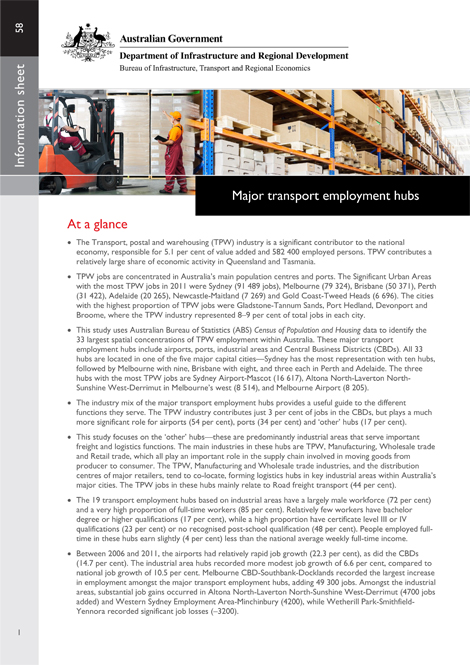
This Information Sheet identifies the 33 largest spatial concentrations of transport industry employment within Australia. These major transport employment hubs are all located within the five most populous capital cities and include airports, ports, CBDs and a range of industrial areas. This study presents evidence on the number of jobs located in each of these transport employment hubs, the industry mix of those jobs, and the characteristics of workers in each location. In particular, it focuses on investigating the nature of employment in the industrial area hubs, many of which serve important freight and logistics functions.
- Major transport employment hubs
National profile of Transport, postal and warehousing workers
This study aims to improve understanding of the current characteristics of the Transport, postal and warehousing (TPW) workforce and how the workforce is evolving over time. It provides details of the sub-industries in which TPW workers are employed, their hours worked, gender, age, occupation, educational qualifications, income and commuting behaviour. It also describes some of the key changes that occurred between 2006 and 2011, such as the ageing and upskilling of the TPW workforce.
- National profile of Transport, postal and warehousing workers