
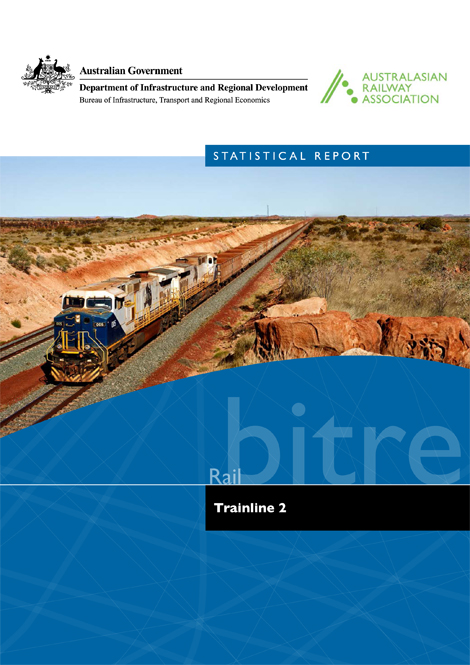
Trainline 2 is a collaborative report between the Australasian Railway Association (ARA) and BITRE. It is a further development of the previous rail freight performance publications series and Trainline 1.
The report provides an overview of freight, urban and non-urban passenger rail. Traffic levels, infrastructure and rolling stock provision and railway performance are considered.
Infrastructure, transport and productivity
This information sheet reviews trends in Australian productivity with a focus on the transport sector.
Well targeted investments in transport infrastructure result in productivity increases that benefit many other industries. The paper provides for specific examples that cover trucks, freight, waterfront and rail productivity enhancements.
- Infrastructure, transport and productivity
Freightline 1—Australia freight transport overview
The Freightline series is intended to provide information on interregional freight movements across Australia, filling a major gap in Australian transport-related data and information, to help better inform and support policy development and infrastructure planning. The Freightline series begins with a broad overview of the freight task, followed by separate commodity-specific issues that provide more detailed information about the size and location of major freight movements, supply chain composition and key infrastructure components. Freightline 1 (this issue) provides a broad overview of freight movements in Australia, highlighting some of the major commodity flows.
- Freightline 1–Australia freight transport overview
Freightline 2—Australia iron ore freight transport
The Freightline series is intended to provide information on interregional freight movements across Australia, filling a major gap in Australian transport-related data and information, to help better inform and support policy development and infrastructure planning. The Freightline series begins with a broad overview of the freight task, followed by separate commodity-specific issues that provide more detailed information about the size and location of major freight movements, supply chain composition and key infrastructure components. Freightline 2 (this issue) focusses on Australian iron ore transport supply chains and freight movements in 2011–12.
- Freightline 2–Australia iron ore freight transport
Infrastructure Investment Macromonitor
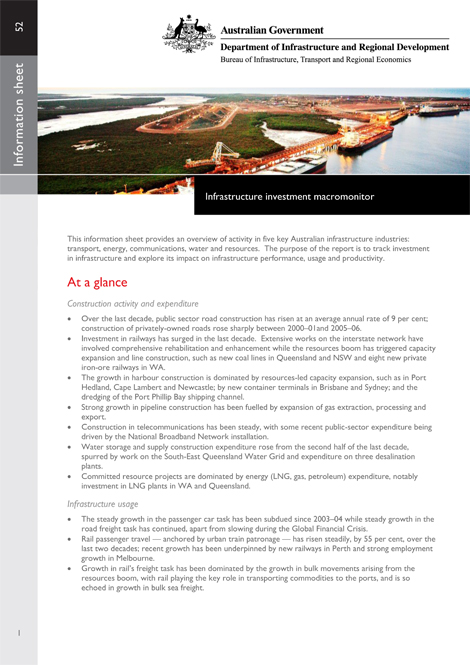
This information sheet provides an overview of activity in five key Australian infrastructure industries: transport, energy, communications, water and resources.
The purpose of the report is to track investment in infrastructure and explore its impact on infrastructure performance, usage and productivity.
- Infrastructure Investment Macromonitor
Australian infrastructure statistics—Yearbook 2013 and Key Australian infrastructure statistics booklet
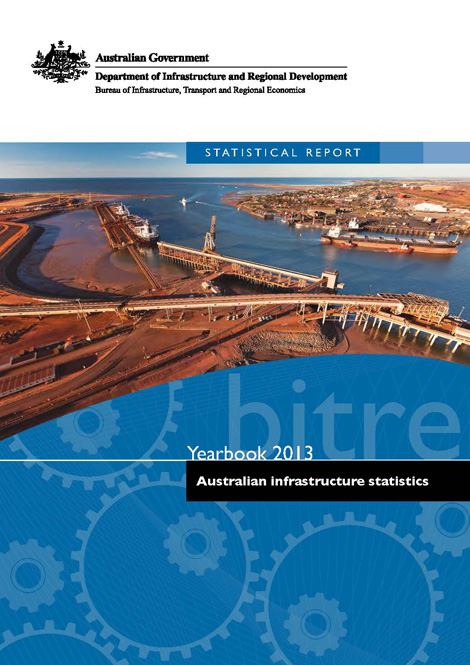
The Yearbook is an important piece of work for the Department and provides a comprehensive evidence base to examine long-term and emerging trends as well as inform policy development and regulatory reform in the transport, energy, water and communications sectors. It is the only comprehensive source of time series statistics for Australia's major areas of economic infrastructure. The Yearbook is accompanied by the first Key Australian Infrastructure Statistics booklet which is a summary of statistics from the Yearbook.
- Yearbook 2013–Australian Infrastructure Statistics
- Key Australian Infrastructure Statistics
- Australian Infrastructure Statistics
Yearbook 2013
Part 1–Infrastructure and the Economy
- Australian Infrastructure Statistics
Yearbook 2013
Part T–Transport
- Australian Infrastructure Statistics
Yearbook 2013
Part E–Energy
- Australian Infrastructure Statistics
Yearbook 2013
Part C–Communication
- Australian Infrastructure Statistics
Yearbook 2013
Part W–Water
Australian infrastructure statistics—Yearbook 2012
The Australian Infrastructure Statistics Yearbook provides a single comprehensive source of Australian infrastructure time series statistics for measures of transport, energy, communications and water infrastructure and the use of this infrastructure in Australia. Statistics are presented in a coherent framework that enables comparisons across the four forms of infrastructure and the activities associated with each form of infrastructure.
- Australian Infrastructure Statistics–Yearbook 2012
- Australian Infrastructure Statistics Yearbook 2012
Part I–Infrastructure and the Economy
- Australian Infrastructure Statistics Yearbook 2012
Part T–Transport
- Australian Infrastructure Statistics Yearbook 2012
Part E–Energy
- Australian Infrastructure Statistics Yearbook 2012
Part C–Communication
- Australian Infrastructure Statistics Yearbook 2012
Part W–Water
Understanding Australia's urban railways
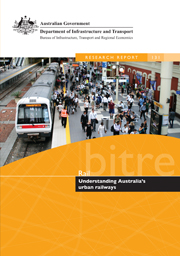
Understanding Australia's Urban Railways provides an overview of the urban passenger and freight railways in Sydney, Melbourne, Brisbane, Perth and Adelaide. For passenger rail, the report explores service provision; patronage trends; recent and planned network expansion; and the key challenges facing each system. In addition, the report examines the main characteristics of each city's rail freight network including: the extent of the freight/passenger rail interface; recent and planned network expansion; and the principal freight task on each system.
- Understanding Australia's urban railways
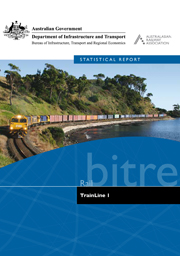
TrainLine 1 is a collaborative report between the Australasian Railway Association (ARA) and BITRE. It is a further development of the previous rail freight performance publications series. This report provides an overview of rail freight performance, railway infrastructure standards and freight haulage between 2007–08 and 2009–10. Further development of the range of information is envisaged.
The report is split into 3 sections that provide freight market, freight train and track indicators.
Relative Efficiencies in the Transportation of Commodities
This Report assesses the relative efficiencies of road and rail in the transportation of several bulk commodities. The work explores potential constraints to the efficient transportation of bulk commodities, including the pricing systems applied by road and rail operators.
- Relative Efficiencies in the Transportation of Commodities