
Freight Rates in Australia
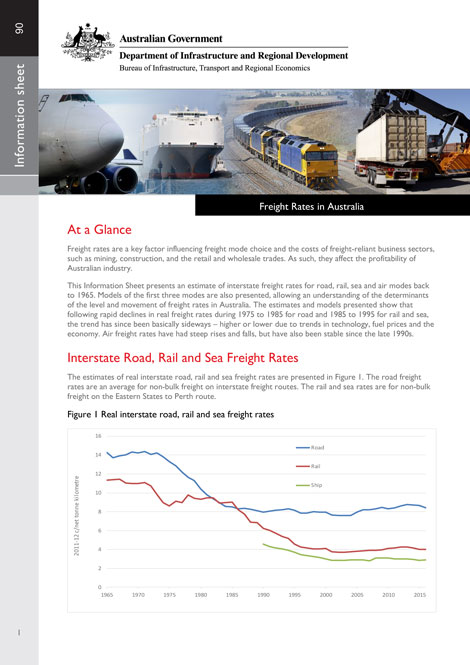
This Information Sheet presents an estimate of interstate freight rates for road, rail, sea and air modes back to 1965. Models of the first three modes are also presented, allowing an understanding of the determinants of the level and movement of freight rates in Australia.
The estimates and models presented show that following rapid declines in real freight rates during 1975 to 1985 for road and 1985 to 1995 for rail and sea, the trend has since been basically sideways–higher or lower due to trends in technology, fuel prices and the economy.
- Freight Rates in Australia
Australian Infrastructure Statistics—Yearbook 2016
The Australian infrastructure statistics yearbook provides a comprehensive evidence base to examine long-term and emerging trends as well as inform policy development and regulatory reform in the transport, energy, water and communications sectors. It is the only comprehensive source of time series statistics for Australia's major areas of economic infrastructure. The yearbook is accompanied by the Key Australian Infrastructure Statistics Booklet which is a summary of statistics from the yearbook.
- Yearbook 2016–Australian Infrastructure Statistics
- Key Australian Infrastructure Statistics 2016
- Australian Infrastructure Statistics
Yearbook 2016
Part I–Infrastructure and the Economy
- Australian Infrastructure Statistics
Yearbook 2016
Part T–Transport
- Australian Infrastructure Statistics
Yearbook 2016
Part E–Energy
- Australian Infrastructure Statistics
Yearbook 2016
Part C–Communication
- Australian Infrastructure Statistics
Yearbook 2016
Part W–Water
Trainline is a compendium of Australia's railways providing insights, analysis, and an understanding of the railway industry. Australia's railways are evolving via changes within and outside the industry. These changes include logistics, commodity flows, technology, urban patronage and regional passenger services. The publication presents an overview and data on railway transport tasks performed, characteristics of the railways and train operators' rolling stock that runs and aspects of railway performance including safety, environment and reliability.
A dozen facts about transport in Australia
This information sheet covers a wide range of subjects, including commuting, freight, rail, energy and safety. The following 12 facts are included:
- How big is the transport network?
- How far do we travel?
- Is this increasing?
- How do we travel?
- Are we changing how we travel?
- Why do we travel like this?
- What about freight?
- Is freight transport increasing?
- Are we commuting longer?
- How do we pay for transport?
- Is transport becoming more energy efficient and causing less emissions? and
- Is transport safety improving?
- A dozen facts about transport in Australia
Five facts about commuting in Australia
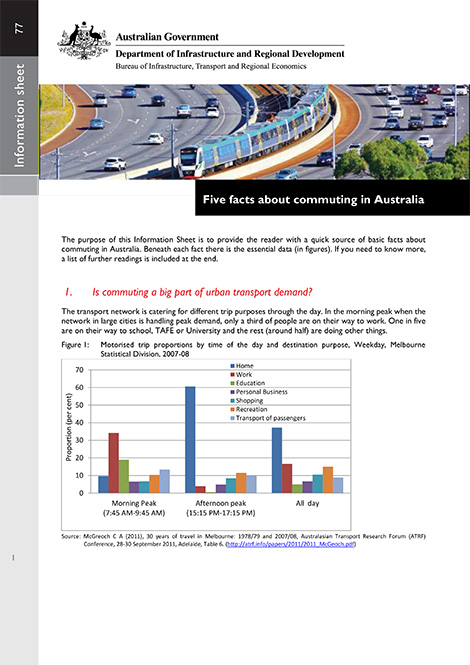
This Information Sheet covers a wide range of subjects, including volume and length of commuting, traffic congestion and commuting patterns. The following five questions are discussed:
- Is commuting a big part of urban transport demand?
- Is it true that a lot of people are spending hours stuck in traffic?
- What has an Italian physicist got to do with commuting?
- Why do some people commute longer? and
- Are our commuting patterns changing?
- Five facts about commuting in Australia
Why short-haul intermodal rail services succeed
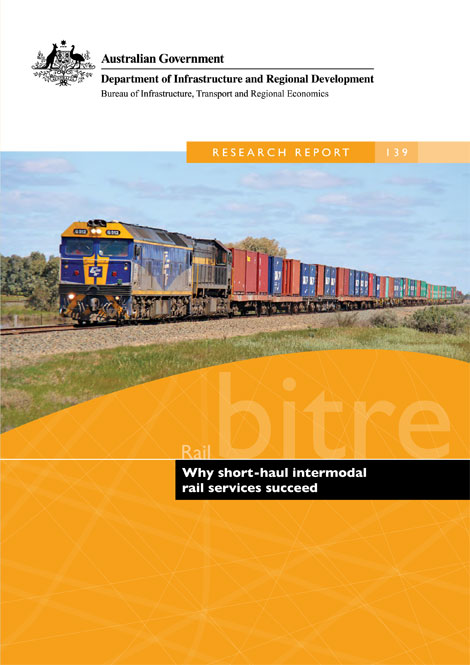
The shipping container has revolutionised freight transport over the last half-century but its success is bringing challenges, not least in landside container movements. Port-induced road traffic congestion impacts on port arteries and communities and undermines port efficiency. Policymakers and planners seek to shift activities from roads to rail. This is a challenge, however, because most of the containers move over short distances, where trains are relatively uncompetitive. Despite that, there are instances where port–hinterland rail services exist. This report analyses the underlying necessary conditions that need to prevail for those rail services to be sustainable.
- Why short-haul intermodal rail services succeed
Freightline 3—Australia sugar freight transport
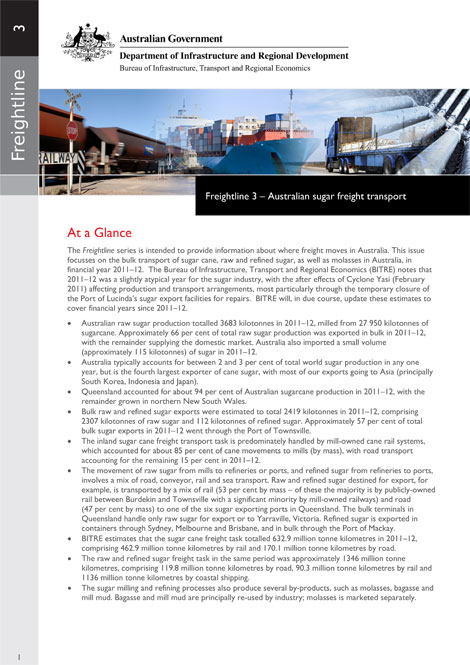
The Freightline series is intended to provide information on interregional freight movements across Australia, filling a major gap in Australian transport-related data and information, to help better inform and support policy development and infrastructure planning. The Freightline series begins with a broad overview of the freight task, followed by separate commodity-specific issues that provide more detailed information about the size and location of major freight movements, supply chain composition and key infrastructure components. Freightline 3 (this issue) focusses on Australian sugar-related transport supply chains and freight movements in 2011–12.
- Freightline 3–Australia sugar freight transport
Australian infrastructure statistics—Yearbook 2015 and key Australian infrastructure statistics booklet 2015
The Yearbook provides a comprehensive evidence base to examine long-term and emerging trends as well as inform policy development and regulatory reform in the transport, energy, water and communications sectors. It is the only comprehensive source of time series statistics for Australia's major areas of economic infrastructure. The Yearbook is accompanied by the key Australian infrastructure statistics booklet which is a summary of statistics from the Yearbook.
- Yearbook 2015–Australian Infrastructure Statistics
- Key Australian Infrastructure Statistics 2015
- Australian Infrastructure Statistics
Yearbook 2015
Part I–Infrastructure and the Economy
- Australian Infrastructure Statistics
Yearbook 2015
Part T–Transport
- Australian Infrastructure Statistics
Yearbook 2015
Part E–Energy
- Australian Infrastructure Statistics
Yearbook 2015
Part C–Communication
- Australian Infrastructure Statistics
Yearbook 2015
Part W–Water
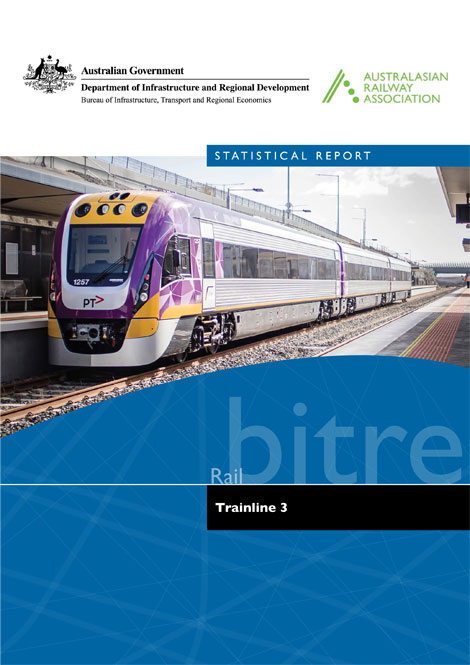
Trainline 3 is a collaborative compendium between the Australasian Railway Association (ARA) and BITRE, providing insights, analysis, and an understanding of the Australian freight and passenger railway industry.
Australia's railways are evolving due to factors within and outside the industry, including changes in bulk and non-bulk logistics, commodity flows, technology, urban rail patronage and regional passenger services. The publication presents an overview and data illustrating these changes in terms of rail tasks performed, characteristics of the railway networks, train operators' rolling stock and aspects of railway performance including safety, environment and reliability.
Australian infrastructure statistics—Yearbook 2014 and key Australian infrastructure statistics booklet
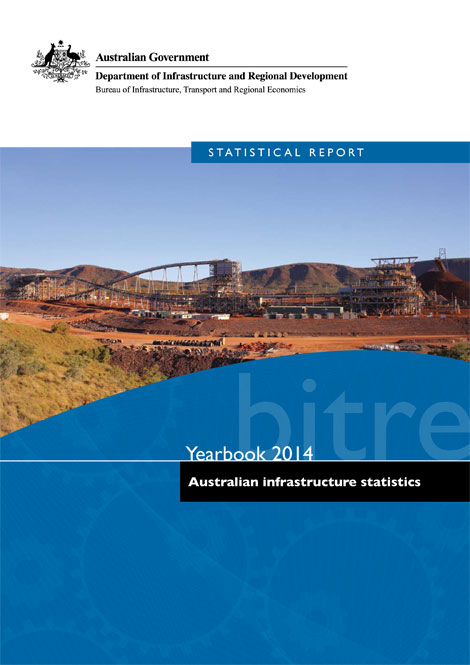
The Yearbook provides a comprehensive evidence base to examine long-term and emerging trends as well as inform policy development and regulatory reform in the transport, energy, water and communications sectors. It is the only comprehensive source of time series statistics for Australia's major areas of economic infrastructure. The Yearbook is accompanied by the Key Australian Infrastructure Statistics booklet which is a summary of statistics from the Yearbook.
- Yearbook 2014–Australian Infrastructure Statistics
- Key Australian Infrastructure Statistics
- Australian Infrastructure Statistics
Yearbook 2014
Part I–Infrastructure and the Economy
- Australian Infrastructure Statistics
Yearbook 2014
Part T–Transport
- Australian Infrastructure Statistics
Yearbook 2014
Part E–Energy
- Australian Infrastructure Statistics
Yearbook 2014
Part C–Communication
- Australian Infrastructure Statistics
Yearbook 2014
Part W–Water