
Urban Passenger fares
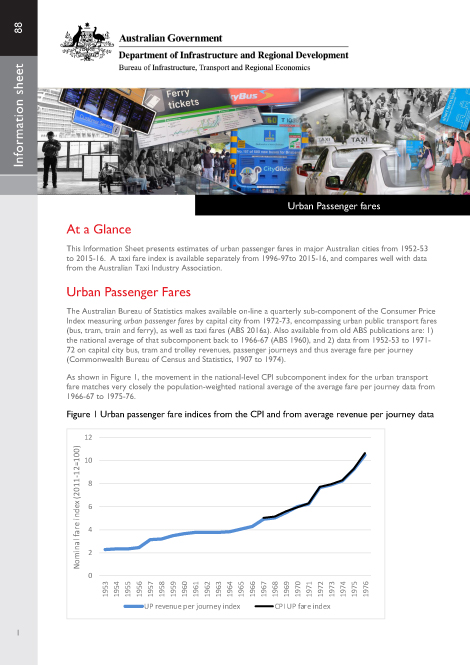
This Information Sheet presents estimates of urban passenger fares in major Australian cities from 1952-53 to 2015-16. A taxi fare index is available separately from 1996-97 to 2015-16. The general trend has been for rising real urban passenger fares, except during the period 1973-74 to 1979-80, when real fares fell as nominal fare levels failed to keep up with higher inflation rates. Rises in both real urban passenger fares and real taxi fares slowed after 2000-01.
- Urban Passenger fares
Light commercial vehicle safety
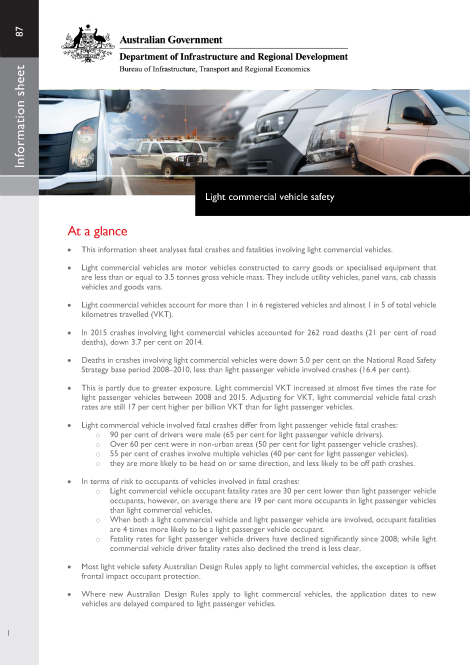
This information sheet analyses fatal crashes and fatalities involving light commercial vehicles. Light commercial vehicles account for more than 1 in 6 registered vehicles and almost 1 in 5 of total vehicle kilometres travelled (VKT).
In 2015 crashes involving light commercial vehicles accounted for 262 road deaths (21 per cent of road deaths), down 3.7 per cent on 2014. Deaths in crashes involving light commercial vehicles were down 5.0 per cent on the National Road Safety Strategy base period 2008–2010, less than light passenger vehicle involved crashes (down 16.4 per cent). This is partly due to greater exposure. Adjusting for VKT, light commercial vehicle fatal crash rates are still 17 per cent higher per billion VKT than for light passenger vehicles.
- Light commercial vehicle safety
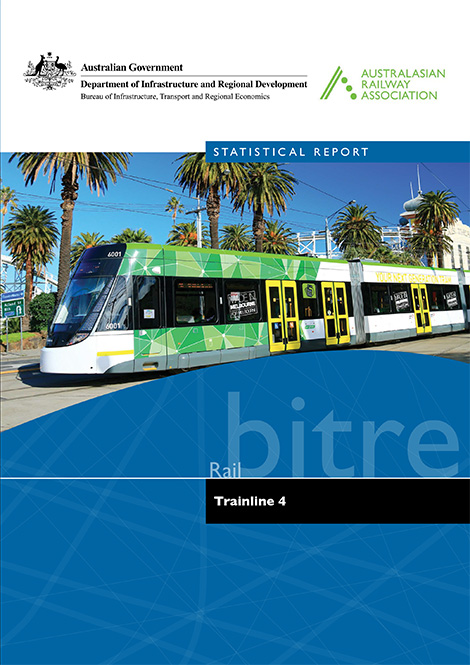
Trainline is a compendium of Australia's railways providing insights, analysis, and an understanding of the railway industry. Australia's railways are evolving via changes within and outside the industry. These changes include logistics, commodity flows, technology, urban patronage and regional passenger services. The publication presents an overview and data on railway transport tasks performed, characteristics of the railways and train operators' rolling stock that runs and aspects of railway performance including safety, environment and reliability.
Traffic on the national road network, 2013–14
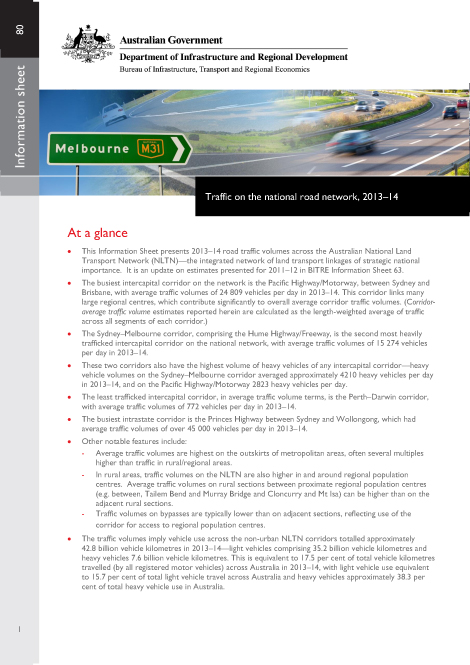
This Information Sheet presents 2013–14 road traffic volumes across the Australian National Land Transport Network (NLTN)–the integrated network of land transport linkages of strategic national importance. It is an update on estimates presented for 2011–12 in BITRE Information Sheet 63.
- Traffic on the national road network, 2013–14
Five facts about commuting in Australia
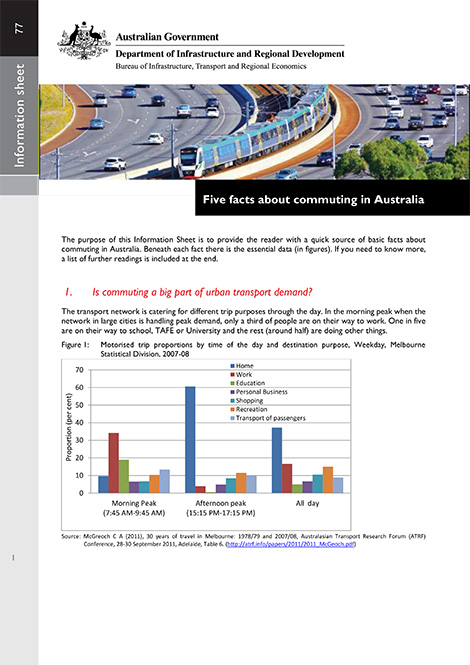
This Information Sheet covers a wide range of subjects, including volume and length of commuting, traffic congestion and commuting patterns. The following five questions are discussed:
- Is commuting a big part of urban transport demand?
- Is it true that a lot of people are spending hours stuck in traffic?
- What has an Italian physicist got to do with commuting?
- Why do some people commute longer? and
- Are our commuting patterns changing?
- Five facts about commuting in Australia
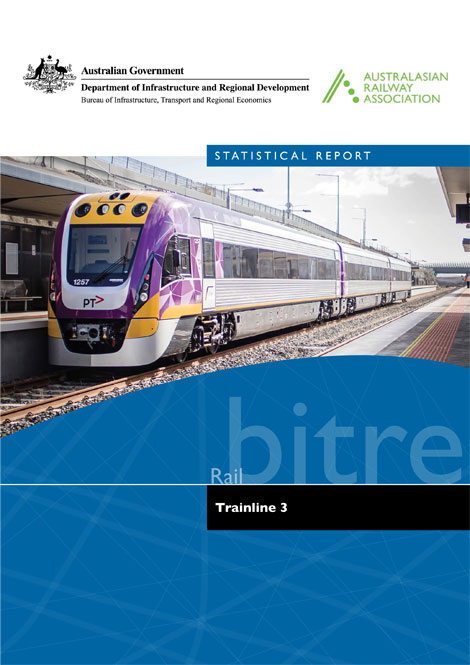
Trainline 3 is a collaborative compendium between the Australasian Railway Association (ARA) and BITRE, providing insights, analysis, and an understanding of the Australian freight and passenger railway industry.
Australia's railways are evolving due to factors within and outside the industry, including changes in bulk and non-bulk logistics, commodity flows, technology, urban rail patronage and regional passenger services. The publication presents an overview and data illustrating these changes in terms of rail tasks performed, characteristics of the railway networks, train operators' rolling stock and aspects of railway performance including safety, environment and reliability.
Pedestrians and road safety
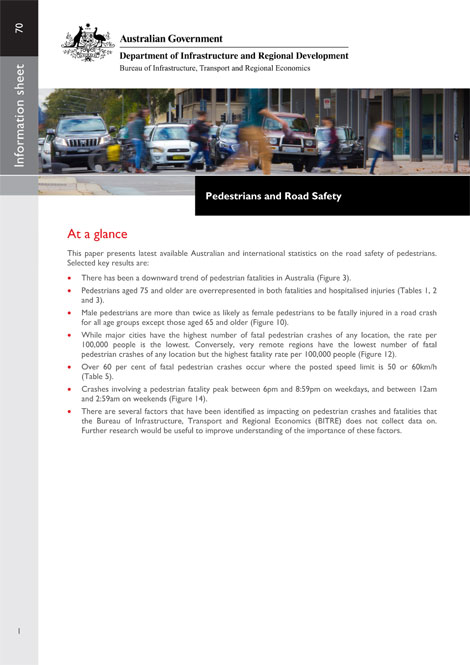
Pedestrians comprise the largest single road user group because almost everyone is a pedestrian at some point. People walk for leisure, to go to work, school or local shops, and to access other modes of transport. In Australia, there has been a consistent downward trend in total road fatalities, including pedestrian fatalities. Since 2005, pedestrian fatalities as a percentage of all road fatalities have remained relatively stable.
- Pedestrians and road safety
The impact of airbags and electronic stability control on Australian light vehicle fatalities
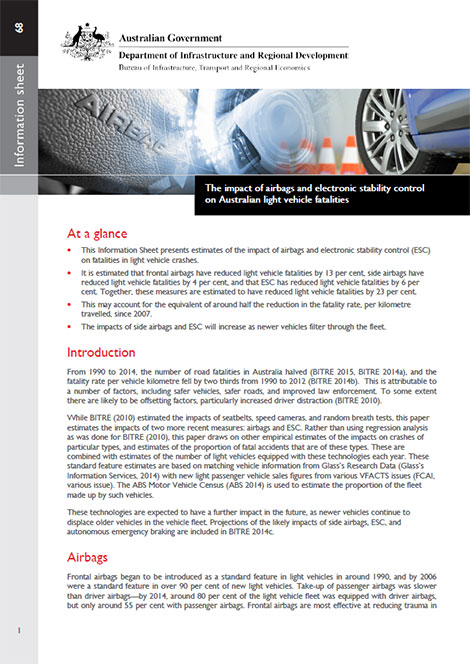
This Information Sheet presents estimates of the impact of airbags and electronic stability control (ESC) on fatalities in light vehicle crashes. It is estimated that frontal airbags have reduced light vehicle fatalities by 13 per cent, side airbags have reduced light vehicle fatalities by 4 per cent, and that ESC has reduced light vehicle fatalities by 6 per cent. Together, these measures are estimated to have reduced light vehicle fatalities by 23 per cent. This may account for the equivalent of around half the reduction in the fatality rate, per kilometre travelled, since 2007. The impacts of side airbags and ESC will increase as newer vehicles filter through the fleet.
- The impact of airbags and electronic stability control on Australian light vehicle fatalities
Containerised and non-containerised trade through Australian ports to 2032–33
This report presents 20-year forecasts of exports and imports of containerised and non-containerised freight and sea passenger movements through Australia's 5 largest capital city ports and, in aggregation, all other ports. The forecasts, which update those previously published by BITRE in 2002, 2006 and 2010, are driven by population, real income, exchange rates, import prices and export prices. The most recent economic outlook and population growth forecasts for Australia and its major trading partners have been used to derive the forecasts. The forecasts imply that Australia's sea trade will double over the next 20 years, largely due to the continuing positive economic outlook for Australia and its major trading partners. The long-term outlook for the cruise shipping industry is also positive, largely due to the projected economic growth in source countries of cruise passengers, particularly the USA.
Trainline 2 is a collaborative report between the Australasian Railway Association (ARA) and BITRE. It is a further development of the previous rail freight performance publications series and Trainline 1.
The report provides an overview of freight, urban and non-urban passenger rail. Traffic levels, infrastructure and rolling stock provision and railway performance are considered.