
Australian Sea Freight 2011–12
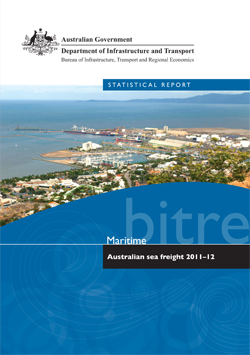
This is the latest in a series of Bureau of Infrastructure, Transport and Regional Economics (BITRE) reports that provide information on Australian sea freight movements, vessel activity, the use of coastal trading licences, and the size and composition of the Australian trading fleet. This report contains statistics on maritime freight and shipping activities in Australia from 2005–06 to 2011–12.
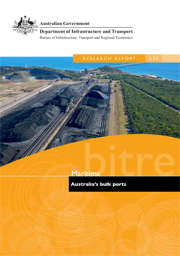
The report provides a profile of Australia's principal bulk ports and the logistics chain that delivers commodities through those ports. Efficient logistics are essential for these volumes, requiring substantial investment as well as good co-ordination of the different links in the logistics chain. These factors have been especially important in the last decade, with tonnage rising by over 75 per cent. The report illustrates the tasks performed at each port using the broad range of data and indicators that are published by port authorities and bulk terminal operators.
- Australia's Bulk Ports
Tasmanian Passenger and Freight movements
This information sheet provides a summary of Tasmanian passenger and freight movements in 2011–12. It brings together key data about Tasmanian transport from other Bureau publications and unpublished data sources.
- Tasmanian Passenger and Freight movements
Australian Sea Freight 2010–11
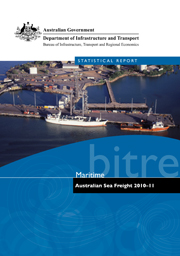
This report presents comprehensive statistics on maritime freight in Australia. Compared to past issues that focused on data for the most recent year, this issue contains time series to establish the trend of Australian sea freight statistics over the most recent ten years from 2001–02 to 2010–11. The information presented comprises international and coastal freight statistics, the use of coastal voyage permits, vessel activity at Australian ports, and the size and composition of the Australian trading fleet.
Australian infrastructure statistics—Yearbook 2012
The Australian Infrastructure Statistics Yearbook provides a single comprehensive source of Australian infrastructure time series statistics for measures of transport, energy, communications and water infrastructure and the use of this infrastructure in Australia. Statistics are presented in a coherent framework that enables comparisons across the four forms of infrastructure and the activities associated with each form of infrastructure.
- Australian Infrastructure Statistics–Yearbook 2012
- Australian Infrastructure Statistics Yearbook 2012
Part I–Infrastructure and the Economy
- Australian Infrastructure Statistics Yearbook 2012
Part T–Transport
- Australian Infrastructure Statistics Yearbook 2012
Part E–Energy
- Australian Infrastructure Statistics Yearbook 2012
Part C–Communication
- Australian Infrastructure Statistics Yearbook 2012
Part W–Water
Relative Efficiencies in the Transportation of Commodities
This Report assesses the relative efficiencies of road and rail in the transportation of several bulk commodities. The work explores potential constraints to the efficient transportation of bulk commodities, including the pricing systems applied by road and rail operators.
- Relative Efficiencies in the Transportation of Commodities
Container and Ship Movements Through Australian Ports: 2007–08 to 2029–30, Preliminary Estimates
Paper given to the 31st Australasian Transport Research Forum, 2 October–3 October 2008, Gold Coast. Authors: Godfrey Lubulwa, Rob Bolin, Ben Slatter, Tony Carmody
- Container and Ship Movements Through Australian Ports: 2007–08 to 2029–30, Preliminary Estimates
Road Freight Estimates by State/Territory
Paper given to the 31st Australasian Transport Research Forum, 2 October–3 October 2008, Gold Coast. Authors: David Gargett, Afzal Hossain
- Road Freight Estimates by State/Territory
External Costs of Inter-Capital Freight in Australia
Paper given to the 33rd Australasian Transport Research Forum, 29 September–1 October 2010, Canberra. Author: Jack McAuley.
- External Costs of Inter-Capital Freight in Australia
Development of a Rail Freight Terminal at Acacia Ridge
This is a Report on the proposed terminal facility at Acacia Ridge. It is becoming increasingly apparent that terminal facilities are a key to the efficient operation of the Australian railway system. In many cases, however, the layout and structures do not permit modern. Methods to be employed effectively, so that serious delays occur. As the problems are so serious at Acacia Ridge, this report was compiled in 3 months.
- Development of a Rail Freight Terminal at Acacia Ridge