
Costs and benefits of emerging road transport technologies
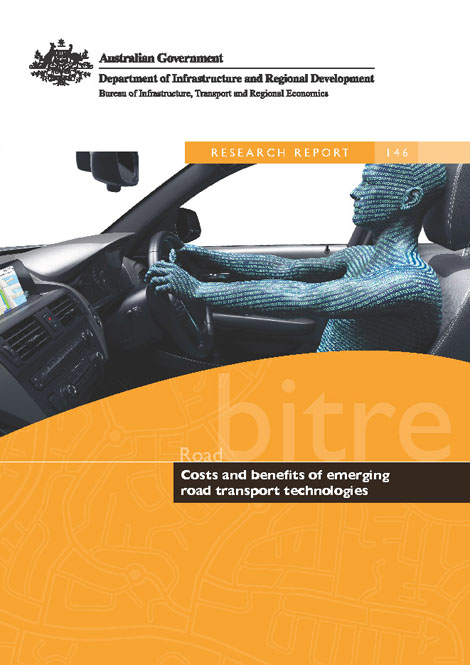
Road transport technologies are evolving rapidly. Recent years have seen the expansion of intelligent transport systems (ITS), such as ramp metering and signal coordination, and low-level vehicle automation. In coming years, communication platforms will connect vehicles, thereby enabling Cooperative-ITS (C-ITS) technologies, such as collision avoidance systems. Car manufacturers and technology companies are actively developing fully automated vehicles. This report summarises estimates of the costs and benefits of ITS, C-ITS and automated vehicles from the existing Australian and international literature. It also provides policy makers with guidance on what further research would improve understanding of the implications of these technologies under Australian conditions.
- Costs and benefits of emerging road transport technologies
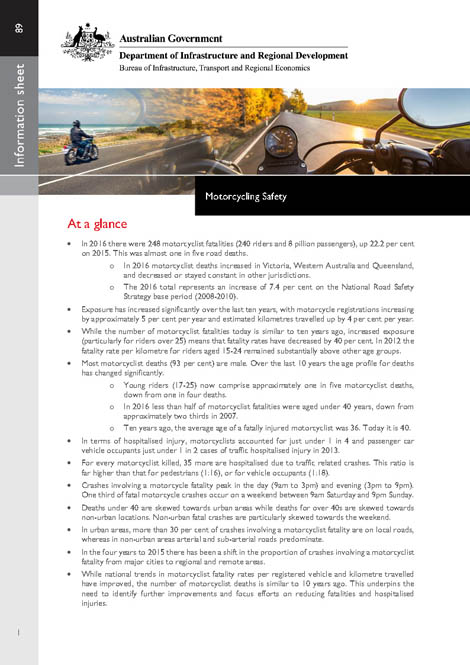
This information sheet provides an overview of the current status of motorcycling safety in Australia. In 2016 motorcyclist deaths increased by 22 per cent, to 248 deaths (almost 1 in five road deaths). This represents an increase of 7.4 per cent on the National Road Safety Strategy base years (2008-2010).
While the national trend in motorcyclist fatality rates over the last decade has improved by 40 per cent, increased exposure means that the number of motorcyclist deaths in Australia is now similar to 10 years ago. This underpins the need to identify further areas for improvement and focus efforts on reducing motorcyclist fatalities and hospitalised injuries.
- Motorcycling Safety
Light commercial vehicle safety
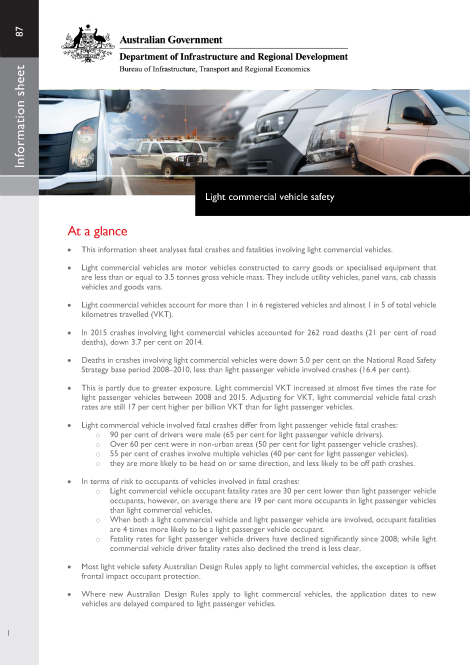
This information sheet analyses fatal crashes and fatalities involving light commercial vehicles. Light commercial vehicles account for more than 1 in 6 registered vehicles and almost 1 in 5 of total vehicle kilometres travelled (VKT).
In 2015 crashes involving light commercial vehicles accounted for 262 road deaths (21 per cent of road deaths), down 3.7 per cent on 2014. Deaths in crashes involving light commercial vehicles were down 5.0 per cent on the National Road Safety Strategy base period 2008–2010, less than light passenger vehicle involved crashes (down 16.4 per cent). This is partly due to greater exposure. Adjusting for VKT, light commercial vehicle fatal crash rates are still 17 per cent higher per billion VKT than for light passenger vehicles.
- Light commercial vehicle safety
This Excel sheet provides summary series of hospitalised injuries (injury resulting in confirmed admission to hospital, but not in-hospital death) from road traffic crashes from calendar years 2011 to 2021. These series are produced by the Road Safety Data Hub using data sourced from the Australian Institute of Health and Welfare, with that raw data also included in the file.
The latest 2023 updates have added new data for 2020 and 2021, and new detailed tables on States and Territories:
Australian Infrastructure Statistics—Yearbook 2016
The Australian infrastructure statistics yearbook provides a comprehensive evidence base to examine long-term and emerging trends as well as inform policy development and regulatory reform in the transport, energy, water and communications sectors. It is the only comprehensive source of time series statistics for Australia's major areas of economic infrastructure. The yearbook is accompanied by the Key Australian Infrastructure Statistics Booklet which is a summary of statistics from the yearbook.
- Yearbook 2016–Australian Infrastructure Statistics
- Key Australian Infrastructure Statistics 2016
- Australian Infrastructure Statistics
Yearbook 2016
Part I–Infrastructure and the Economy
- Australian Infrastructure Statistics
Yearbook 2016
Part T–Transport
- Australian Infrastructure Statistics
Yearbook 2016
Part E–Energy
- Australian Infrastructure Statistics
Yearbook 2016
Part C–Communication
- Australian Infrastructure Statistics
Yearbook 2016
Part W–Water
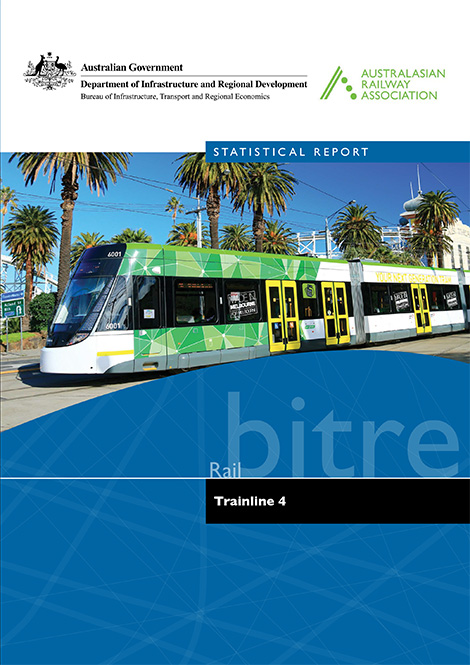
Trainline is a compendium of Australia's railways providing insights, analysis, and an understanding of the railway industry. Australia's railways are evolving via changes within and outside the industry. These changes include logistics, commodity flows, technology, urban patronage and regional passenger services. The publication presents an overview and data on railway transport tasks performed, characteristics of the railways and train operators' rolling stock that runs and aspects of railway performance including safety, environment and reliability.
Developing national road safety indicators for injury
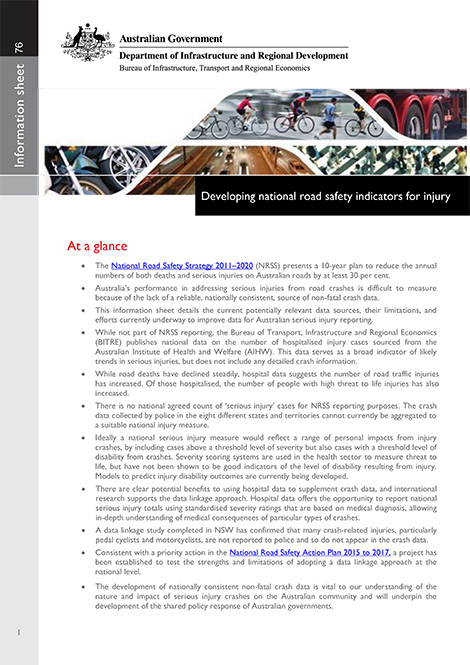
The National Road Safety Strategy 2011–2020 (NRSS) presents a 10-year plan to reduce the annual numbers of both deaths and serious injuries on Australian roads by at least 30 per cent.
Australia's performance in addressing serious injuries from crashes is difficult to measure because of the lack of a reliable, nationally consistent, source of non-fatal crash data.
This information sheet details the current data sources, their limitations, and efforts currently underway to improve data for serious injury reporting.
- Developing national road safety indicators for injury
A dozen facts about transport in Australia
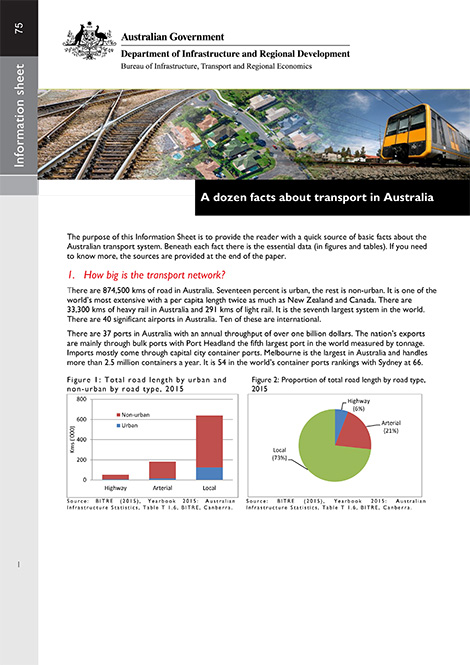
This information sheet covers a wide range of subjects, including commuting, freight, rail, energy and safety. The following 12 facts are included:
- How big is the transport network?
- How far do we travel?
- Is this increasing?
- How do we travel?
- Are we changing how we travel?
- Why do we travel like this?
- What about freight?
- Is freight transport increasing?
- Are we commuting longer?
- How do we pay for transport?
- Is transport becoming more energy efficient and causing less emissions? and
- Is transport safety improving?
- A dozen facts about transport in Australia
Heavy truck safety: crash analysis and trends
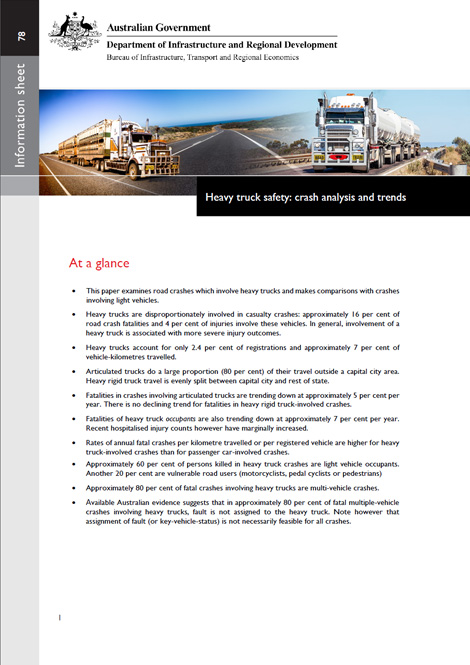
This paper analyses road traffic crashes involving heavy trucks, highlighting characteristics such as severity, location, temporarily and type of crash. A brief introduction to the regulatory environment and statistical summaries of Australia's heavy vehicle fleet are also provided.
- Heavy truck safety: crash analysis and trends
Australian infrastructure statistics—Yearbook 2015 and key Australian infrastructure statistics booklet 2015
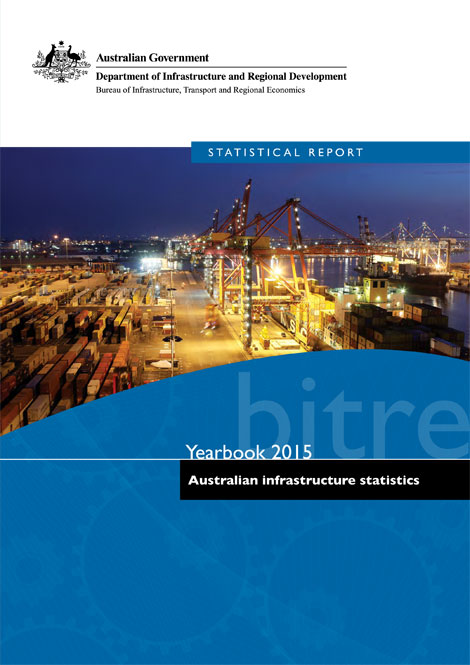
The Yearbook provides a comprehensive evidence base to examine long-term and emerging trends as well as inform policy development and regulatory reform in the transport, energy, water and communications sectors. It is the only comprehensive source of time series statistics for Australia's major areas of economic infrastructure. The Yearbook is accompanied by the key Australian infrastructure statistics booklet which is a summary of statistics from the Yearbook.
- Yearbook 2015–Australian Infrastructure Statistics
- Key Australian Infrastructure Statistics 2015
- Australian Infrastructure Statistics
Yearbook 2015
Part I–Infrastructure and the Economy
- Australian Infrastructure Statistics
Yearbook 2015
Part T–Transport
- Australian Infrastructure Statistics
Yearbook 2015
Part E–Energy
- Australian Infrastructure Statistics
Yearbook 2015
Part C–Communication
- Australian Infrastructure Statistics
Yearbook 2015
Part W–Water