
Trends in Trucks and Traffic
Increasingly in Australia, trucking is an essential feature of economic activity, with road being the only mode possible for much freight traffic (eg in cities), and with rail tending to be less competitive than road on many intercity links.
- Trends in Trucks and Traffic
Urban Congestion: the Implications for Greenhouse Gas Emissions
Urban car travel in Australia is expected to continue to grow appreciably over the next 20 years (by close to 30 per cent) though at a somewhat slower rate of growth than for the last few decades.
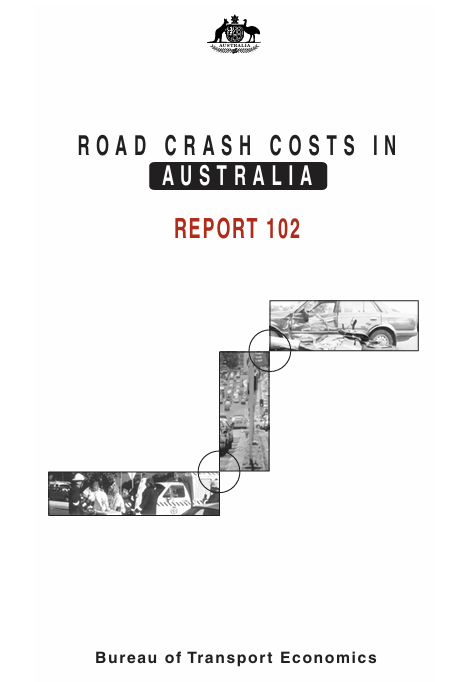
During the 1990s around 2000 people died per year and over 20 000 sustained serious injuries on Australian roads per year. When the human cost is considered in combination with associated property damage and the costs of the infrastructure required to deal with road crashes, it is clear that society bears a huge overall cost. Determining the magnitude of this cost and its components provides a better understanding of the benefits of activities that reduce the incidence and severity of road crashes.
Local roads are considered by regional communities to be a major contributor to their prosperity and social amenity. This report presents the first detailed picture of local road spending at the regional level. Recently, local roads have attracted considerable attention and debate at the national level. However, we simply do not have the detailed statistics and analyses required to understand the adequacy of local road spending nationally. Because there is no central source of data on regional roads, the writing of this report required the collection of financial data from no less than sixteen sources across Australia. The BTE understands that the Australian Bureau of Statistics has work in hand to upgrade regional statistics. Consequently our understanding of local road finances should improve over the next few years.
- Spending on Local Roads
The Black Spot Program 1996–2002: An Evaluation of the First Three Years
The Federal Government has, since 1990–91, allocated substantial resources through its Black Spot Program to reduce the number and severity of crashes at black spot locations as part of its overall road safety strategy. Bureau of Transport and Communications Economics (BTCE) Report 90 Evaluation of the Black Spot Program published in 1995 evaluated the program that operated from 1990–91 to 1992–93 inclusive.
- The Black Spot Program 1996–2002: An Evaluation of the First Three Years
Fuel Consumption by New Passenger Vehicles in Australia
BTRE has examined trends in the fuel consumption of new passenger vehicles. The overall trend in fuel consumption was down during the 1980s. However during the 1990s, a more gradual reduction in the fuel consumption of cars, coupled with increasing sales of 4-wheel-drive vehicles, saw fuel consumption for new passenger vehicles as a whole stabilise.
- Fuel Consumption by New Passenger Vehicles in Australia
Urban Pollutant Emissions from Motor Vehicles: Australian Trends to 2020
This report presents the results of a BTRE study to estimate likely future levels of noxious pollutant emissions from motor vehicles in Australian metropolitan areas.
State Spending on Roads
Over the last few years, the Commonwealth has devoted considerable resources to the task of helping local government authorities maintain and upgrade their road systems. The major initiative was an extra $1.2 billion in road funding paid directly to councils through the Roads to Recovery programme but federal authorities have also been directed to work with their local government counterparts to improve road policies and practices. The Bureau of Transport and Regional Economics' main contribution to this initiative has been to carry out two research projects. A regional analysis of council road finances was published last year in BTRE Working Paper 44, Spending on Local Roads, and this report presents a complementary study of State and Territory spending on roads including the assistance they provide to local government. It also identifies the roads for which State and council authorities are respectively responsible in each jurisdiction. The BTRE would like to thank State, Territory and Local Government organisations that assisted in the preparation of this report by providing information or advice on road finances. The data presented in this report is based on the responses provided by the States and Territories to the BTRE's Survey of State Government Spending on Roads. The BTRE has made every effort to ensure the figures are internally consistent and has relied on the State and Territories to ensure the accuracy of the data.
- State Spending on Roads
Land Transport Infrastructure Pricing: An Introduction
The BTRE projects that the total freight task will continue to grow strongly. Such growth will increase the infrastructure maintenance needs and possibly hasten the need for capacity expansion. Setting prices for infrastructure use that reflect costs provides important signals as to the appropriate level of transport activity, choice of transport mode, and the level of infrastructure spending. At the Australian Logistics Council (ALC) meeting on 7 November 2002, the Council asked BTRE to provide a comparative analysis of current land transport pricing regimes and their objectives and to present the findings at the next Council meeting, held on 27 February 2003. This working paper comprises the paper prepared for the ALC and already released by the ALC as a discussion paper.
- Land Transport Infrastructure Pricing: An Introduction
Road Speed Limits: Economic Effects of Allowing more Flexibility
On rural roads, the speed that a driver chooses will affect their travel time, vehicle operating costs and crash costs. Recent Austroads valuations of these costs are used in this paper to estimate the total economic cost to society of travelling at different speeds on roads with different crash rates. Critical in this analysis is estimating the change in crash cost that would result from a change in vehicle speeds. This report assumes a 10 km/h change in average speeds produces a 30% change in crash costs based on international evidence. For a hypothetical mix of cars and trucks on a rural road with an average crash cost, the speed that produces the lowest total of travel time cost, vehicle operating cost and crash cost is between 90 and 100 km/h. On a hypothetical road with a low crash rate (and a crash cost one quarter of the average), the optimum speed is between 110 and 120 km/h. Achieving different speed regimes is not just a matter of changing the posted speed limit. The paper concludes by suggesting that ITS technology could be used to vary and manage speeds.
- Road Speed Limits: Economic Effects of Allowing more Flexibility