
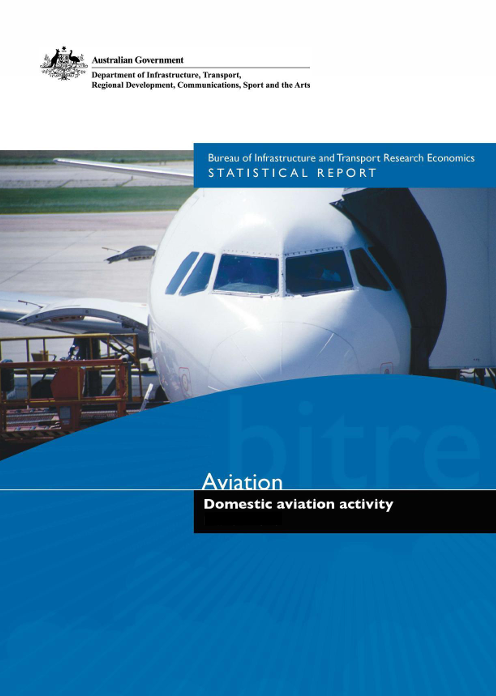
Information and data on domestic aviation can be found at the following links.
- Australian domestic aviation activity—monthly publications
- Australian domestic aviation activity—time series
- Australian domestic aviation activity—annual publications
Below are graphs and summary analysis relating to domestic aviation activity.
Summary
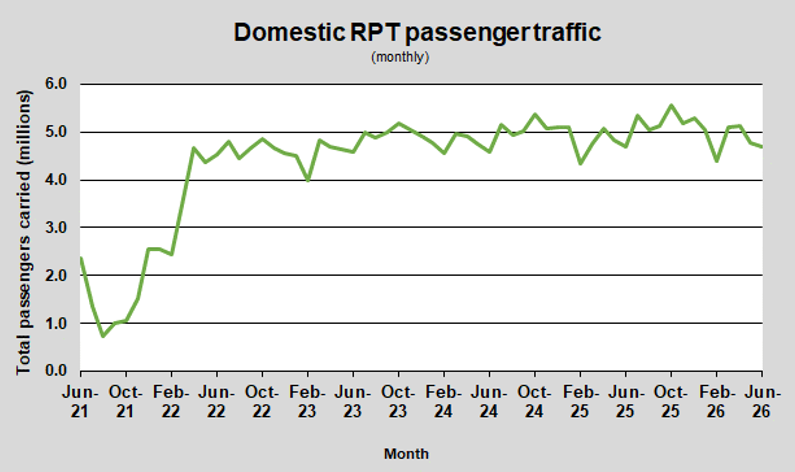
There were 5.10 million passengers carried on Australian domestic commercial aviation (including charter operations) in June 2026 compared with 5.05 million in June 2025 (up 1.0%). This is an increase of 3.7% on pre-COVID June 2019 passenger numbers (4.92 million).
4.69 million passengers were carried on Regular Public Transport (RPT) flights in June 2026 (excluding charter operations), a decrease of 0.1% compared with June 2025.
For the month of June 2026 there were 47.6 thousand RPT aircraft trips, a decrease of 2.3% on June 2025.
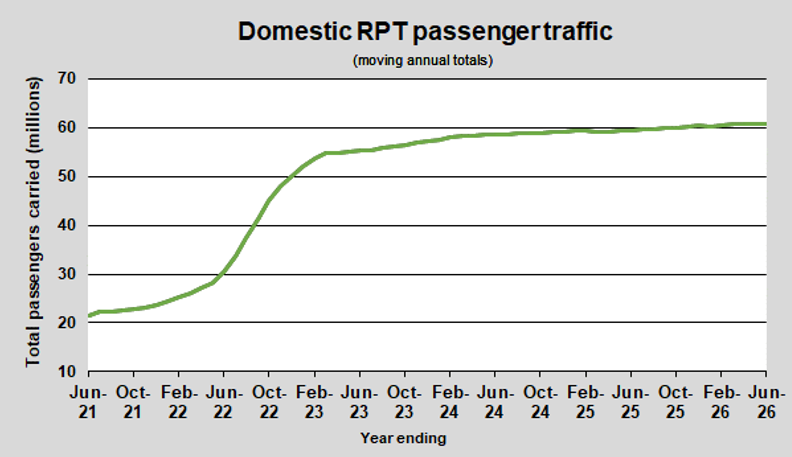
For the year ending June 2026 there were 60.75 million RPT passengers, an increase of 2.2% on the year ending June 2025.
RPT revenue passenger kilometres (RPKs) performed were 5.64 billion for the month, compared with 5.69 billion in June 2025 (down 0.8%).
Capacity, measured by available seat kilometres (ASKs), decreased to 6.92 billion in June 2026 compared with 7.10 billion in June 2025 (down 2.5%).
The industry-wide load factor (RPKs/ASKs) increased from 80.1% in June 2025 to 81.5% in June 2026.
Total cargo movements at Australian airports on domestic RPT flights were 27.3 thousand tonnes in June 2026, an increase of 4.3% compared with June 2025.
In June 2026 there were 2.08 million domestic passenger movements through regional airports, an increase of 0.1% from June 2025.
Fixed-wing charter operators carried 409.9 thousand passengers in June 2026, an increase of 15.8% compared with June 2025.
Summary of annual RPT activity
| YE June 2025 | YE June 2026 | % Change | |
|---|---|---|---|
| Total passengers carried (millions) | 59.46 | 60.75 | 2.2 |
| Revenue passenger kilometres (billions) | 71.62 | 73.26 | 2.3 |
| Available seats (millions) | 73.32 | 75.26 | 2.6 |
| Available seat kilometres (billions) | 86.35 | 89.08 | 3.2 |
| Load factor % | 82.9 | 82.2 | -0.7* |
| Aircraft trips (000s) | 601.0 | 602.9 | 0.3 |
* percentage point difference
Domestic airfares

BITRE's domestic airfare index monitors changes over time in the price of Australian air travel. Fares are collected monthly for the top 70 routes in the Australian domestic network.
Domestic discount airfares
Click the expand button at the bottom right of the dashboard to enter full screen mode.
Note: The above Power BI report may not display the most recent data available.
Cheapest available return fares from January 2010 to latest data month.
For Graphs, Summary table and Notes see further down the page.
See here for Airfares collection methodology
Airfares time series from October 1992 to latest data month.
Graphs
Domestic airfares (Business)

Domestic airfares (Restricted Economy)

Domestic airfares (Best Discount)

Summary table
Real Domestic Airfare Index (July 2003 = 100)
| Survey Month | Best Discount | Business | Restricted Economy |
|---|---|---|---|
| Sep 2025 | 75.2 | 59.2 | 66.2 |
| Oct 2025 | 68.9 | 57.0 | 60.9 |
| Nov 2025 | 65.5 | 50.9 | 56.7 |
| Dec 2025 | 76.3 | 51.0 | 61.8 |
| Jan 2026 | 62.3 | 48.5 | 52.3 |
| Feb 2026 | 70.0 | 49.4 | 57.6 |
| Mar 2026 | 70.6 | 52.3 | 55.7 |
| Apr 2026 | 62.3 | 51.6 | 55.8 |
| May 2026 | 61.0 | 52.1 | 55.4 |
| Jun 2026 | 69.3 | 50.4 | 55.4 |
| Jul 2026 | 63.7 | 49.8 | 56.2 |
| Aug 2026 | 69.8 | 50.0 | 55.6 |
| Sep 2026 | 73.9 | 52.2 | 64.9 |
Notes
Indexes are constructed from BITRE's monthly survey of airline internet booking sites. Fares are recorded only when they are available on the nominated day of travel (the last Thursday of the month). The series is a price index of the lowest available fare in each fare class, weighted over selected routes. It does not measure real airline yields or average fares paid by passengers. For more information on methodology use the link at the top of this page.
Occasionally, the index may record an unusual result when the nominated day of travel falls on, or adjacent to, a public holiday:
- The travel date fell on a public holiday for April 2024, December 2024 and December 2025.
- The travel date fell the day before a public holiday for December 2020, January 2024, March 2024 and December 2025.
- The return travel date fell the day before a public holiday in March 2020 and March 2022.
- The travel date for April 2025 fell between 2 public holidays.
- The travel date for January 2025 fell after a public holiday
April 2021 to current—Best Discount index: During the period of "Half Off" airfares made available through Tourism Aviation Network Support (TANS), the BITRE Airfares Survey has collected the cheapest available fare—using "Half Off" fares where available.
April 2021—Restricted Economy index: Virgin Australia Restricted Economy fares on some routes were noticeably lower this month. The Virgin Australia web site notes that complimentary food would no longer be provided on Economy class fares as of 25 March 2021. It is not clear what part this change has played in the reductions to Virgin Australia's Restricted Economy fares.
Business class fares from April 2020: Fares collected may not include normal entitlements like meals and lounge access during the period impacted by COVID-19.
Index calculation for April 2020 to November 2020: There were significant reductions to airline services in April and May 2020 in particular due to the COVID-19 pandemic and valid fares were not available for many routes covered by the survey. The indexes for April to November 2020 are based on the available routes during those months compared to the same routes in the base period.
November 2017 change to Restricted Economy index: From November 2017, refunds of Jetstar's Restricted Economy products (Starter with Max) for cancellations are only available in the form of vouchers. Vouchers may only be redeemed for other Jetstar products and are therefore considered by BITRE to be closer to a transfer than a full refund. This change in Jetstar's product places it outside BITRE's definition of a restricted economy fare, which has resulted in a sharp increase in the restricted economy index for November 2017.
March 2015—the Full Economy index is discontinued: From the middle of February 2015, Qantas Airways ceased offering Full Economy fares for domestic travel. It is no longer possible to produce an index for this fare category. In the future, if Full Economy fares are offered on sufficient routes, the index for this fare category could be reinstated.
December 2011 and January 2012 changes to Business and Full Economy indexes: Both the Business and Full Economy indexes were substantially affected by changes to fare offered. In December 2011 the Business index fell substantially mainly due to reductions in many of these fares by Qantas. This index again dropped significantly in January 2012 as Virgin Australia introduced Business class fares on many more of their routes. With the expansion of Virgin Australia's Business class fares they removed their Premium Economy class fare completely. The removal of these fares resulted in the Full Economy index rising substantially in January 2012.
June 2011 change to Restricted Economy index: In June 2011 both Virgin Australia and Jetstar introduced simplified fare structures. The new fare types used in constructing the indexes are shown on the Methodology page. The major impact of this change was to the Restricted Economy index. The new Virgin Australia fares used for this category (Flexi) were substantially lower than the previously used Virgin fares (Flexible). In a competitive response Qantas also reduced its Flexi Saver fares on competing routes. These changes produced a sharp drop in the Restricted Economy index.
February 2008 change to Full Economy index: Prior to February 2008 the Full Economy Fare category was based solely on the Qantas Fully Flexible Fare. From February 2008 on the category was expanded to include Virgin Blue's Corporate Plus Fare, leading to a drop in the index at the point of changeover.
Consumer price index Source: Australian Bureau of Statistics, Catalogue No 6401.0. We acknowledge that the ABS has rebased CPI to September 2025 and this will be incorporated from the start of the 2026-27 financial year.
Summary of current report
This annual survey covers all civilian registered aircraft used in the Commercial Air Transport (CAT), general aviation and sport and recreation sectors of the Australian aviation industry.
The CAT sector is scheduled commercial air transport and non-scheduled commercial air transport operations. The general aviation sector is all other VH registered aircraft (other than commercial air transport). The sport and recreation sector includes aircraft registered with one of the following Civil Aviation Safety Authority regulated self-administration bodies:
- Recreational Aviation Australia (RA-Aus),
- Gliding Australia,
- Sports Aviation Federation of Australia (SAFA) or,
- the Australian Sport Rotorcraft Association (ASRA).
The major categories of flying are aerial work, own use business flying, instructional flying, personal and pleasure flying and other flying. In addition, the sport aviation segment includes operations by ultralight aircraft, gliders, hang gliders and gyrocopters. The survey results are merged with details from the civil aircraft register which gives access to additional relevant information including aircraft type, engine and fuel type, country and year of manufacture.
The base measure of this report is flying hours. All operators of Australian registered aircraft are asked to report the hours flown and landings across the various flying categories. The VH registered response to this year's reporting request was 70.2%.
Since 2020 aircraft registered with RA-Aus have been included in the annual Australian Aircraft Activity Report. The RA-Aus response to this year’s reporting request was 72.6%. Statistics for the remainder of the sport aviation segment are collected directly from the self-administrating associations.
Key Indicators
In 2024 the total hours flown in Australia by Australian owned and operated aircraft increased by 1.4% to 3.63 million hours.
CAT hours flown by VH registered aircraft increased by 1.5% to 1.93 million hours. Hours flown by scheduled commercial air transport increased by 4.7% to 1.44 million hours, while hours flown by non-scheduled commercial air transport decreased by 6.9% to 489,442 hours.
General aviation hours flown by VH registered aircraft increased by 2% to 1.4 million hours. Sport and pleasure flying hours decreased (down 10% to 221,665 hours), instructional flying (up 14.5% to 437,458 hours), own-use business flying (up 1.3% to 131,330 hours) and aerial work (down 1.4% to 542,419 hours).
Sport aviation (ultralights, gliders, hang gliders and gyrocopters) activity generally experiences large swings in activity from year to year. In 2024, sport aviation activity decreased 1.5 % to 328,574 hours.
Hours Flown in Australian Aircraft Activity (000's)—year end December
| Year | |||
|---|---|---|---|
| 2023 | 2024 | ||
| (thousands) | |||
| Commercial air transport | Scheduled | 1 371.6 | 1 436.2 |
| Non-scheduled | 526.0 | 489.4 | |
| Total commercial air transport | 1 897.6 | 1 925.6 | |
| General aviation (VH)* | Aerial work | 550.4 | 542.4 |
| Own-use business | 129.6 | 131.3 | |
| Instructional flying | 381.9 | 437.5 | |
| Sport and pleasure flying | 246.0 | 221.7 | |
| Other flying | 41.9 | 43.5 | |
| Total general aviation (VH) | 1 349.9 | 1 376.4 | |
| Sport aviation (non-VH) | 333.6 | 328.6 | |
| Total hours flown | 3 581.1 | 3 630.6 | |
*VH aircraft are registered with CASA
*non-VH aircraft are registered with self-administrating associations
Overview of project appraisal for land transport
On 5 September2014, Assistant Minister for Infrastructure and Regional Development, the HonJamie Briggs MP, released for public comment, a proposed project appraisal framework,developed by the Bureau of Infrastructure, Transport and Regional Economics, inconsultation with state and territory governments. BITRE has revised the paperin view of the submissions received. The Assistant Minister released the finalversion on 7 November 2014.
The paper is the outcome of Australian, state and territory governments agreeing to consult todevelop a more sophisticated and consistent framework to assess and evaluatemajor infrastructure projects.
- Overview of project appraisal for land transport
Australian Transport Statistics 2006
Australian Transport Statistics provides an easy introduction to a diverse range of transport statistics. Topics include employment, GDP, passenger and freight movements, trade, funding, motor vehicles, fatalities and estimated greenhouse gas emissions attributed to the transport industry. Various international comparisons are included and details provided for the road, rail, marine and aviation sectors. Data are gathered from various sources within the Bureau of Transport and Regional Economics and from external organisations.
National guidelines for transport system management in Australia
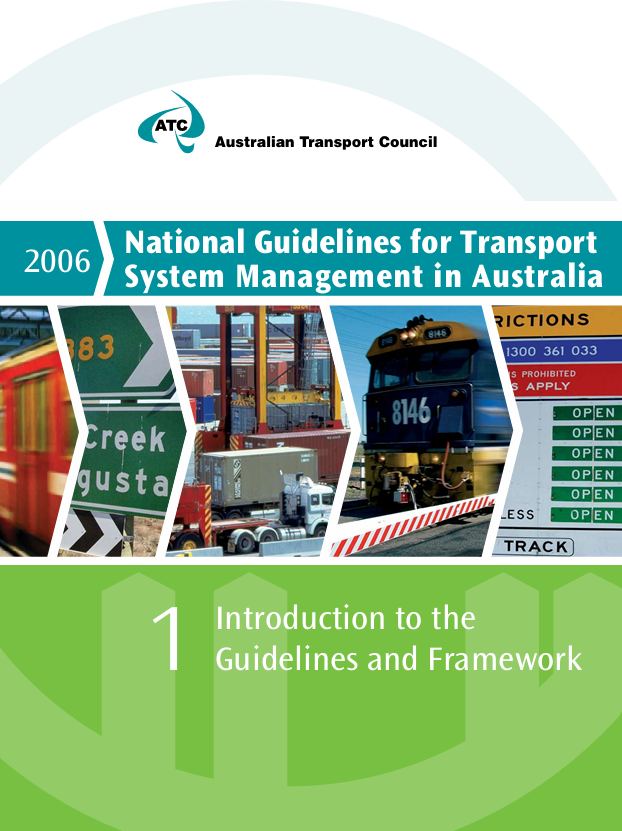
The first edition of the Guidelines (ATC 2004a) was produced by the Guidelines Assessment Methodology Working Group (endorsed by the Standing Committee on Transport). It incorporated a generic framework with an initial focus on non-urban land transport (road, rail, inter-modal).
In 2005, The Australian Transport Council (ATC) established a Guidelines Implementation Committee (GIC) to review, update and improve the Guidelines in line with learnings and feedback received during their implementation. The ATC also asked the GIC to extend the Guidelines to urban transport.
This second edition of the Guidelines has been produced by the GIC in response to the directive of the ATC. The Guidelines have been restructured to make them more concise, accessible and user-friendly, while maintaining rigour. The Guidelines have also been extended to urban transport.
BTRE 2007 Transport Colloquium—Australian Transport and the Challenge of Growth

Keynote Speaker: Prof. Dr. Rothengatter is an internationally recognised authority on the application of transport theory to policymaking. He is head of the Institute of Economic Policy Research and the Unit of Transport and Communication at the University of Karlsruhe, Germany.
To be included on the 2008 Colloquium mailing list, please email btre.colloquium@dotars.gov.au
- BTRE 2007 Transport Colloquium–Program
Regional economic growth: BITRE's taxable income database
This economic growth update builds on information paper 54, Focus on regions 3–Taxable Income.
The taxable income database contains small-area data from 1980–81 to 2004–05 on a number of indicators. The main indicator is the amount of taxable income each region earns, the change in which can be used as an indicator of economic growth.
The interactive pdfs accompanying the update contain maps of regional growth, graphs of growth by state and remoteness class, and the methodology for the update.
- Notes on method: the BITRE's taxable income database 2007 update
- Taxable income database

Regional economic growth: BITRE's taxable income database (2007 update)
This is the 2007 update of BITRE's economic growth database. For the latest update of the database, please click here Regional economic growth database update 2005–06.
The taxable income database contains small-area data from 1980–81 to 2004–05 on a number of indicators. The main indicator is the amount of taxable income each region earns, the change in which can be used as an indicator of economic growth.
In the interactive pdfs accompanying the update, BITRE has created over a hundred maps and many supporting graphs which allow you to explore inter-regional comparisons and time series of regional growth in Australia. These are often at the local government level.
To access these, you will need to download (SAVE) the files below (~8MB).
NOTE:This program will not run unless SAVED first.
Download (SAVE) the EconomicGrowth_V1.1.zip file, extract it, and double click other_002_EconomicGrowth_V1.1.Msi to install. Mac and Linux users download the Zip file and double click to extract.
The pdfs and database will then be permanently accessible on your computer.
This economic growth update builds on information paper 54, Focus on regions 3–Taxable Income.
- Regional Economic Growth for MS Windows (msi)
- Regional Economic Growth for Mac and Linux
- Notes on method: the BITRE's taxable income database 2007 update
- Taxable income database
Australian Transport Statistics Yearbook 2007
Australian Transport Statistics provides a short summary of a diverse range of transport statistics. Topics include employment, GDP, passenger and freight movements, trade, funding, motor vehicles, fatalities and estimated greenhouse gas emissions attributed to the transport industry. Information is provided for the road, rail, maritime and aviation sectors. Data are gathered from various sources both within BTRE and external organisations.
- Australian Transport Statistics Yearbook 2007
- Australian Transport Statistics Yearbook 2007–Spreadsheets
