
Taxes and Charges in Australian Transport: A Transmodal Overview
Public debate on whether the road or the rail sector is relatively more disadvantaged in terms of competition tends naturally to be driven by the specific interests of the protagonists. The focus of the debate reflects changing issues as new, alleged discrepancies are discovered. It has therefore ranged from taxes paid, the extent of charges levied, and the degree of direct or indirect financial assistance provided by governments, and the fairness of increasing mass limits for heavy road vehicles. It is thus not surprising that the debate continues, and that it is not particularly fruitful or illuminating. The BTCE has adopted a different approach. Given the intensity of the debate and the fact that it has continued for so long, it was surprising that little or no systematic information exists on taxes and charges in the transport sector. The BTCE's first step was therefore to compile the lists presented in the appendixes (to which many public and private organisations and individuals generously contributed). Recognising that all four modes (it was not possible to include pipelines) are substitutes to some extent, the list is not limited to road and rail. Most importantly, the summary matrix in table 1 (liftout) and the underlying analytical approach reflect marginal cost principles in the hope that this methodology will assist objective comparisons between modes, as well as the formulation of policy options in any consideration of general taxation reform.
- Taxes and Charges in Australian Transport: A Transmodal Overview
Competitive Neutrality Between Road and Rail
Transport models have been used for several decades now, both for research, and as an analytical tool to assist planners and decision-makers. As the complexity of traffic and environmental problems in our cities has increased, policy makers have come to depend on models to an even greater extent. The immense increase in available computing power over the last decade has abetted this dependence. Customised software has simplified even the most complex mathematics to such an extent that modelling is no longer the preserve of a select few 'rocket scientist'. If asked, however, many policy analysts and decision-makers would probably admit to a lack of understanding of the models on the results of which they rely. Billions of dollars in resources are expended annually in Australia despite a lack of full understanding of the basis on which decisions are made. To assist both researchers and decision-makers, Dr William (Weiguo) Lu has dissected the major models that have been used to analyse urban transport tasks. This Working Paper therefore represents something of a 'scene-setter' for further work. While a purely non-technical approach is not feasible, he has sought to provide an intuitive exposition of the basic concepts involved, relying on a minimum of mathematical expression.
- Competitive Neutrality Between Road and Rail
Trends in Trucks and Traffic
Increasingly in Australia, trucking is an essential feature of economic activity, with road being the only mode possible for much freight traffic (eg in cities), and with rail tending to be less competitive than road on many intercity links.
- Trends in Trucks and Traffic
Brisbane to Melbourne Rail Link: Economic Analysis
Historically, railways have provided the means to open up new areas for economic development. When built to link existing centres of economic activity, they have given rise to greatly increased opportunities for trade and travel.
- Brisbane to Melbourne Rail Link: Economic Analysis
Land Transport Infrastructure Pricing: An Introduction
The BTRE projects that the total freight task will continue to grow strongly. Such growth will increase the infrastructure maintenance needs and possibly hasten the need for capacity expansion. Setting prices for infrastructure use that reflect costs provides important signals as to the appropriate level of transport activity, choice of transport mode, and the level of infrastructure spending. At the Australian Logistics Council (ALC) meeting on 7 November 2002, the Council asked BTRE to provide a comparative analysis of current land transport pricing regimes and their objectives and to present the findings at the next Council meeting, held on 27 February 2003. This working paper comprises the paper prepared for the ALC and already released by the ALC as a discussion paper.
- Land Transport Infrastructure Pricing: An Introduction

This report is the third in a series covering the socio-economic costs of transport accidents in Australia. Transport accidents impose a significant burden on the Australian community. Not all of their consequences can be expressed in financial terms. However, to weigh up options for minimising and dealing with this burden, it is important to know the costs of transport accidents.
- Rail Accident Costs in Australia
Rail Infrastructure Pricing: Principles and Practice
Since the early 1990s, railway operations in Australia and in many overseas countries have been radically reformed. One reform has been widespread outsourcing of railway activities such as infrastructure maintenance, to encourage efficient provision through competitive tendering for services. In some cases, entire rail operations have been contracted out or privatised. The major reform, however, has been to introduce regulations to require access to rail infrastructure by outside ("third-party") train operators. This mandated access also supports rail interoperability objectives facilitating train service coordination by streamlining the logistics chain across infrastructure networks.
Prior to these regulations, there were no access charges because the track use was an internal transaction within the railway company the company maintaining the infrastructure had exclusive use of the tracks for its own trains. In essence, the railway's revenue was generated only from tariffs for transporting goods and passengers. However, with mandatory access, rail infrastructure owners offer an additional service non-track owners' access to the infrastructure.
What are fair, equitable and efficient charges for that access? We know that the level and structure of these charges matter, for they account for, perhaps, one-third of the train operator's total operating costs. This report focuses on the rail infrastructure pricing structures that have developed with mandated access around the world, and the lessons that can be drawn from the subsequent experiences.
Our analysis involves consideration of the benefits and costs of mandatory access; the principles of efficient access charges; Australia's systems of access and pricing; international pricing and access systems and the lessons from the experiences with them. While principles of access charges apply equally to freight and passenger trains, mandated access is generally directed only at freight operations. For that reason, in this report we consider only freight operations.
- Rail Infrastructure Pricing: Principles and Practice
Optimising Harmonisation in the Australian Railway Industry
In the last decade, Australia's railways have undergone an ownership, operational and technological revolution. The establishment of national public and private train operators has finally brought seamless rail freight services across the country. There has been a complementary development in track management, with one manager (Australian Rail Track Corporation) rather than five, now controlling most of the interstate track.
The standardisation of the Melbourne-Adelaide railway in 1995 removed the break-of-gauge on the East-West Corridor. This has facilitated the subsequent more than doubling of rail freight task between those cities.
Infrastructure investments and complementary funding of new generation locomotives have enabled train operators to harness train economics of heavier, longer trains, for instance, with Melbourne-Adelaide trains now 50 per cent longer than a decade ago.
These changes are transforming the industry. However, the perception is that the legacy of the separate State-based networks may still draw a long shadow over the performance of the network. This report investigates the extent to which physical, operational and regulatory breaks-of-gauge impede the industry. The report provides guidance to policy makers and industry on those issues.
- Optimising Harmonisation in the Australian Railway Industry
Passenger Movements between Australian Cities, 1970–71 to 2030–31
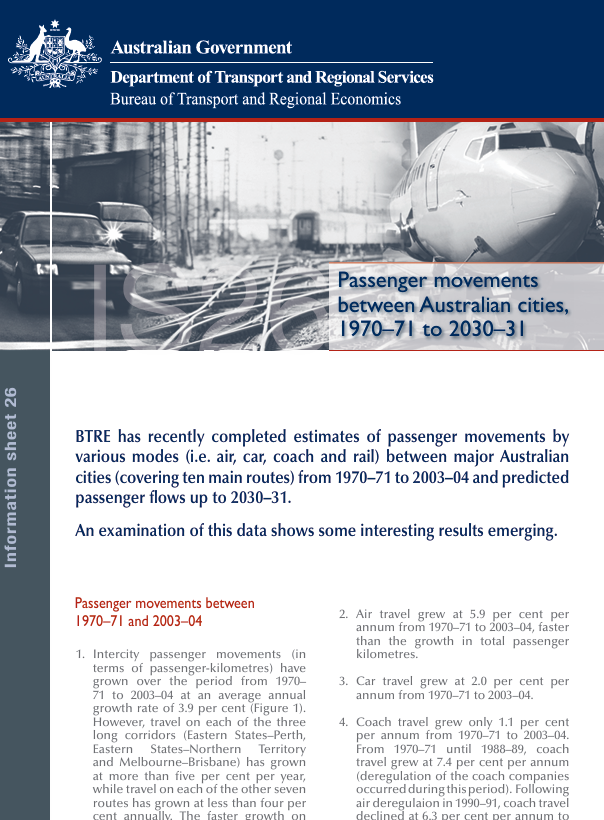
BTRE has recently completed estimates of passenger movements by various modes (i.e. air, car, coach and rail) between major Australian cities (covering ten main routes) from 1970–71 to 2003–04 and predicted passenger flows up to 2030–31.
Filling a gap in rail data: an investigation of the Gheringhap Loop train sightings
This paper analyses train sightings data collected at Gheringhap, Victoria, located on the Melbourne to Adelaide main line. These sightings provide an independent source of information on train movements, train lengths, and reliability, and, given knowledge of freight volumes, can be used to estimate average wagon loads. In cases where trains are not scheduled, sightings such as these are presently the only publicly available source of data for freight volumes on specific routes.
Following the growth in private train operations since the mid-1990s and the privatisation of National Rail in 2002, rail freight activity data became increasingly scarce. The lack of data can be a challenge for the BTRE in providing the government with timely and accurate information about trends in Australian freight transport. The rail industry has recognised this deficiency: the Australasian Railway Association and its members are working with the BTRE to produce the first public report on the performance of the Defined Interstate Rail Network and to supply data for AusLink planning.
In the meantime, the BTRE has investigated other potential data sources, including information from railway enthusiasts. This paper presents an analysis of one such source of rail data that is reported online, from video-taped observations made and collated by Graham Elliott at Gheringhap Loop, Victoria, on the mainline between Adelaide and Melbourne. The paper provides a short review of the reliability of the data, makes observations about trends in freight activity from the data set, and draws some conclusions about the value of the data collection method.
- Filling a gap in rail data: an investigation of the Gheringhap Loop train sightings