
The pitfalls in competitive tendering: addressing the risks revealed by experience in Australia and Britain
Paper presented to European Conference of Ministers of Transport "Workshop on Competitive Tendering for Rail Services" held in Paris on 12 January 2006. Paper to be published in forthcoming ECMT Workshop Proceedings. Author: Peter Kain.
- The pitfalls in competitive tendering: addressing the risks revealed by experience in Australia and Britain
Freight Rates in Australia 1964–65 to 2007–08

This Information Sheet provides indexed trends in average interstate non-bulk freight rates, from 1964–65 to 2007–08, updating the freight rate indexes previously published in Freight Rates in Australia, Information Sheet 19 (BTRE 2002). The estimates show that, following generally declining real freight rates over the previous two decades, real freight rates for road, rail and long-distance coastal shipping have risen since 2000–01 (Table 1 provides nominal and real indexed freight rate series and Figures 1 to 4 illustrate indexed trends in real freight rates). Recent increases in crude oil prices, and flow through to diesel fuel prices, have been an important contributing factor in recent freight rate increases for road, rail and coastal shipping.
- Freight Rates in Australia 1964–65 to 2007–08
Road and Rail Freight: Competitors or Complements?
Up until the early 1960s, railways dominated all but the shortest land-based freight task. Since then, vast improvements in road vehicle productivity and road infrastructure quality, the gradual removal of regulations restricting road freight carriage and the exponential growth in interstate trade has broadened the range of freight tasks for which road is better suited than rail.
Rail Freight Performance Indicators 2007–08—Statistical Report
This statistical report is the third in this series and is a result of collaboration between the Australasian Railway Association (ARA) and the Bureau of Infrastructure, Transport and Regional Economics (BITRE).
- Rail Freight Performance Indicators 2007–08–Statistical Report
Brief—A profile of high-speed railways
This paper discusses high-speed train services. The paper sets out what is meant by 'high-speed', explains the objective of introducing services and sets out where they have been introduced. The paper also considers funding experiences and Australian high-speed train proposals.
- Brief–A profile of high-speed railways
Interstate freight in Australia
This report provides estimates and forecasts of interstate freight moving between 56 state-to-state origin-destination pairs, for example, South Australia-Queensland.
- Interstate freight in Australia
Australian rail freight performance indicators 2005–06
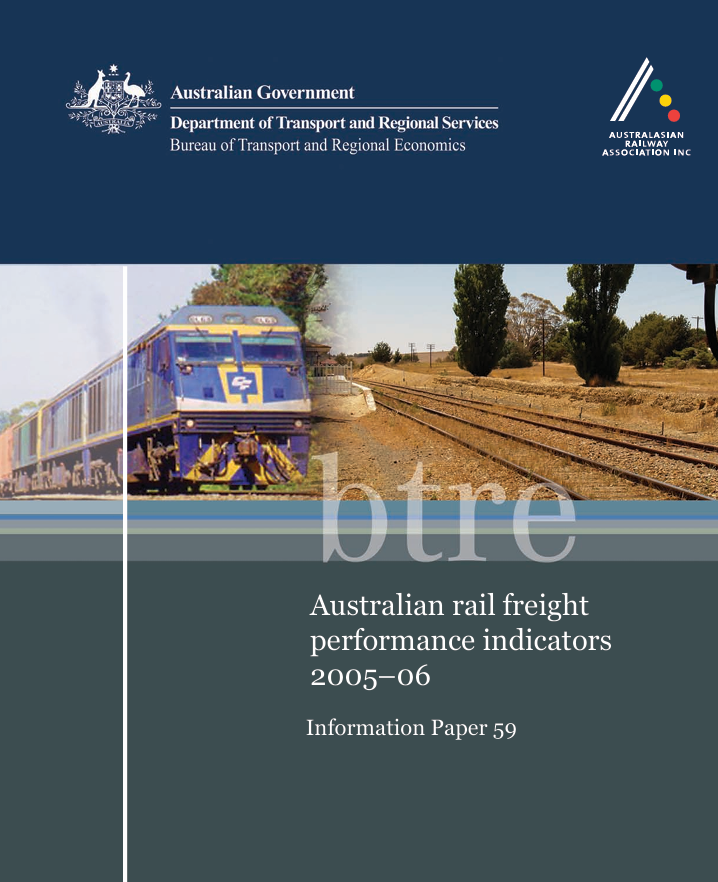
In 2002, the ATC approved a set of 6 targets and indicators to measure performance improvements of the interstate rail track over time. Early reports against the indicators were derived entirely from track managers' (below rail) datasets. An ARA survey of train operators (above rail) reporting on key performance indicators showed that results from track managers' datasets were, for some indicators, inconsistent with results based on rail operators' data. There are distinct reporting methodologies between above and below rail.
Australian intercapital rail freight performance indicators 2006–07
Results for 2006–07 are reported against a set of 11 railway indicators. These are in three groups: three train indicators, four track indicators and four market indicators.
- Australian intercapital rail freight performance indicators 2006–07
Rail Freight Performance Indicators 2007–08
This statistical report is the third in this series and is a result of collaboration between the Australasian Railway Association (ARA) and the Bureau of Infrastructure, Transport and Regional Economics (BITRE).
- Rail Freight Performance Indicators 2007–08