
Waterline 51—November 2012
This Waterline provides the latest data available on stevedoring productivity and landside performance. Beginning with this issue, a new wharf side indicator is provided for each port. It measures the average number of crane lifts performed per hour spent in berth by a container ship. Waterline is the main container port performance report referred to in the National Port Strategy.
Australian sea freight 2010–11
This report presents comprehensive statistics on maritime freight in Australia. Compared to past issues that focused on data for the most recent year, this issue contains time series to establish the trend of Australian sea freight statistics over the most recent 10 years from 2001–02 to 2010–11. The information presented comprises international and coastal freight statistics, the use of coastal voyage permits, vessel activity at Australian ports and the size and composition of the Australian trading fleet.
Bass Strait Passenger Vehicle Equalisation Scheme Monitoring Report No. 13
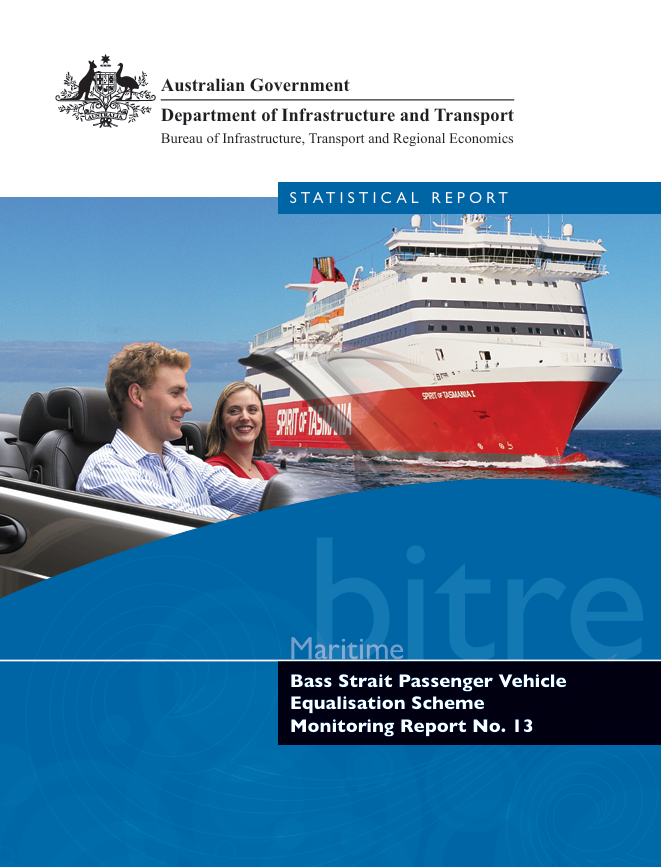
This report presents the results of our thirteenth review of the Bass Strait Passenger Vehicle Equalisation Scheme, covering the operation and impact of the Scheme for the period 1 July 2009 to 30 June 2011.
Container and Ship Movements Through Australian Ports: 2007–08 to 2029–30, Preliminary Estimates
Paper given to the 31st Australasian Transport Research Forum, 2 October–3 October 2008, Gold Coast. Authors: Godfrey Lubulwa, Rob Bolin, Ben Slatter, Tony Carmody
- Container and Ship Movements Through Australian Ports: 2007–08 to 2029–30, Preliminary Estimates
Australian sea port activity to 2029–30
Paper given to the 32nd Australasian Transport Research Forum, 29 September–1 October 2009, Auckland.Authors: Godfrey Lubulwa, Rob Bolin and Anatoli Lightfoot.
- Australian Sea Port Activity to 2029–30
An Investigation of Best Practice Landside Efficiency at Australian Container Ports
Paper given to the 34th Australasian Transport Research Forum, 28–30 September 2011, Adelaide. Authors: Godfrey Lubulwa, Adam Malarz, Shun Peng Wang.
- An Investigation of Best Practice Landside Efficiency at Australian Container Ports
An Assessment of Tasmania's Interstate Transport Problems
This study attempts a quantitative assessment of Tasmania's transport disabilities relative to the other States and covers interstate shipping to Tasmania, together with closely related topics such as Tasmanian port operations and freight forwarding. Particular note has been taken of the Senate Standing Committee on Primary and Secondary Industry and Trade Committee's views that Tasmania has a 'transport disability' and that any comparisons should take into account its position as a sovereign state.
- An Assessment of Tasmania's Interstate Transport Problems
The Economics of an Australian Landbridge
The study examines the economics of a landbridge based on Fremantle, and also considers Adelaide and Melbourne as terminal ports for the European trades. In addition, the benefits and costs implied by a strategy of alternate calls at Sydney and Melbourne are considered.
- The Economics of an Australian Landbridge
Port Pirie: Economic Evaluation of Harbour Improvements
This report examines in detail the proposal to deepen and widen the entrance channel and harbour of Port Pirie. Not only is this the major port for Broken Hill lead and zinc concentrates and refined metals, but it also handles a considerable volume of wheat and barley exports.
Of the various benefits identified from the work, only two have been found to be substantial in economic terms.
These are the possibility of utilising to full capacity the somewhat larger bulk carriers for bulk concentrate exports and similarly, the possibility of fully loading wheat export ships so that they would not require topping up at deep water ports.
- Port Pirie: Economic Evaluation of Harbour Improvements
Provision of General Cargo Facilities at the Port of Darwin
This study investigates evaluates the various options that could be taken in improving port facilities in Darwin, with particular reference to the impact of Cyclone Tracy.
- Provision of General Cargo Facilities at the Port of Darwin